
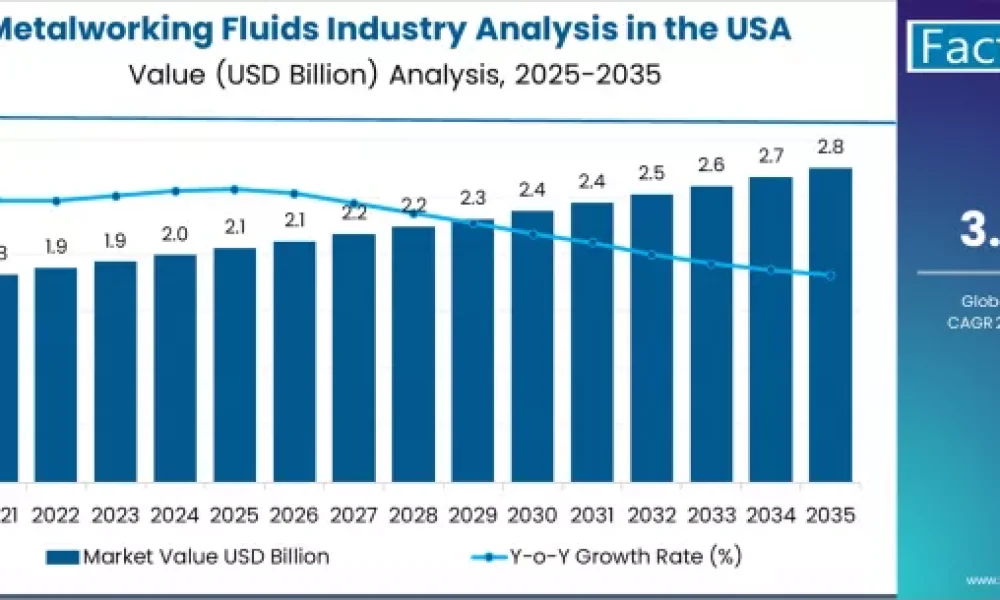
The U.S. metalworking fluids market is set for steady expansion as industries increasingly prioritize precision machining, equipment longevity, and advanced lubrication technologies. According to an in-depth analysis, the demand for metalworking fluids in the USA is projected to grow from USD 2.05 billion in 2025 to approximately USD 2.76 billion by 2035, rising at a CAGR of 3.0% and recording an absolute increase of USD 0.71 billion over the forecast period.
Metalworking fluids—integral to metal fabrication, machining, and industrial maintenance—are gaining heightened importance as manufacturers focus on productivity enhancements, equipment protection, and sustainable production standards.
To access the complete data tables and in-depth insights, request a Discount On The Report here: https://www.factmr.com/connectus/sample?flag=S&rep_id=12007
Key Market Drivers
Growing Need for Enhanced Machining Efficiency
A surge in precision engineering, CNC machining, and high-speed metal cutting processes is driving strong demand for metalworking fluids capable of improving surface finish, reducing friction, and extending tool life. Industries such as aerospace, defense, automotive, and heavy machinery continue to adopt advanced formulations to optimize operational performance.
Expansion of the U.S. Manufacturing and Automotive Sectors
Reindustrialization trends—including reshoring and domestic production boosts—are accelerating metal fabrication activities. Automotive OEMs and suppliers are increasingly using specialized fluids for forming, cutting, and grinding applications, supporting market growth across the value chain.
Focus on Worker Safety and Equipment Longevity
Improved workplace safety standards and growing emphasis on equipment maintenance are encouraging manufacturers to deploy fluids with enhanced cooling, corrosion prevention, and lubrication properties. The shift toward low-toxicity and low-odor formulations is further boosting adoption.
Rise of Sustainable and Bio-Based Metalworking Fluids
Environmental regulations and corporate sustainability commitments are driving interest in eco-friendly, biodegradable, and low-VOC formulations. Bio-based fluids derived from plant oils are emerging as high-performance alternatives to mineral-oil-based products, supporting cleaner industrial operations.
Regional Insights
Midwest: Manufacturing Powerhouse
The Midwest continues to dominate metalworking fluid consumption due to its dense network of automotive plants, machinery manufacturers, and metal fabrication units.
South: Rapid Industrialization and Oil & Gas Influence
Industrial growth in Texas and surrounding states fuels demand for fluids used in machining, drilling, and heavy equipment operations.
Northeast: Strong Aerospace and Defense Demand
High-value manufacturing clusters rely extensively on precision machining fluids for advanced components.
West Coast: Innovation and Sustainable Fluid Adoption
Technology-driven industries and sustainability-focused manufacturers are accelerating adoption of bio-based and synthetic formulations.
Market Segmentation Insights
By Product Type
- Mineral-Based Metalworking Fluids – Widely used across heavy industries for their cost-efficiency.
- Synthetic & Semi-Synthetic Fluids – Gaining traction for superior cooling, reduced misting, and extended fluid life.
- Bio-Based Fluids – Growing fast due to environmental compliance and improved lubricity.
By Application
- Machining & Metal Cutting
- Grinding & Finishing
- Forming & Stamping
- Rust Prevention & Protection
- Others (Heat Treatment, Industrial Maintenance)
Market Challenges
Despite strong growth potential, the U.S. metalworking fluids industry faces several hurdles:
- Strict EPA and OSHA Regulations: Compliance requires continual innovation in low-toxicity and environmentally safe formulations.
- High Cost of Synthetic and Bio-Based Fluids: Premium pricing challenges adoption among cost-sensitive manufacturers.
- Fluid Disposal and Recycling Issues: Effective waste management and recycling technologies remain critical industry concerns.
- Workforce Skill Gaps: Proper handling and monitoring of metalworking fluids require technical expertise that is increasingly scarce.
Competitive Landscape
The market is moderately consolidated, with leading players focusing on R&D, sustainable formulations, and strategic partnerships with manufacturing industries. Companies are expanding product portfolios, enhancing distribution networks, and investing in fluid monitoring technologies.
Prominent Companies Include:
- ExxonMobil
- Quaker Houghton
- TotalEnergies
- FUCHS Lubricants
- Chevron
- Castrol
- Lubrizol
- Idemitsu Kosan
These companies are advancing high-performance, eco-friendly solutions while strengthening their presence across U.S. industrial hubs.
Future Outlook: Advancing Toward Sustainable, High-Efficiency Manufacturing
The next decade will see metalworking fluids play a central role in the evolution of U.S. manufacturing. As industries adopt automation, precision machining, and sustainable operations, demand for advanced fluid technologies will continue to rise.
Manufacturers that invest in eco-friendly formulations, fluid recycling systems, and digital monitoring technologies are expected to gain competitive advantage. With consistent growth ahead, the U.S. market is poised to remain a global leader in metalworking fluid innovation and demand.
Have a specific Requirements and Need Assistant on Report Pricing or Limited Budget please contact us – [email protected]
About Fact.MR
Fact.MR is a global market research and consulting firm, trusted by Fortune 500 companies and emerging businesses for reliable insights and strategic intelligence. With a presence across the U.S., UK, India, and Dubai, we deliver data-driven research and tailored consulting solutions across 30+ industries and 1,000+ markets. Backed by deep expertise and advanced analytics, Fact.MR helps organizations uncover opportunities, reduce risks, and make informed decisions for sustainable growth.



