
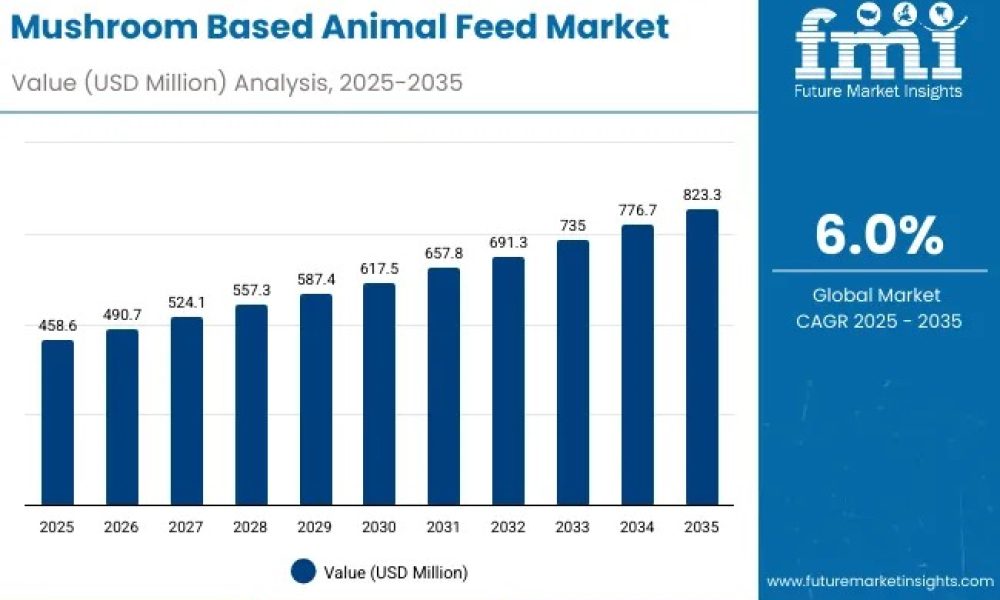
The mushroom-based animal feed market, valued at USD 458.6 million in 2025, is forecast to reach USD 823.3 million by 2035, expanding at a 6% CAGR as livestock, aquaculture, and specialty animal producers shift toward functional, sustainable protein systems. The category leverages advanced protein recovery, waste stream valorization, and bioactive extraction technologies to support species-specific nutrition and feed efficiency performance.
Mushroom-derived feed formulations are gaining traction as cost-effective protein alternatives, particularly through edible mushroom waste processing that delivers 15%–25% protein levels and essential amino acid profiles comparable to conventional ingredients. Improved digestibility and consistent nutritional structure make these systems suitable for poultry, swine, ruminant, and aquaculture applications. Button mushroom substrate processing, for example, yields uniform nutrient composition optimized for monogastric species.
Explore trends before investing – request a sample report today! https://www.futuremarketinsights.com/reports/sample/rep-gb-28924
Market Quick Stats
- Market Size (2025): USD 458.6 million
- Forecast Value (2035): USD 823.3 million
- CAGR: 6%
- Leading Mushroom Type: Edible Mushroom Waste
- High-Growth Regions: Europe, South Asia Pacific, East Asia
- Notable Players: Enifer, NoMy, Seaqure Labs, alongside food-tech leaders MycoTechnology Inc., Mushlabs GmbH, Kinoko-Tech Ltd.
Livestock & Aquaculture Remain the Engine of Market Expansion
Livestock feed manufacturers are integrating mushroom-based proteins at 2%–8% inclusion rates to enhance gut health, feed efficiency, and immune response while reducing reliance on antibiotic inputs. Poultry operations, in particular, report improved digestive performance and lower feed conversion ratios using mushroom-based ingredients.
Aquaculture producers utilize mushroom meal as a reliable fishmeal replacement for tilapia, catfish, and crustaceans. Shrimp feed formulations benefit from tailored nutrient density and optimal particle size distribution essential for crustacean feeding behavior, resulting in improved growth indices and reduced environmental load.
Segmental Analysis
By Mushroom Type: Edible Mushroom Waste Leads with 55% Market Share
Edible mushroom waste dominates due to its:
- High protein reliability (90–95% consistency)
- Low processing complexity
- Seamless compatibility with automated feed mill systems
- Strong cost advantages for large-scale feed manufacturers
This segment’s operational simplicity and predictable nutritional composition support widespread adoption across poultry, cattle, swine, and aquaculture facilities.
By End-Use Species: Livestock Holds 70% Market Share
The livestock segment demonstrates leadership driven by:
- Rising demand for alternative proteins
- Large-scale feed modernization programs
- Increased prioritization of gut health and immunity enhancement
- Integration with automated feeding infrastructure
Producers in cattle, poultry, and swine markets increasingly adopt mushroom-based blends to support performance, minimize ingredient volatility, and enhance nutrition compliance.
By Product Format: Pelletized Feed Commands 40% Market Share
Pelletized formats dominate due to:
- High handling convenience
- Compatibility with existing pelleting lines
- Strong processing efficiency
- Reduced dust and waste during distribution
Feed mills favor pelletized systems for their uniformity, stability, and predictable inclusion rates across commercial formulations.
Drivers, Restraints & Trends
Major Market Drivers
- Rising need for cost-effective alternative proteins
- Strengthening circular economy initiatives via waste valorization
- Growing functional feed approvals for immunity and performance enhancement
Key Restraints
- Capital-intensive processing requirements
- Competitive pricing pressure from conventional protein sources
Notable Trends
- Rapid growth in health-integrated functional feeds
- Strong aquaculture-driven expansion across Asia
Regional Outlook
South Asia Pacific and Europe lead adoption, supported by agricultural modernization and advanced feed infrastructure. Countries such as India (6.7% CAGR) and Germany (6.6% CAGR) drive growth through feed capacity development and technology-forward manufacturing.
- USA (6.4% CAGR): Expansion driven by nutrition-compliant feed programs
- France (5.7% CAGR): Strong preference for precision feed systems
- UK (5.6% CAGR): Established quality and technical support ecosystems
- China (5.5% CAGR): Increasing industrial-scale integration
Brazil shows steady long-term potential at 1.9% CAGR, driven by sustainability initiatives and growing awareness of alternative feed proteins.
Subscribe for Year-Round Insights → Stay ahead with quarterly and annual data updates! https://www.futuremarketinsights.com/reports/brochure/rep-gb-28924
Competitive Landscape
The market hosts 15–20 active players, with the top five contributing 40–45% of revenue. MycoTechnology Inc. leads with 9% market share, followed by innovators such as Mushlabs, Kinoko-Tech, Enifer, NoMy, and Seaqure Labs.
Growth opportunities lie in:
- Functional feed applications
- IoT-enabled ingredient monitoring
- Predictive nutrition services and compliance-driven feed solutions
About Future Market Insights (FMI)
Future Market Insights, Inc. (FMI) is an ESOMAR-certified, ISO 9001:2015 market research and consulting organization, trusted by Fortune 500 clients and global enterprises. With operations in the U.S., UK, India, and Dubai, FMI provides data-backed insights and strategic intelligence across 30+ industries and 1200 markets worldwide.



