
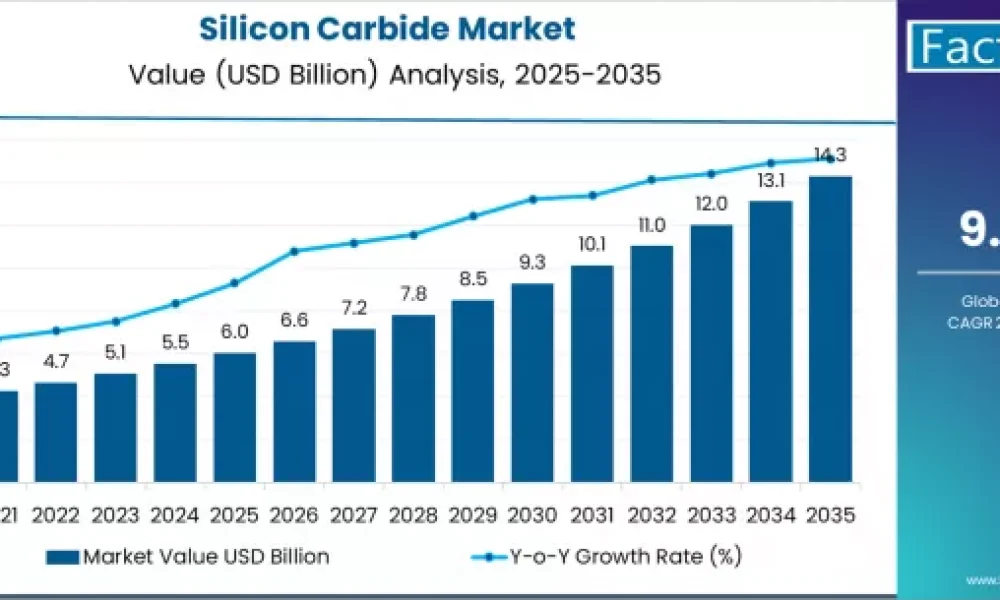
The global silicon carbide (SiC) market is set to witness robust growth between 2025 and 2035, driven by rising demand for high-efficiency power electronics, automotive electrification, renewable energy infrastructure, and industrial-grade abrasive and refractory materials. SiC—available in varieties such as black and green silicon carbide—is a versatile material used in applications ranging from high-performance semiconductors to abrasives, industrial furnaces, and cutting-edge power conversion devices. This report outlines market size, growth drivers, regional dynamics (with a focus on Europe), technological trends, and strategic implications for stakeholders.
Market Size and Growth
The global silicon carbide market is projected to grow from approximately USD 6.04 billion in 2025 to around USD 14.3 billion by 2035, reflecting a strong compound annual growth rate (CAGR) of about 9.0%. This expansion shows an increase of more than 2.3 times, underlining strong demand across multiple end-use industries worldwide.
To access the complete data tables and in-depth insights, request a Discount On The Report here: https://www.factmr.com/connectus/sample?flag=S&rep_id=12079
Key Growth Drivers
- Electrification & Power Electronics: Growing adoption of electric vehicles (EVs), renewable energy systems, energy storage and high-efficiency inverters places SiC at the center of next-generation power conversion technologies. SiC semiconductors offer superior energy efficiency, high-temperature tolerance, and switching performance compared with traditional silicon-based devices.
- Industrial and Manufacturing Demand: SiC remains vital for industrial uses such as abrasives, refractories, metallurgical processing, grinding tools, cutting equipment, and furnace linings due to its high hardness, thermal stability, and wear resistance.
- Expansion of Semiconductor & Electronics Industry: As wide-bandgap semiconductors become mainstream for high-power and high-frequency applications, demand for high-purity green silicon carbide for wafer manufacturing and advanced electronics continues to rise.
- Global Industrialization & Infrastructure Growth: Rapid industrial expansion, steel production, heavy-duty manufacturing, and growth in renewable energy infrastructure all contribute to increased consumption of SiC-based materials.
Regional (European) Market Dynamics
Europe stands as a strategically significant region due to its advanced automotive industry, rapid EV adoption, industrial modernization, and strong investment in renewable energy technologies. The region is expected to grow in line with global projections, supported by demand for SiC in EV powertrains, charging infrastructure, industrial furnaces, and manufacturing processes.
European manufacturers are increasingly adopting SiC for power electronics used in electric vehicles, solar inverters, wind energy systems, and industrial equipment. Both black SiC (for abrasives and refractories) and green SiC (for electronics and semiconductors) contribute to regional demand.
Product / Segment Insights
- By Type: Black silicon carbide is expected to lead the product type share, accounting for about 54.8% in 2025, due to widespread industrial usage.
- By Application: The electronics segment, which includes SiC semiconductors and power devices, is expected to capture roughly 27.0% of the overall market share in 2025.
- Industrial Applications: SiC’s exceptional durability and thermal resistance continue to support its use in grinding wheels, sandblasting equipment, refractory materials, metallurgical additives, and industrial heating systems.
Challenges and Market Constraints
- Higher Production Costs: High-purity SiC used in electronics requires complex manufacturing processes, resulting in higher production costs that may limit adoption in price-sensitive markets.
- Supply-Chain and Capacity Limitations: Production challenges—especially in crystal growth, wafer manufacturing, and substrate quality—may restrict rapid capacity expansion globally.
- Competition from Lower-Cost Materials: In applications where performance requirements are moderate, traditional materials may compete with SiC, slowing adoption in some segments.
Strategic Implications
- Manufacturers & Material Suppliers: Companies can benefit by diversifying portfolios to include both industrial-grade and high-purity SiC products. Investments in production capacity, wafer technology, and scalable manufacturing processes will be critical.
- OEMs & Device Manufacturers: Industries such as EVs, power electronics, renewable energy, and industrial automation stand to gain significantly from integrating SiC-based components due to higher efficiency and improved thermal performance.
- Investors: The forecasted long-term growth makes SiC an attractive investment, especially for firms strengthening their supply chains, manufacturing technologies, and semiconductor capabilities.
- Policymakers: Policies supporting wide-bandgap semiconductor adoption, EV manufacturing, clean energy infrastructure, and advanced materials development can accelerate market growth.
Outlook Summary
Between 2025 and 2035, the silicon carbide market is forecast to nearly 2.5-fold, expanding from USD 6.04 billion to USD 14.3 billion. Europe will continue to play a major role due to its strong automotive, industrial, and renewable energy sectors. Rising demand for EVs, semiconductor devices, and advanced manufacturing applications positions silicon carbide as a critical material for next-generation electrification, industrial efficiency, and sustainable innovation.
Have a specific Requirements and Need Assistant on Report Pricing or Limited Budget please contact us – [email protected]
About Fact.MR
Fact.MR is a global market research and consulting firm, trusted by Fortune 500 companies and emerging businesses for reliable insights and strategic intelligence. With a presence across the U.S., UK, India, and Dubai, we deliver data-driven research and tailored consulting solutions across 30+ industries and 1,000+ markets. Backed by deep expertise and advanced analytics, Fact.MR helps organizations uncover opportunities, reduce risks, and make informed decisions for sustainable growth.



