
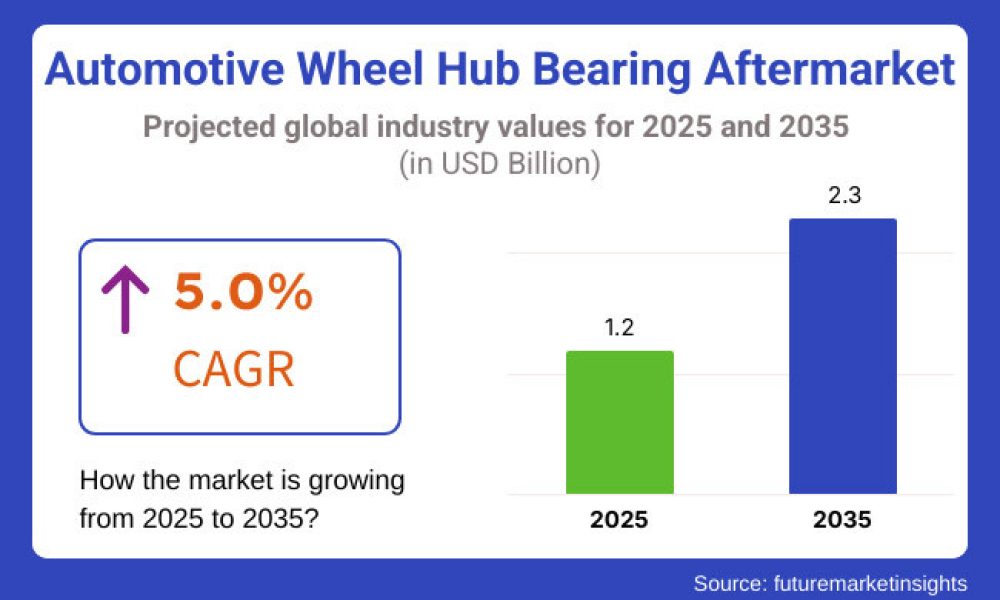
The global automotive wheel hub bearing aftermarket is gaining strong traction as automotive ownership rises and vehicles stay longer on the road. According to latest industry estimates, the market will grow from USD 1.11 billion in 2023 to USD 1.2 billion in 2025, before doubling to USD 2.3 billion by 2035, expanding at a steady 5.0% CAGR.
The surge reflects increased vehicle parc, the growing replacement demand for bearings, and the steady adoption of advanced bearing technologies offering improved durability, reduced friction, and longer service life.
Aftermarket Strengthens as Vehicle Lifespans Extend
The aftermarket remains a crucial lifeline for the global automotive ecosystem. Wheel hub bearings—vital for friction reduction, vehicle stability, and wheel rotation—naturally degrade with time, driving continuous replacement demand. With global vehicle fleets aging and more cars being driven beyond 12 years of service, particularly in markets such as the USA and Europe, demand for durable, affordable replacement bearings is surging.
Price sensitivity in emerging markets across APAC and the Middle East challenges suppliers to deliver cost-effective solutions without compromising quality. Counterfeit products remain a significant concern, making authentication, supply chain transparency, and brand trust key differentiators in the competitive aftermarket landscape.
Get access to comprehensive data tables and detailed market insights — request your sample report today!
Regional Momentum: APAC, Europe, USA, and Saudi Arabia
Across Asia-Pacific, rising disposable income, a rapidly growing vehicle population, and a strong e-commerce ecosystem are driving aftermarket expansion. Japan and South Korea continue to lead innovation in low-friction, long-life ceramic and hybrid bearings, aligned with national carbon-neutrality goals and electric mobility acceleration.
In Europe, stringent emission norms and the transition toward connected and autonomous mobility are encouraging adoption of smart, sensor-integrated wheel hub bearings. Major OEMs and aftermarket leaders such as Bosch, ZF Friedrichshafen, and Schaeffler are advancing energy-efficient, recyclable bearing systems to comply with circular economy mandates.
The USA aftermarket is benefiting from an aging vehicle fleet and strong do-it-yourself (DIY) maintenance culture. Timken, SKF, and NTN Corporation lead in corrosion-resistant, high-performance bearings with integrated sensing capabilities for predictive maintenance and enhanced safety.
Meanwhile, Saudi Arabia is emerging as a regional growth hotspot as it diversifies beyond oil and invests heavily in automotive and industrial manufacturing under Vision 2030. Rising passenger vehicle sales and infrastructure investments are fueling steady aftermarket demand for high-durability wheel hub bearings suited to harsh desert conditions.
Risk Assessment for Automotive Wheel Hub Bearing Aftermarket
With the increasing penetration of electric vehicles, there are multiple risk factors affecting the automotive wheel hub bearing aftermarket. EVs produce higher torque and weigh more than traditional vehicles which leads to a 15 to 20% reduction in bearing life. This accelerated use causes higher wear to be applied when used, increasing the need for replacements – with manufacturers needing to balance performance and durability.
To justify the price, advanced ceramic hybrid bearings can reduce wear significantly, up to 30%, making them more resilient to fatigue, wear, and corrosion, particularly oxidation, compared to traditional bearings; however, broader acceptance remains challenged by high prices, particularly in price-sensitive markets. The market is also flooded with counterfeit and inferior bearings which not only threaten the safety of the vehicle but also cause a loss of reputation for the brand and faith in the consumer.
The market landscape is also complicated by uncertainties in the supply chain, discrepancies in quality control, and the potential for regulatory scrutiny. These factors present challenges that manufacturers and aftermarket suppliers will need to address through robust quality control, effective authentication protocols, and pricing strategies, while maintaining a focus on safety and reliability in a dynamic and competitive industry.
Technology and Trends Shaping the Future
Between 2020 and 2024, the aftermarket benefited from growing e-commerce penetration and the rising need for high-quality replacement parts. From 2025 to 2035, the industry is poised for transformation led by IoT, AI, and smart diagnostics.
Key innovations include:
- Smart bearings with real-time condition monitoring for temperature, vibration, and wear.
- AI-powered predictive maintenance to prevent failures before they occur.
- Lightweight, recyclable materials supporting sustainability and reduced emissions.
- 3D-printed bearing components enabling localized, on-demand production.
EVs and autonomous vehicles are also reshaping material science and design needs. With higher torque and weight, EVs shorten bearing life by 15–20%, driving demand for hybrid ceramic bearings that reduce wear by up to 30%. Sustainability trends further encourage adoption of biodegradable lubricants and eco-friendly production methods across regions.
Competitive Landscape and Market Leaders
The aftermarket is highly competitive, with global players focusing on product innovation, acquisitions, and regional expansion.
Market share breakdown (2024):
- SKF Group: 20–25%
- NTN Corporation: 15–20%
- Timken Company: 12–16%
- NSK Ltd.: 10–14%
- Schaeffler Group: 6–10%
Why Choose FMI: Empowering Decisions that Drive Real-World Outcomes: https://www.futuremarketinsights.com/why-fmi
About Future Market Insights (FMI)
Future Market Insights, Inc. (FMI) is an ESOMAR-certified, ISO 9001:2015 market research and consulting organization, trusted by Fortune 500 clients and global enterprises. With operations in the U.S., UK, India, and Dubai, FMI provides data-backed insights and strategic intelligence across 30+ industries and 1200 markets worldwide.



