
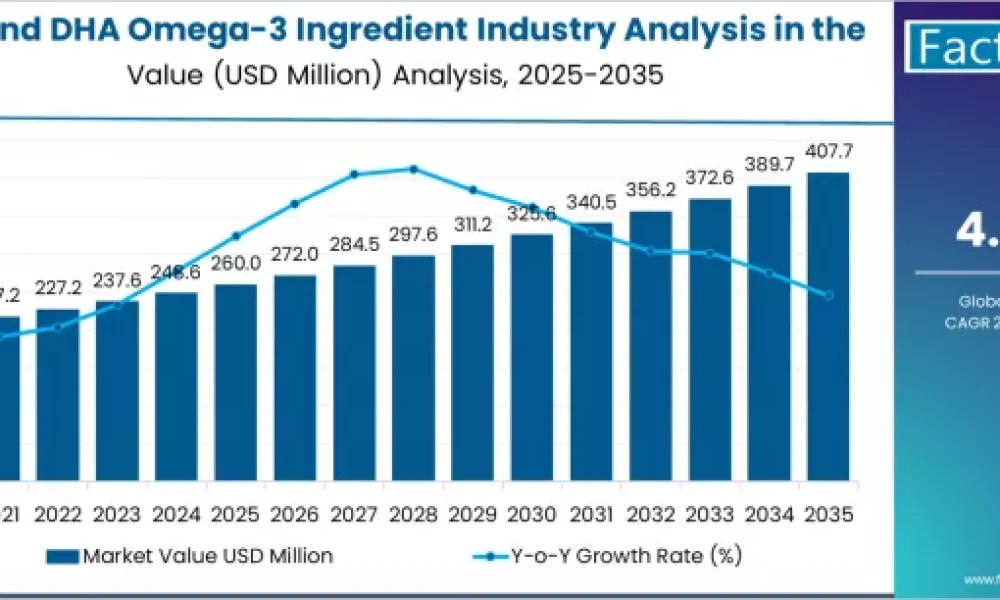
The UK market for EPA (eicosapentaenoic acid) and DHA (docosahexaenoic acid) omega-3 ingredients is on track for steady growth over the coming decade, supported by rising health awareness, expanding supplement usage, and growing adoption of advanced omega-3 formulations — including marine- and algae-derived oils. In 2025, the market is estimated at roughly USD 260.0 million, and it is forecast to reach about USD 408.0 million by 2035, reflecting a compound annual growth rate (CAGR) of approximately 4.6%.
Market Structure: Sources, Applications & Leading Segments
Dominant Source — Marine Oils: In 2025, marine oils account for about 63.0% of total demand for EPA and DHA ingredients in the UK. This reflects their established supply chains, high concentration of EPA/DHA, and broad regulatory acceptance.
Other Sources — Algal & Concentrates: Alongside traditional marine-derived oils, algal-based omega-3 and concentrated/ethyl ester (EE) forms are gaining traction, particularly among consumers seeking vegetarian or vegan alternatives, or clean-label formulations.
Primary Application — Dietary Supplements: The leading application segment in 2025 is dietary supplements, accounting for roughly 52.0% of ingredient demand. This underscores the central role of consumer health products in driving omega-3 ingredient consumption.
Emerging Applications — Functional Foods, Infant Nutrition & Fortified Foods: Beyond supplements, demand is rising for fortified foods, infant formulas, and functional-food/beverage applications. The growing interest in cognitive, cardiovascular and overall wellness nutrition is helping broaden applications.
To access the complete data tables and in-depth insights, request a Discount On The Report here: https://www.factmr.com/connectus/sample?flag=S&rep_id=11955
Key Growth Drivers
• Rising Health & Preventive Wellness Awareness
Growing awareness around cardiovascular health, cognitive function, and overall preventive wellness is a major impetus for omega-3 ingredient demand. Consumers in the UK are increasingly turning to EPA and DHA to support heart health, brain function, and long-term wellness — creating robust demand for both marine-derived and alternative omega-3 sources.
• Shift Toward Diverse Product Formats & Clean-Label Ingredients
There is a noticeable shift from traditional capsule-based supplements to more diverse formats such as softgels, emulsions, gummies, fortified foods, and beverages. Additionally, demand for clean-label and plant-based (algae-derived) omega-3 solutions is rising, driven by growing consumer interest in sustainability, vegan diets, and cleaner ingredient sourcing.
• Technological Innovation & Bioavailability Enhancements
Advances in extraction, purification, concentration, and delivery technologies — including microencapsulation, refined marine oil processing, and algae-based omega-3 production — are enhancing purity, stability, and bioavailability of EPA/DHA ingredients. These improvements support premium product development and help meet stricter regulatory and quality demands.
• Expansion of Preventive Healthcare & Supplement Industry
The supplement industry in the UK is evolving beyond basic nutritional needs to support preventive health, age-related wellness, cognitive support, and specialized nutritional demands. As supplement manufacturers and nutritional brands aim to meet these evolving consumer needs, demand for high-quality EPA and DHA ingredients is increasing accordingly.
Challenges & Market Constraints
Sourcing & Sustainability Concerns: Reliance on marine oils raises sustainability and supply-chain concerns. Fluctuations in raw material availability and cost may impact long-term supply stability, prompting increased interest in algae-based and plant-derived omega-3 sources.
Regulatory & Quality Compliance: Meeting stringent purity, stability, and regulatory standards — especially for products aimed at high-efficacy health claims — requires significant investment in extraction/purification and quality-assurance infrastructure.
Competition from Alternative Nutritional Ingredients: As consumers demand more sustainable, vegan, or allergen-free products, algae- or plant-based omega-3 alternatives, or even different nutrient combinations, pose competitive pressures to traditional marine-based ingredients.
Strategic Outlook & Opportunities
For Ingredient Suppliers & Manufacturers
Invest in algae-based omega-3 production and high-purity marine oil refinements to meet sustainability and clean-label demands.
Expand R&D in delivery systems — emulsions, microencapsulated powders, concentrated oils — to support diverse applications including supplements, functional foods, beverages, and infant nutrition.
Focus on robust quality assurance, transparency, and regulatory compliance to appeal to premium wellness and pharmaceutical markets.
For Nutritional Brands & Consumer Health Companies
Diversify product portfolios: offer omega-3 enriched foods, beverages, supplements, and vegetarian/vegan-aligned alternatives to address evolving consumer preferences.
Leverage growing awareness of heart, brain, and overall wellness to market products with clinically relevant EPA:DHA ratios or targeted health outcomes.
Emphasize sustainable sourcing and clean-label credentials — especially for environmentally conscious and plant-based consumers.
For Investors & Market Entrants
Explore high-growth segments: algae-based omega-3 ingredients, infant nutrition, cognitive and heart health supplements, and functional foods.
Support innovation in concentration and bioavailability enhancement, as well as scalable, sustainable sourcing infrastructure.
Monitor regulatory trends, clinical research, and consumer health shifts to anticipate new demand waves.
Ten-Year Market Outlook (2025–2035)
By 2035, the UK EPA & DHA omega-3 ingredient industry is projected to reach approximately USD 408.0 million, nearly a USD 148.0 million increase over 2025. Growth after 2030 is expected to accelerate, driven by rising acceptance of algae-based omega-3s, innovation in high-bioavailability formulations, increased product diversification into food and functional nutrition categories, and expanding preventive health adoption across demographics.
As consumer demand for heart health, cognitive wellness, and holistic preventive nutrition continues to rise — along with a shift toward sustainability and clean labels — the UK market is well-positioned for sustained expansion. Ingredient suppliers, supplement manufacturers, and nutritional brands that innovate in sourcing, formulation, and delivery will likely lead the next wave of growth.
Have specific requirements or need assistance on report pricing or have a limited budget? Please contact [email protected]
About Fact.MR:
Fact.MR is a global market research and consulting firm, trusted by Fortune 500 companies and emerging businesses for reliable insights and strategic intelligence. With a presence across the U.S., UK, India, and Dubai, we deliver data-driven research and tailored consulting solutions across 30+ industries and 1,000+ markets. Backed by deep expertise and advanced analytics, Fact.MR helps organizations uncover opportunities, reduce risks, and make informed decisions for sustainable growth.



