
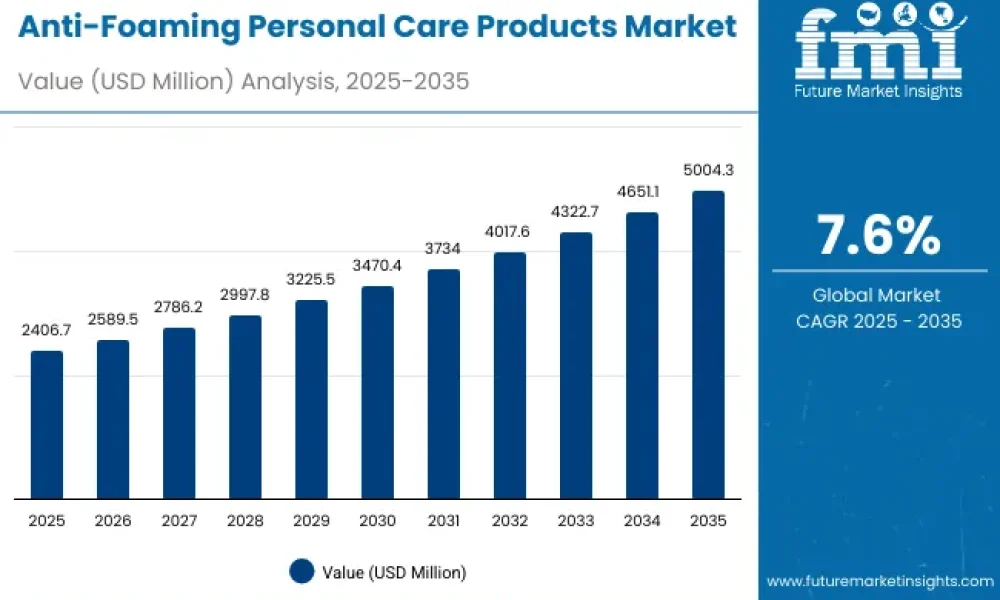
The Anti-Foaming Personal Care Products Market is projected to reach USD 2,406.7 million in 2025, with forecasts indicating a significant expansion to USD 5,004.3 million by 2035. The industry is set to grow by 193% over the decade, driven by rising demand for balanced-foam shampoos, sulfate-free cleansers, AI-enabled product formulation, and global e-commerce expansion. The market will advance at a CAGR of 7.6% from 2025 to 2035, showing strong potential across hair care, skincare, and hygiene product categories.
The Anti-Foaming Personal Care Products Market continues to evolve as consumer preferences shift toward controlled-foam, dermatology-backed, and clean-label formulations. Anti-foaming agents have become essential ingredients in shampoos, conditioners, body washes, facial cleansers, and hand washes, enhancing rinse-off, reducing irritation, and improving overall sensory experience.
Subscribe for Year-Round Insights → Stay ahead with quarterly and annual data updates : https://www.futuremarketinsights.com/reports/sample/rep-gb-26524
Quick Stats (2025–2035):
- 2025 Market Value: USD 2,406.7 million
- 2035 Market Forecast: USD 5,004.3 million
- Decade Growth: USD 2,597.6 million
- Leading Product Segment (2025): Shampoos & conditioners (43.1%)
- Leading Regions: East Asia, South Asia & Pacific, Europe
- Top Global Players: Procter & Gamble, Unilever, Johnson & Johnson, L’Oréal, Henkel, Amorepacific, Shiseido, Kao Corporation
Key Market Highlights
- Strong Growth Momentum (2025–2035)
- From 2025 to 2030, the market increases by USD 1,063.7 million, driven by widespread adoption of silicone-based defoamers in rinse-off formulations.
- From 2030 to 2035, growth accelerates with an additional USD 1,533.9 million, supported by AI-enabled formulation systems, premium product innovation, and e-commerce channel expansion.
- By 2035, the market achieves slightly more than a 2X increase in total size.
- Rising Demand for Controlled-Foam Hair Care
- Shampoos & conditioners remain the largest product category with 43.1% value share in 2025.
- Anti-foaming agents improve product texture, balance foam levels, and reduce scalp irritation—key drivers of premium haircare adoption.
- The shift towards sulfate-free and dermatologist-approved solutions is strengthening segment growth.
- Silicone-Based Defoamers Lead with 46.3% Share
- Silicone-based actives dominate due to superior chemical stability and compatibility with liquid and gel formats.
- Advancements in silicone delivery systems enhance performance, especially in mass-market haircare and body wash formulations.
- Liquid Formulations at the Forefront
- Liquid formats account for 52.4% of market share in 2025, driven by their versatility, ease of application, and strong consumer familiarity.
- Innovation in liquid cleansing bases—especially clean-label surfactants—will help retain category leadership.
Market Drivers
- Growing Preference for Balanced-Foam, Scalp-Friendly Shampoos
Consumers increasingly recognize that excessive foam does not equal better cleansing. Anti-foaming agents enable comfortable rinse-off and superior scalp health, driving strong adoption in the haircare category.
- Rapid E-commerce Expansion
Online platforms such as Amazon, Tmall, and specialty beauty stores are elevating visibility for premium low-foam cleansers, vegan formulations, and dermatologist-tested products. Ingredient transparency online further boosts niche demand.
Market Restraints
- Strong Cultural Association Between Lather and Cleanliness
Markets such as India and Southeast Asia still associate heavy foam with superior cleaning, slowing adoption of low-foam solutions in mass retail.
- Regulatory Pressure on Silicone-Based Actives
Europe and Japan are introducing stricter guidelines on silicone usage due to environmental concerns, increasing compliance costs and pushing brands toward reformulation.
Key Market Trends
- Rapid Shift Toward Natural Oil-Based & Polymer Defoamers
Eco-conscious consumers increasingly prefer coconut-oil-based, sunflower-oil-based, and biopolymer solutions, boosting sustainable product portfolios.
- Strong Growth in India and China
- India: CAGR 15.2%—fastest globally; rising demand for sulfate-free & scalp-health shampoos.
- China: CAGR 13.6%—driven by polymer-based innovations and premium liquid cleansers.
Competitive Landscape
The market is moderately fragmented, with global giants and regional innovators shaping the competitive environment.
Leading companies include:
- Procter & Gamble (8.4% market share in 2025)
- Unilever
- Johnson & Johnson
- Colgate-Palmolive
- Beiersdorf
- L’Oréal
- Henkel
- Amorepacific
- Shiseido
- Kao Corporation
Emerging digital-first brands specializing in clean-label, sulfate-free, and low-foam formulations are capturing niche consumer segments, supported by subscription models and AI-based personalization.
Conclusion
The Anti-Foaming Personal Care Products Market is entering a decade of transformative growth, driven by technological innovation, evolving consumer expectations, and rising demand for clean-label and foam-controlled personal care solutions. With strong momentum across Asia-Pacific and continued premiumization in Western markets, the industry is positioned for robust expansion through 2035.
Have a specific Requirements and Need Assistant on Report Pricing or Limited Budget please contact us – [email protected]
About Future Market Insights (FMI)
Future Market Insights, Inc. (FMI) is an ESOMAR-certified, ISO 9001:2015 market research and consulting organization, trusted by Fortune 500 clients and global enterprises. With operations in the U.S., UK, India, and Dubai, FMI provides data-backed insights and strategic intelligence across 30+ industries and 1200 markets worldwide.



