
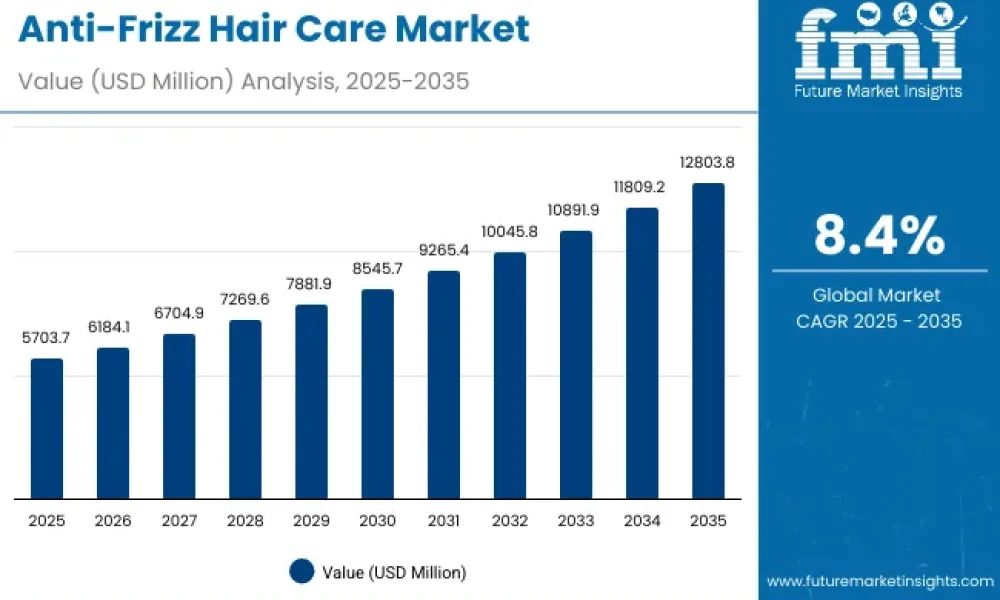
The global Anti-Frizz Hair Care Market is on a strong growth trajectory, expected to reach USD 5,703.7 million in 2025 and surge to USD 12,803.8 million by 2035, representing an impressive 125% expansion over the decade. With a CAGR of 8.4%, the market is set to double in size, fueled by rising demand for high-performance formulations, clean-label products, and texture-specific solutions worldwide.
Anti-Frizz Hair Care Market Overview
The anti-frizz category, once limited largely to salon-exclusive products, has now evolved into a mainstream global segment driven by consumer awareness, e-commerce penetration, and ingredient-led innovation. By 2025, serums & oils lead the product landscape with a 39.2% revenue share, while argan oil-based formulations dominate ingredient preferences with 41.6% share.
Rapid adoption across North America, Europe, and Asia-Pacific, coupled with rising concerns around humidity, hair damage, chemical treatments, and daily styling, continues to support category expansion.
Subscribe for Year-Round Insights → Stay ahead with quarterly and annual data updates : https://www.futuremarketinsights.com/reports/sample/rep-gb-26530
Quick Market Stats
- Market Value 2025: USD 5,703.7 million
- Market Value 2035: USD 12,803.8 million
- CAGR (2025–2035): 8.4%
- Leading Product Segment: Serums & oils (39.2%)
- Top Growth Regions: North America, Asia-Pacific, Europe
- Major Companies: Moroccanoil, L’Oréal Professional, Living Proof, OGX, John Frieda, Kerastase, Aveda, Garnier, Tresemmé, Pantene
Key Market Highlights (Pointwise Summary)
- Strong Decade-Long Growth Momentum
- The market adds USD 7,100.1 million between 2025 and 2035.
- 2025–2030: Adds USD 2,842 million (40% of total growth), driven by premium serums, argan oil blends, and salon-grade treatments.
- 2030–2035: Adds USD 4,258.1 million (60% of total growth), led by e-commerce, premium hair masks, keratin leave-in creams, and rapid adoption in India, China, and Japan.
- Rising Shift Toward Natural & Clean Label Products
- Vegan, silicone-free, dermatologist-tested, and botanical-infused products are gaining mainstream attention.
- Younger demographics, especially in East Asia, are driving this shift.
- E-Commerce and Digital Discovery Boost Market Penetration
- Online sales explode across the USA, China, India, and Europe.
- Influencer-driven content and tutorials popularize product routines for curly, wavy, and chemically treated hair.
Segmental Insights
Product Type Outlook: Serums & Oils Lead (39.2% in 2025)
Serums & oils maintain dominance due to:
- Instant smoothing and shine enhancement
- Lightweight formulations compatible with multiple hair types
- Growing use of argan, jojoba, moringa, and coconut oil
- High traction across North American and European salons
Multi-benefit serums offering UV defense, heat protection, and scalp support are gaining rapid attention and will remain core growth drivers through 2035.
Ingredient Base Outlook: Argan Oil Takes the Lead (41.6% in 2025)
Argan oil’s leadership is driven by:
- High vitamin E and fatty acid content
- Strong demand from curly, wavy, and chemically treated hair consumers
- High adoption in premium brands like Moroccanoil and Kerastase
- Rising preference for ethically sourced Moroccan argan oil
Sustainable and fair-trade sourcing of argan oil is becoming a powerful differentiator among leading brands.
Hair Type Outlook: Curly & Wavy Hair Dominates (46.1% in 2025)
Curly & wavy hair segments dominate due to:
- Higher susceptibility to frizz
- Growing acceptance of natural textures
- Strong consumption in North America, Europe, South Asia, and Latin America
Butter-based blends, texture-enhancing creams, and sulfate-free masks are at the forefront of this category’s growth.
Market Drivers, Restraints & Trends
Key Drivers
- Rising demand for premium serums & oils in urban markets
- Expanding curly & wavy hair consumer base across global regions
- Increased awareness of frizz control, hydration, and humidity protection
Key Restraints
- Growing consumer pushback against silicones and synthetic additives
- Price sensitivity in emerging economies limiting premium category adoption
Key Trends
- Surge in ethically sourced argan oil formulations
- Digital-first adoption with e-commerce, live-streaming, and influencer partnerships
Regional & Country-Level Outlook
Fastest-Growing Markets (2025–2035)
- India: CAGR 14.6%
- China: CAGR 13.0%
- Japan: CAGR 10.6%
Strong growth stems from rising disposable incomes, urban lifestyles, and expanding e-commerce accessibility.
Mature Yet Steady Markets
- USA: CAGR 5.4%
- Germany: 6.3%
- UK: 8.5%
These markets prioritize clean-label options, sustainable packaging, and texture-specific solutions.
Conclusion
The Anti-Frizz Hair Care Market (2025–2035) is set for robust expansion driven by innovation in serums, oils, and clean-label formulations. With rising consumer focus on hair nourishment, styling flexibility, and humidity resistance, the market will continue to favor brands offering performance-led, ethically sourced, and digitally accessible products. North America remains the largest market, while Asia-Pacific emerges as the fastest-growing, reshaping global demand patterns in the decade ahead.
Have a specific Requirements and Need Assistant on Report Pricing or Limited Budget please contact us – [email protected]
About Future Market Insights (FMI)
Future Market Insights, Inc. (FMI) is an ESOMAR-certified, ISO 9001:2015 market research and consulting organization, trusted by Fortune 500 clients and global enterprises. With operations in the U.S., UK, India, and Dubai, FMI provides data-backed insights and strategic intelligence across 30+ industries and 1200 markets worldwide.



