
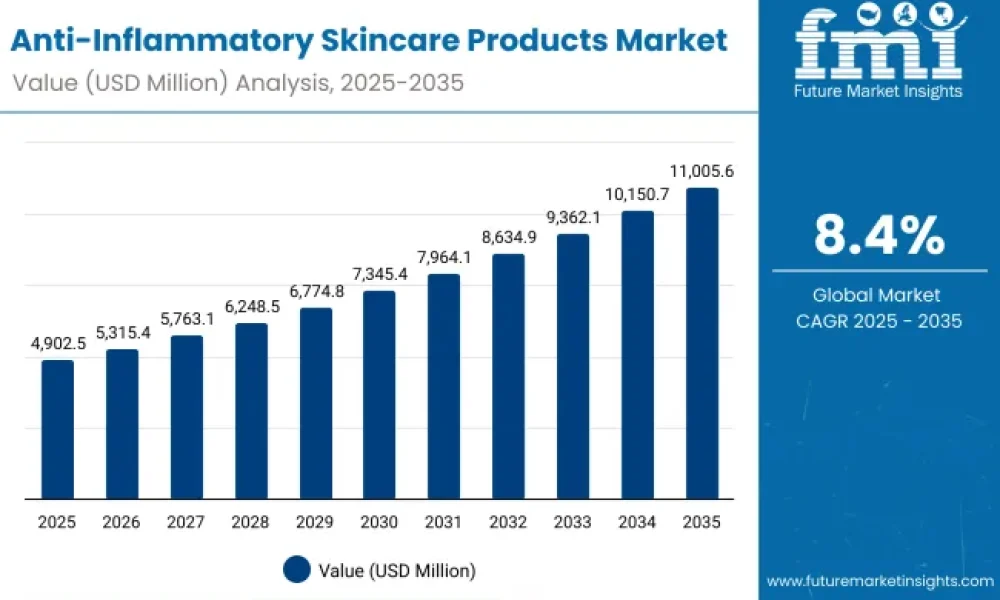
The Global Anti-Inflammatory Skincare Products Market is positioned for strong expansion, rising from USD 4,902.5 million in 2025 to USD 11,005.6 million by 2035. This significant increase of USD 6,103.1 million reflects a 193% growth over the decade, supported by a CAGR of 8.4%. Driven by the rising prevalence of sensitive skin, widespread dermatology endorsements, botanical-led formulations, and digital skincare personalization, the market is evolving rapidly across both mature and emerging regions.
Between 2025 and 2035, the market will grow at more than double its current valuation. The first half of the decade (2025–2030) contributes 40% of total growth, while the latter half (2030–2035) accelerates to deliver 60%, reflecting evolving consumer preferences toward AI-enabled skin diagnostics, preventive skincare, and clean-label formulations.
Subscribe for Year-Round Insights → Stay ahead with quarterly and annual data updates : https://www.futuremarketinsights.com/reports/sample/rep-gb-26584
Key 2025 Snapshot
- Market Value: USD 4,902.5 million
- Leading Product Segment: Soothing creams & balms (42.4% share)
- Leading Active: Centella asiatica (37.1% share)
- Top Regions: Asia-Pacific, Europe, North America
- Key Players: La Roche-Posay, Avene, Eucerin, Cetaphil, Vanicream, Bioderma, Clinique, Paula’s Choice, First Aid Beauty, Aveeno
Key Market Drivers
- Growing Prevalence of Sensitive and Inflamed Skin
- 60–70% of women and 40–50% of men globally report having sensitive skin.
- Urban pollution, lifestyle stress, and climatic variations are increasing skin reactivity.
- Consumers are shifting to dermatologist-tested anti-inflammatory solutions for rosacea, eczema, and redness management.
- Dermatologist Endorsements Boosting Trust
- Clinical validations such as “hypoallergenic,” “non-comedogenic,” and “dermatologist-tested” drive adoption.
- Pharmacy-based brands—La Roche-Posay, Avene, Eucerin—remain category leaders due to strong medical credibility.
- Dermatology clinics are increasingly recommending OTC soothing creams and Cica-based formulations.
Market Restraints
- Stringent Regulatory Restrictions
- Claims such as “treats eczema” or “cures rosacea” are limited in the EU and USA.
- Compliance complexities slow down new product development and market entry.
- Price Sensitivity in Developing Markets
- Premium dermatologist-backed formulations face affordability challenges in India, Brazil, and Southeast Asia.
- Local and private-label players gain traction with affordable botanical alternatives.
Key Market Trends
- Surge in Botanical Actives
- Rising preference for Centella asiatica, green tea extract, and colloidal oatmeal.
- Consumer trust toward plant-based, barrier-strengthening, and irritation-reducing actives is increasing.
- East Asia leads the botanical innovation wave, influencing global premium and mass skincare.
- Growth of Digital Dermatology and Personalization
- AI-based skincare analysis tools personalize soothing creams, serums, and gel mask regimens.
- Subscription-based anti-redness kits are gaining popularity.
- China’s livestream e-commerce ecosystem accelerates Cica product adoption.
Segmental Highlights
Product Type
- Soothing creams & balms (42.4% in 2025) dominate due to daily usability, thicker textures, and instant relief.
- Gel masks and thermal water sprays gain traction by 2030–2035 due to preventive and wellness skincare trends.
Key Actives
- Centella asiatica (37.1% share) leads globally as a top anti-inflammatory active.
- Green tea and colloidal oatmeal emerge as strong complementary ingredients.
Skin Concern
- Irritated / sensitive skin holds 44.9% share, reflecting heightened consumer awareness of skin barrier health.
Regional Outlook
Asia-Pacific
- Fastest growth driven by China (CAGR 12.1%) and India (CAGR 13.7%).
- Popularity of K-beauty/C-beauty and affordable botanical formulations strengthen market momentum.
North America
- The USA grows steadily at 5.1% CAGR, supported by strong pharmacy presence and increasing demand for soothing balms.
Europe
- Dominated by dermo-cosmetic brands from France and Germany.
- Consistent growth at 7.3% CAGR, driven by premium, clinical-grade sensitive-skin solutions.
Competitive Landscape
Leading brands emphasize clinical credibility, “clean” ingredients, and hybrid omnichannel models. Digital-first brands are gaining ground through personalized regimens and subscription-based anti-redness kits, while pharmacy giants maintain dominance through dermatologist trust and wide retail access.
Conclusion
The Anti-Inflammatory Skincare Products Market is entering a high-growth phase marked by scientific innovation, rising sensitive-skin prevalence, and digitized skincare experiences. With a projected USD 11,005.6 million value by 2035, the market offers strong opportunities for brands adopting botanical actives, dermatologist-backed formulations, and AI-driven personalization.
Have a specific Requirements and Need Assistant on Report Pricing or Limited Budget please contact us – [email protected]
About Future Market Insights (FMI)
Future Market Insights, Inc. (FMI) is an ESOMAR-certified, ISO 9001:2015 market research and consulting organization, trusted by Fortune 500 clients and global enterprises. With operations in the U.S., UK, India, and Dubai, FMI provides data-backed insights and strategic intelligence across 30+ industries and 1200 markets worldwide.



