
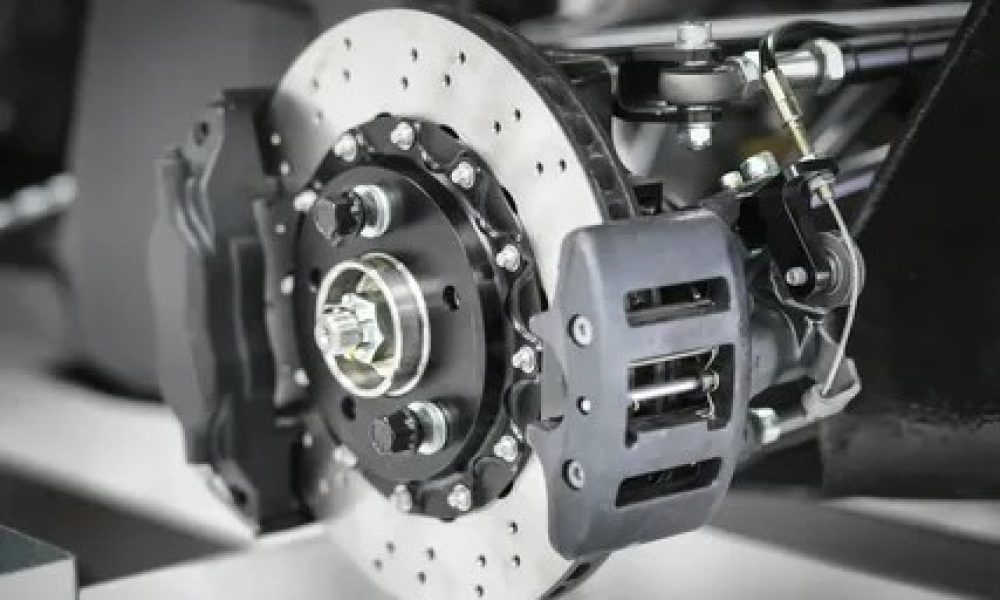
The global Automotive Brake System Market is entering a transformative decade, driven by rapid advancements in electronic braking architectures, stringent global safety regulations, and accelerating electric vehicle (EV) adoption. The market is projected to expand from USD 7,556.4 million in 2025 to USD 20,140.4 million by 2035, registering a strong CAGR of 10.3% over the forecast period.
A surge in demand for brake-by-wire platforms, regenerative braking integration, and ADAS-compatible systems is reshaping OEM strategies worldwide. Continued investment in lightweight calipers, low-emission friction materials, and modular software-driven control units is expected to define system innovation through 2035.
Breakthrough Developments from Leading Technology Providers
In 2024, ZF unveiled a next-generation brake-by-wire system engineered specifically for battery electric and automated vehicles. The platform eliminates hydraulic components entirely, relying on electronic signaling to deliver precision actuation. According to ZF’s official announcement, the system meets redundancy and efficiency thresholds tailored to Level 4 autonomous driving, supporting compatibility with regenerative braking and offering significantly reduced maintenance requirements.
Similarly, Bosch announced updates to its brake control platform, emphasizing seamless integration with vehicle software. Featuring over-the-air update capabilities, customizable braking profiles, and ADAS-aligned architecture, the system offers OEMs unprecedented flexibility to configure braking behavior for region-specific regulations and diverse vehicle platforms.
In the commercial vehicle segment, Accelera (a Cummins brand) launched its advanced Endurance Braking System in 2024, designed for electric trucks and buses operating under demanding load and terrain cycles. By combining regenerative braking with thermal management technologies, the platform improves braking consistency, energy capture, and system durability—crucial for long-haul EV fleets.
Subscribe for Year-Round Insights → Stay ahead with quarterly and annual data updates
https://www.futuremarketinsights.com/reports/sample/rep-gb-503
Disc Brake Systems Gain Dominance Across Passenger and EV Platforms
Disc brake systems accounted for 71% of global market share in 2025 and are set to grow at a CAGR of 10.6% through 2035. Their industry-wide adoption is driven by superior heat dissipation, performance consistency, and enhanced compatibility with electronic control units and ADAS features.
OEMs across Europe, Asia, and North America are transitioning to four-wheel disc configurations, especially for mid-sized, compact, and premium vehicle classes. EV manufacturers are opting for lightweight disc designs that minimize drag and support regenerative braking efficiency, while suppliers focus heavily on corrosion resistance, noise reduction, and optimized rotor-pad formulations.
Mid-Sized Passenger Cars Remain the Highest-Volume Application Segment
Mid-sized passenger vehicles represented 36% of the market in 2025 and are expected to maintain growth at a 10.4% CAGR through 2035. This segment continues to benefit from rising demand in Asia-Pacific and Europe, where consumers value affordability, fuel efficiency, and balanced performance.
With ADAS features increasingly standard in mid-sized models, demand for electronically compatible brake systems—ABS, ESC, AEB, and advanced brake control modules—continues to grow. Suppliers are refining materials, friction technologies, and thermal control to deliver consistent braking performance across diverse global driving scenarios.
Market Challenges: High Costs and Complex System Integration
Advanced braking technologies—such as brake-by-wire, electronic stability control, and autonomous emergency braking—carry elevated manufacturing and maintenance costs that restrict adoption in price-sensitive markets. The need for high-performance ECUs, sensors, and actuators drives up system complexity, posing challenges for both OEMs and aftermarket players.
Integration difficulties also persist. Modern braking systems must communicate seamlessly with ADAS modules, powertrains, and vehicle chassis systems, increasing calibration overhead and development timelines. Retrofitting older vehicles remains technically challenging due to incompatible electronic architectures.
Market Opportunities: EV Growth, Autonomous Vehicles, and Smart Braking
The accelerating shift toward EVs and autonomous mobility offers substantial growth potential for next-generation braking technologies. EVs rely heavily on regenerative braking, while autonomous vehicles require ultra-responsive electronic controls and multi-layer redundancy.
The rise of intelligent braking systems—equipped with AI-driven diagnostics, remote monitoring, and predictive maintenance capabilities—represents an emerging market frontier. Lightweight materials such as carbon-ceramic composites and aluminum-based components offer further opportunities for performance enhancement and emissions reduction.
Regional Insights
- United States (CAGR: 4.8%)
Growth driven by strict NHTSA safety requirements, rising EV production, strong ADAS integration, and robust OEM–aftermarket demand. - United Kingdom (CAGR: 4.5%)
Rapid EV adoption, autonomous vehicle investments, and government-backed sustainability policies are driving strong regenerative brake system deployment. - European Union (CAGR: 4.9%)
Mandatory ABS, ESC, and AEB compliance, coupled with aggressive EV rollout and sustainability-driven friction material innovation, fuels market expansion. - Japan (CAGR: 4.7%)
Leadership in brake-by-wire and AI-powered control systems, combined with strong EV penetration and stringent safety norms, supports market growth. - South Korea (CAGR: 4.6%)
Innovation from Hyundai and Kia, smart braking R&D, and expanded autonomous driving programs reinforce the country’s strong growth trajectory.
Personalize Your Experience: Ask for Customization to Meet Your Requirements
https://www.futuremarketinsights.com/customization-available/rep-gb-503
Competitive Landscape
The market is moderately consolidated, with leading players actively investing in smart braking, lightweight materials, and EV-aligned solutions:
- Robert Bosch GmbH
- Continental AG
- ZF Friedrichshafen AG
- Aisin Seiki Co., Ltd.
- Brembo S.p.A.
- Hitachi Astemo Ltd.
- Akebono Brake Industry Co., Ltd.
- Mando Corporation
- Nissin Kogyo Co., Ltd.
- Tenneco Inc.
Looking Ahead
With the transition to electric mobility, autonomous functions, and advanced software-defined vehicles accelerating worldwide, the Automotive Brake System Market is expected to enter a decade marked by innovation, regulatory alignment, and rapid technological evolution. Manufacturers with strong footholds in electronic braking, regenerative technologies, and AI-driven control systems are positioned to capture significant growth opportunities.
Why Choose FMI: Empowering Decisions that Drive Real-World Outcomes:
https://www.futuremarketinsights.com/why-fmi
About Future Market Insights (FMI)
Future Market Insights, Inc. (FMI) is an ESOMAR-certified, ISO 9001:2015 market research and consulting organization, trusted by Fortune 500 clients and global enterprises. With operations in the U.S., UK, India, and Dubai, FMI provides data-backed insights and strategic intelligence across 30+ industries and 1200 markets worldwide.



