
The global demand for nitrification and urease inhibitors is expanding at a steady pace, supported by sustainability mandates, the push for nitrogen-efficient fertilizers, and rapid adoption of precision agriculture. According to new industry forecasts, the Nitrification and Urease Inhibitors Market will grow from USD 3.7 billion in 2025 to USD 6.1 billion by 2035, advancing at a CAGR of 5.2% and generating an absolute dollar opportunity of USD 2.4 billion.
The market’s long-term trajectory is shaped by strong adoption trends across APAC, Europe, the United States, and Saudi Arabia, where governments and agribusinesses are intensifying efforts to control nitrogen losses, protect soil health, and meet emissions targets. Enhanced efficiency fertilizers, emerging crop nutrition technologies, and regulatory pressure on ammonia and nitrate emissions are further accelerating market penetration.
Subscribe for Year-Round Insights → Stay ahead with quarterly and annual data updates: https://www.futuremarketinsights.com/reports/sample/rep-gb-24585
Robust Multi-Phase Growth from 2025 to 2035
The industry demonstrates clear three-stage expansion:
Early Phase (2021–2025): USD 2.9 billion ➜ USD 3.7 billion
This period added USD 0.8 billion, driven by:
- heightened awareness of nitrogen loss via leaching and volatilization,
- adoption in cereal and grain crops (corn, wheat, rice),
- regulatory scrutiny of fertilizer usage.
Mid Phase (2026–2030): USD 3.9 billion ➜ USD 4.7 billion
Another USD 0.8 billion opportunity emerges through:
- improved inhibitor formulations with longer soil persistence,
- government subsidy programs for nitrogen efficiency,
- pressure to reduce greenhouse gas emissions from agriculture.
Late Phase (2031–2035): USD 5.0 billion ➜ USD 6.1 billion
The largest contribution—USD 1.1 billion (46% of total opportunity)—is expected due to:
- rapid uptake in emerging markets,
- high-value crop expansion,
- integration of inhibitors into precision farming and fertigation systems.
Key Market Highlights (2025 Snapshot)
- Market Value (2025): USD 3.7 billion
- Forecast Value (2035): USD 6.1 billion
- Forecast CAGR (2025–2035): 5.2%
- Leading Application Method (2025): Fertigation (59.5%)
- Top Regions: North America, Asia-Pacific, Europe, Middle East (notably Saudi Arabia)
- Leading Players: BASF SE, Corteva Agriscience, Solvay SA, Koch Agronomic, Compo Expert GmbH, J R Simplot, Helena Agri-Enterprises
Growing Importance in Global Fertilizer Efficiency Frameworks
Nitrification and urease inhibitors now contribute:
- 28–30% of the global nitrogen stabilizers market
- 22–24% of enhanced efficiency fertilizers
- 18–20% adoption across cereal and grain systems
- 14–16% share within environmental solutions due to emissions compliance
Stricter guidelines around ammonia emissions, nitrate runoff, and groundwater contamination are positioning these inhibitors as essential inputs for sustainable agriculture.
Why the Market Is Growing
- Nitrogen Efficiency Takes Center Stage
As fertilizer prices fluctuate globally, farmers seek solutions that maximize nitrogen retention. Inhibitors delay the conversion of urea, reducing losses and improving crop yield consistency—especially crucial in cereals and intensive farming systems.
- Policy & Compliance Push
Regions including Europe, the USA, and GCC (with Saudi Arabia leading regional sustainability programs) are aligning agricultural incentives with environmental standards. Subsidies and nitrogen-use regulations directly boost inhibitor adoption.
- Precision Agriculture Integration
Inhibitors are increasingly incorporated into:
- smart fertigation systems,
- soil moisture and nutrient monitoring platforms,
- automation-enabled irrigation networks,
- controlled-release fertilizer formulations.
- Expansion Across Crop Types
Once used mainly for cereals, inhibitors are now adopted across:
- cash crops (sugarcane, maize, cotton),
- horticulture (fruits & vegetables),
- fiber & forage crops.
Need tailored insights? Request report customization to match your specific business objectives: https://www.futuremarketinsights.com/customization-available/rep-gb-24585
Segmental Insights
By Method: Fertigation Leads (59.5% Share, 2025)
Fertigation remains the leading method due to uniform nutrient distribution, lower losses, and seamless integration with irrigation. Adoption is strong in water-scarce regions across APAC and the Middle East.
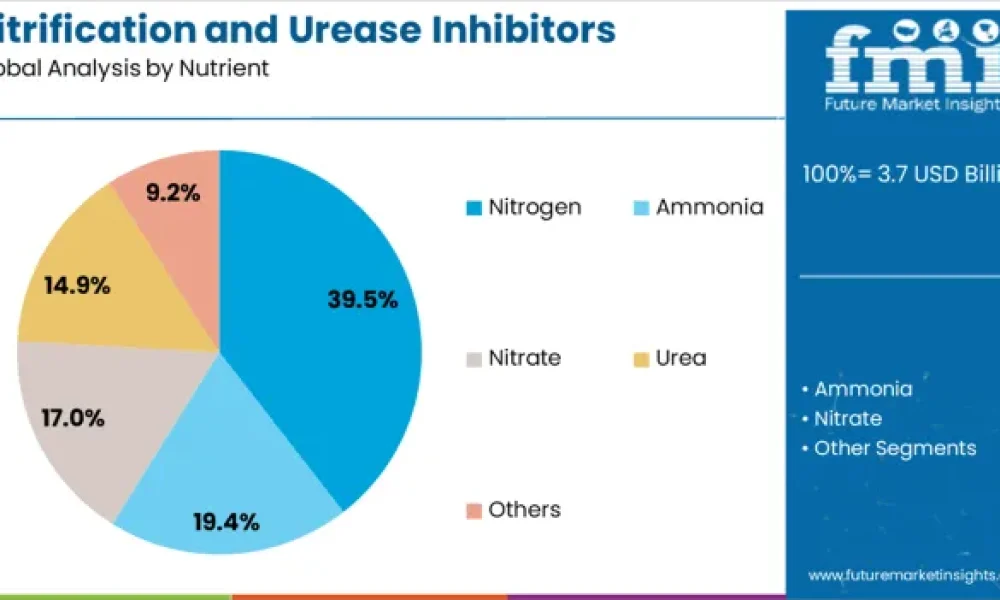
By Nutrient: Nitrogen Dominates (39.5% Share, 2025)
Nitrogen continues to drive demand as farmers seek solutions to prevent volatilization and leaching. Regulatory control on nitrogen runoff sustains leadership.
By Crop Type: Food Crops Command 37% Share
High global demand for cereals and vegetables fuels adoption, as food security remains a policy priority across APAC, Europe, and North America.
Country-Level Growth Performance (2025–2035 CAGR)
- China: 7.0% — world’s fastest growth, driven by large-scale rice, maize, wheat adoption
- India: 6.5% — supported by subsidies, rural distribution, diversified crop adoption
- Germany: 6.0% — strong in cereals, precision farming, sustainability mandates
- France: 5.5% — compliance-led growth across cereals, vineyards, horticulture
- UK: 4.9% — improved uptake through subsidies and precision farming
- USA: 4.4% — slower but steady growth; strong trials in maize, soy, wheat
- Brazil: 3.9% — adoption limited by price sensitivity but rising in sugarcane
The data confirms APAC is the fastest-growing, Europe is compliance-driven, the USA is innovation-led, and Saudi Arabia and GCC markets are emerging strong due to water-efficient fertigation trends.
Competitive Landscape
Key players are intensifying product innovation and regional specialization:
- BASF SE — broadest global stabilizer portfolio; leadership in soil-persistence technologies
- Corteva Agriscience — integrates inhibitors with seeds and crop protection programs
- Solvay SA — advanced chemical formulations optimized for different soil chemistries
- Koch Agronomic Services — strong North American distribution, large-scale field support
- Compo Expert GmbH — European specialization in horticulture and high-value crops
- J R Simplot & Helena Agri-Enterprises — emphasize farmer advisory and customized blends
Strategies include mergers, long-acting inhibitor R&D, partnerships with fertilizer manufacturers, and expansion in APAC and MEA.
About Future Market Insights (FMI)
Future Market Insights, Inc. (FMI) is an ESOMAR-certified, ISO 9001:2015 market research and consulting organization, trusted by Fortune 500 clients and global enterprises. With operations in the U.S., UK, India, and Dubai, FMI provides data-backed insights and strategic intelligence across 30+ industries and 1200 markets worldwide.
Why Choose FMI: Empowering Decisions that Drive Real-World Outcomes: https://www.futuremarketinsights.com/why-fmi



