
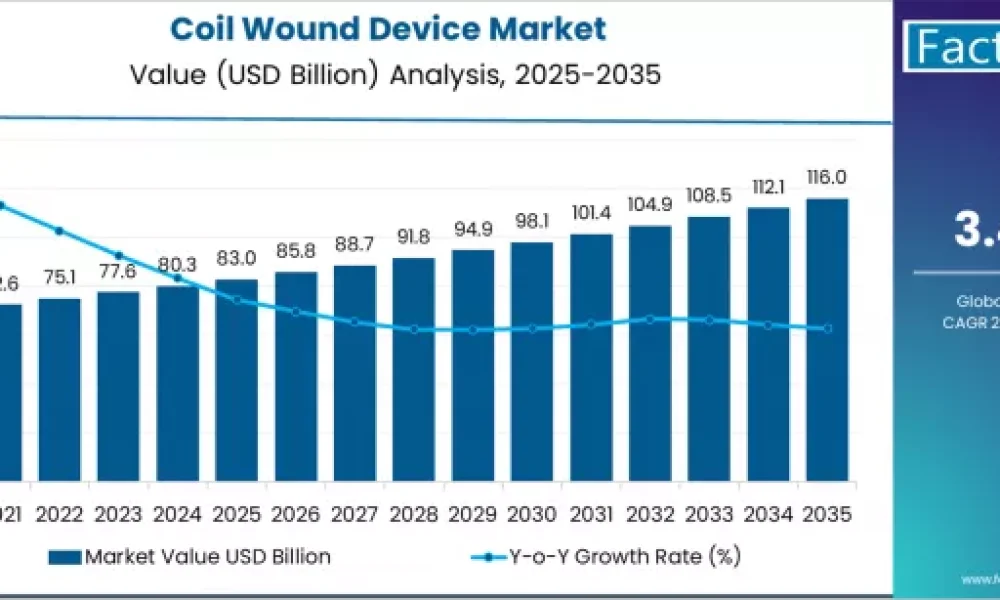
The global coil-wound device market is experiencing strong momentum, driven by ongoing investments in electrical infrastructure, industrial modernization, and innovation in winding technology. The market is projected to grow from USD 83.0 billion in 2025 to USD 116.0 billion by 2035, representing a compound annual growth rate (CAGR) of 3.4%.
Key Market Insights
2025 Market Value: USD 83.0 billion
2035 Forecast Value: USD 116.0 billion
Projected CAGR (2025–2035): ~3.4%
Leading Product Type: Transformers (~55% share)
Dominant End-Use Segment: Power & Utilities (~40%)
Key Growth Regions: Asia Pacific, North America, Europe
Major Players: ABB; Siemens Energy; Schneider Electric; TDK; Vishay; Murata; Panasonic; Sumida; Wurth; Delta
To access the complete data tables and in-depth insights, request a Discount On The Report here: https://www.factmr.com/connectus/sample?flag=S&rep_id=9295
Major Growth Drivers
Expansion of Power Infrastructure
Growing demand for reliable power transmission and distribution systems is fueling the need for high-quality coil-wound devices, such as transformers, that are core to modern grid upgrades.Industrial Modernization and Automation
Industries are increasingly automating their processes. Coil-wound devices like inductors and motors provide the necessary electromagnetic performance for efficient machinery, robotics, and automated systems.Rise in Electrification & EV Adoption
As electric vehicle (EV) production scales up, coil-wound devices are critical in power electronics, drive systems, and energy storage components, driving demand from the automotive sector.High Performance & Reliability
Coil-wound devices offer superior electromagnetic performance, thermal stability, and long operational life. These characteristics are especially valued in demanding applications within utilities and infrastructure.Technical Innovation in Winding
Advanced winding technologies, including precision automated winding, are improving device performance, reducing manufacturing defects, and enabling complex designs for transformers, inductors, and generator coils.
Market Segmentation
By Product Type:
Transformers (55%): Widely used for power conversion and voltage regulation.
Inductors / Chokes (25%): Essential for filtering, energy storage, and EMI control.
Motors / Generators (20%): Used in industrial drive systems and electromechanical applications.
By End-Use:
Power & Utilities (40%): Includes grid infrastructure, renewable energy systems, and substations.
Industrial (25%): Manufacturing facilities, automation lines, and heavy machinery require specialized coil-wound components.
Automotive (20%): Coil-wound devices are critical in EV drives, power electronics, and charging infrastructure.
Electronics / Other Applications: Telecommunications, consumer electronics, and aerospace also contribute.
By Winding Material:
Copper: Preferred for its conductivity and efficiency.
Aluminum: Used where weight reduction and cost-efficiency are critical.
Other Materials: Specialized alloys and composites for niche applications.
Challenges & Risks
Complex Manufacturing: Producing high-quality coil-wound devices requires precision winding, tight tolerances, and rigorous quality control.
Raw Material Costs: Fluctuating prices for copper, aluminum, and core materials (like ferrite or silicon steel) can impact overall costs.
Regulatory & Safety Standards: Devices used in power and grid applications must meet strict performance and safety standards.
Technical Skill Gap: Skilled engineers and technicians are required for design, manufacturing, and validation of advanced coil-wound devices.
Competitive Landscape
Leading manufacturers are positioning themselves strategically by:
Investing in automated winding systems and process optimization
Developing specialized coil-wound solutions for key segments like power, EVs, and industrial automation
Enhancing after-sales support and full-life-cycle service for transformers, inductors, and generators
Collaborating with utilities and OEMs to co-develop tailored coil-wound devices for infrastructure projects
Key players making significant contributions in the market include ABB, Siemens Energy, Schneider Electric, TDK, Vishay, Murata, Panasonic, Sumida, Wurth, and Delta.
Strategic Recommendations
Scale Manufacturing in Growth Regions
Expand production capacity in Asia Pacific to meet rapid infrastructure investments and industrial demand.Advance Automated Winding Technologies
Invest in precision winding machines and real-time quality monitoring to improve yield and reduce manufacturing defects.Develop Application-Specific Solutions
Offer custom coil-wound devices optimized for EVs, renewable systems, and industrial automation to address performance and reliability needs.Strengthen After-Sales Services
Provide lifecycle support, predictive maintenance, and field servicing, especially for critical power and utility applications.Invest in Talent & Skill Development
Build a technical workforce proficient in advanced winding engineering and electromagnetic design to sustain innovation and quality.
Market Outlook
The coil-wound device market is on a steady upward trajectory, with projected value reaching USD 116.0 billion by 2035. Growth is expected to come from infrastructure upgrades, electrification, and the increasing role of intelligent coil-wound solutions in industrial systems.
Companies that combine advanced winding capabilities with strong global reach and application-focused product strategies will be best poised to lead in this attractive and technically demanding market.
Have specific requirements or need assistance on report pricing or have a limited budget? Please contact [email protected]
About Fact.MR:
Fact.MR is a global market research and consulting firm, trusted by Fortune 500 companies and emerging businesses for reliable insights and strategic intelligence. With a presence across the U.S., UK, India, and Dubai, we deliver data-driven research and tailored consulting solutions across 30+ industries and 1,000+ markets. Backed by deep expertise and advanced analytics, Fact.MR helps organizations uncover opportunities, reduce risks, and make informed decisions for sustainable growth.



