
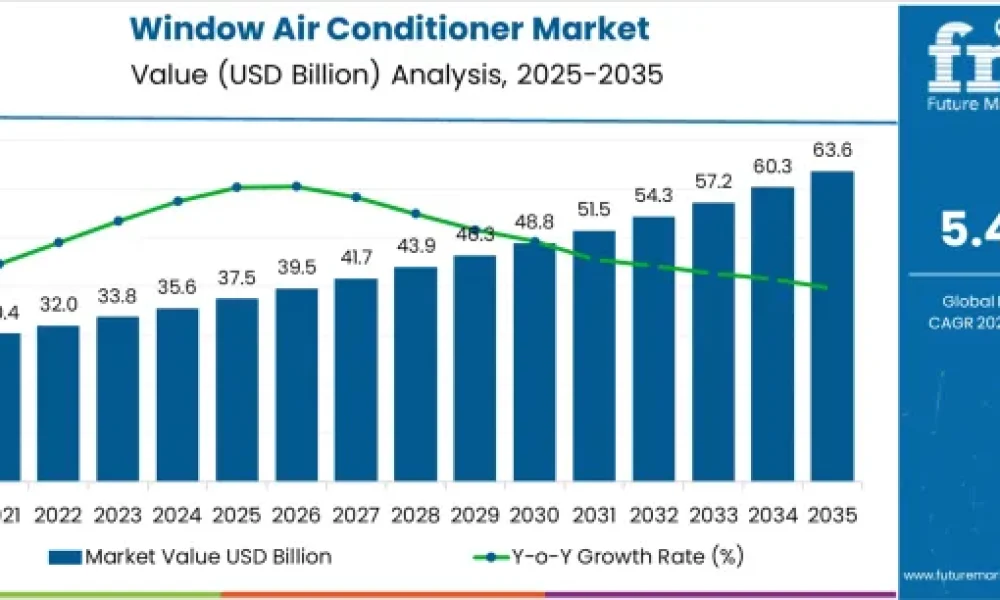
The global Window Air Conditioner (AC) market is poised for robust growth, with the market size estimated at USD 37.5 billion in 2025 and expected to reach USD 63.6 billion by 2035, reflecting a steady compound annual growth rate (CAGR) of 5.4% over the forecast period. This positive outlook is driven by a combination of rising urbanization, increasing disposable incomes, and growing consumer demand for energy-efficient and affordable cooling solutions.
Subscribe for Year-Round Insights → Stay ahead with quarterly and annual data updates: https://www.futuremarketinsights.com/reports/sample/rep-gb-983
Market Overview
Window air conditioners remain a popular choice for cooling small to medium-sized residential and commercial spaces due to their cost-effectiveness, compact size, and ease of installation. The market is currently witnessing heightened demand for units that incorporate advanced technology such as smart controls, improved compressors, and eco-friendly refrigerants, which align with global sustainability and energy conservation goals.
Key Market Drivers
- Urbanization and Rising Disposable Income: The expanding urban population in emerging economies is increasing the demand for affordable cooling solutions suitable for apartments and compact homes.
- Energy Efficiency and Regulatory Push: Stricter energy regulations and consumer preference for lower electricity bills are driving manufacturers to innovate with energy-saving features and eco-friendly refrigerants.
- Technological Advancements: Smart window ACs with remote control, programmable settings, and smart home integration are increasingly popular among tech-savvy consumers.
- Expansion in Residential and Commercial Sectors: Continuous growth in residential construction and the rising need for cost-effective cooling in commercial offices and retail spaces are boosting demand.
Market Segmentation Insights
The Window Air Conditioner Market is segmented based on BTU range, technology, application, and distribution channels, providing a clear picture of growth dynamics.
- BTU Range: The 8,000 to 12,000 BTU segment holds the largest share at 39.4% due to its optimal cooling capacity for average-sized rooms, balancing performance and energy consumption.
- Technology: Automatic window ACs lead with 46.7% market share, thanks to features like automatic temperature control, smart sensors, and energy optimization.
- Application: Residential users dominate the market, accounting for 58.2%, as window ACs meet the cooling needs of urban households where space and affordability are key.
- Distribution Channel: Direct sales represent 38.9% of the market share, with consumers increasingly buying directly from manufacturers to access better prices and customized models.
Regional Outlook
- North America, Asia-Pacific, and Europe are the top growth regions.
- Countries like China (9.7% CAGR) and India (10.5% CAGR) are leading market expansion due to rapid urbanization and rising consumer spending.
- The United States is expected to grow at a moderate CAGR of 3.1%, driven primarily by the industrial and commercial sectors.
Competitive Landscape
The market features strong competition among well-established global players including:
- Daikin Industries, Ltd.
- Mitsubishi Electric Corporation
- Panasonic Corporation
- LG Electronics Inc.
- Samsung Electronics Co., Ltd.
- Gree Electric Appliances, Inc. of Zhuhai
- Whirlpool Corporation
- Haier Group Corporation
- Carrier Global Corporation
- Midea Group Co., Ltd.
These companies focus on innovation, product differentiation, and expanding distribution networks to capture greater market share.
Emerging Trends Shaping the Market
- Smart Window Air Conditioners: The surge in demand for smart window ACs offering remote control via mobile apps, programmable cooling schedules, and compatibility with smart home ecosystems such as Google Assistant and Amazon Alexa.
- Eco-Friendly Cooling Solutions: Growing environmental awareness encourages manufacturers to adopt refrigerants with low global warming potential like hydrofluoroolefins (HFOs) and natural refrigerants such as propane (R290) and isobutane (R600a). Energy-efficient inverter technologies also help reduce power consumption.
- Focus on Indoor Air Quality (IAQ): Consumers increasingly seek window AC units with advanced air purification and humidity control features, including HEPA filters that remove allergens, dust, and mold—especially important for health-conscious households and commercial environments.
Challenges and Opportunities
- Competition from Alternative Cooling Solutions: Portable ACs, split systems, and ductless systems may limit window AC growth.
- Regulatory and Economic Factors: Compliance with strict energy efficiency standards and fluctuating consumer spending due to economic uncertainties pose challenges.
- Untapped Markets: Expanding electricity access and growing middle-class populations in emerging markets offer lucrative opportunities for market players to boost penetration.
Market Outlook Summary
The window air conditioner market’s historical CAGR of 4.3% (2020-2025) and projected CAGR of 5.4% (2025-2035) illustrate a healthy growth trajectory. The product’s affordability, convenience, and continuous innovation in technology and design ensure it remains a preferred cooling solution for both residential and commercial applications worldwide.
Have a specific Requirements and Need Assistant on Report Pricing or Limited Budget please contact us – [email protected]
About Future Market Insights (FMI)
Future Market Insights, Inc. (FMI) is an ESOMAR-certified, ISO 9001:2015 market research and consulting organization, trusted by Fortune 500 clients and global enterprises. With operations in the U.S., UK, India, and Dubai, FMI provides data-backed insights and strategic intelligence across 30+ industries and 1200 markets worldwide.



