
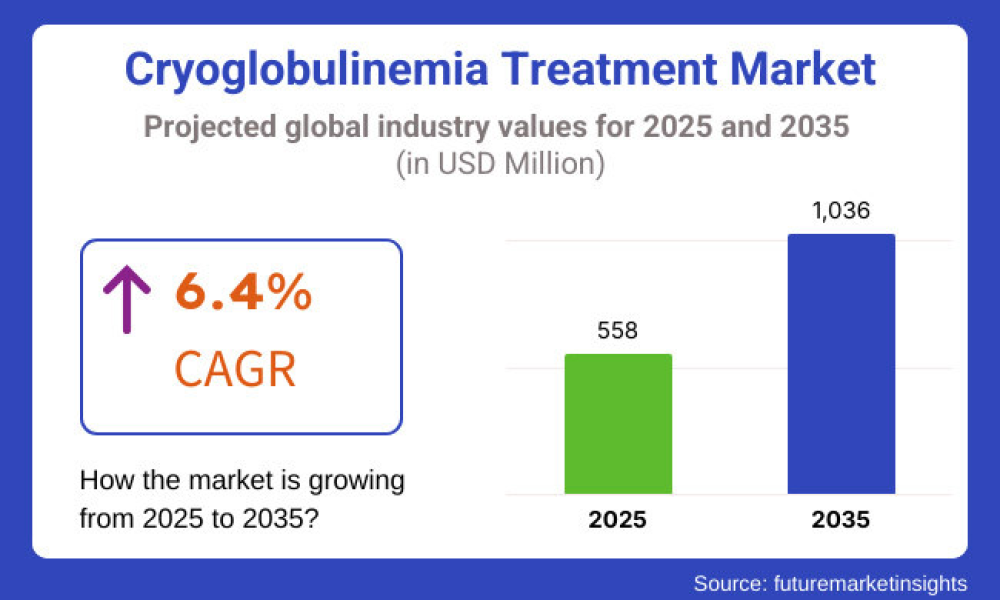
The Cryoglobulinemia Treatment Market in the U.S. is set for robust expansion between 2025 and 2035, driven by the increasing prevalence of cryoglobulinemia and the development of advanced targeted therapies. Valued at approximately USD 558 million in 2025, the market is expected to reach USD 1,036 million by 2035, reflecting a compound annual growth rate (CAGR) of 6.4%.
There are numerous factors fueling this growth. Chief among them is the rising incidence of cryoglobulinemia linked to hepatitis C, autoimmune disorders, and hematologic diseases. Specialists increasingly favor biologic therapies, such as rituximab and other monoclonal antibodies, which are improving treatment outcomes.
Explore trends before investing – request a sample report today!
https://www.futuremarketinsights.com/reports/sample/rep-gb-16640
Treatment Modalities Shaping Market Dynamics
The cryoglobulinemia treatment landscape comprises immunosuppressive drugs, antiviral therapy, biologic therapy, and plasmapheresis. Rituximab has become the preferred monoclonal antibody for severe cases due to its B-cell selectivity, while corticosteroids and cyclophosphamide continue to play a role in systemic vasculitis management. Antiviral drugs, especially direct-acting antivirals (DAAs) like sofosbuvir-ledipasvir, have revolutionized HCV-associated cryoglobulinemia. In life-threatening scenarios, plasmapheresis rapidly reduces circulating cryoglobulins, complementing drug therapy.
Regional Trends Driving Market Strategies
North America
The North American market dominates due to advanced healthcare infrastructure, higher awareness, and increasing biologic adoption. The U.S. maintains a high market share with an active pipeline of clinical trials exploring next-generation biologics and immunotherapies. Rising hepatitis C and autoimmune disease incidence further fuel market growth, although high biologic costs remain a barrier, prompting insurers and hospitals to develop reimbursement and patient support programs.
Europe
Germany, France, and the U.K. lead Europe’s cryoglobulinemia market. Growth is supported by strong healthcare systems, increasing research in autoimmune disease treatments, and rising adoption of antiviral therapies, particularly in regions with higher HCV prevalence such as Spain and Italy. Regulatory support for new biologics and targeted immunotherapies positions Europe for future expansion.
Asia-Pacific
Asia-Pacific is projected to experience the highest growth due to improved healthcare access, rising autoimmune disorder prevalence, and government-backed medical treatments. Japan leads in biologic adoption, while China and India are advancing immunology innovation and R&D investment. Cost and regulatory barriers remain challenges, but ongoing innovation ensures market momentum.
Subscribe for Year-Round Insights → Stay ahead with quarterly and annual data updates –
https://www.futuremarketinsights.com/reports/brochure/rep-gb-16640
Challenges and Opportunities
Challenge: High Cost of Treatment
The high expense of biologic therapies limits patient access globally. Reimbursement hurdles and out-of-pocket costs force pressure on drugmakers to develop cost-effective biosimilars that replicate efficacy while reducing financial burden.
Opportunity: Precision Medicine
Advances in precision medicine, which tailor treatment to patients’ genetic and molecular profiles, promise to enhance outcomes while reducing toxicity. Gene therapy and regenerative medicine are poised to transform cryoglobulinemia management, offering not just improved symptom control but potential cures.
Market Evolution: 2020–2024 vs. 2025–2035
Between 2020 and 2024, DAAs transformed HCV-related cryoglobulinemia treatment, and biologics remained dominant for non-viral etiologies. From 2025 onward, the market is expected to shift toward precision medicine, biosimilars, targeted immunotherapies, and gene therapies, driving overall market growth and expanding treatment accessibility.
Country-Specific Outlook
- USA: Biologics dominate with a 60% share, aided by AI-driven diagnostics, precision medicine, and government orphan drug support. CAGR 6.5%.
- UK: NHS-backed initiatives enable biosimilar adoption and targeted therapies. CAGR 6.2%.
- EU: Regulatory incentives, advanced biopharmaceutical sectors, and EMA orphan drug guidelines accelerate adoption of innovative therapies. CAGR 6.7%.
- Japan: Advanced diagnostics, AI integration, and regenerative medicine investments drive market expansion. CAGR 6.3%.
- South Korea: Investment in biologics, biosimilars, and AI-aided drug discovery supports growth. CAGR 6.6%.
Segment Analysis: Treatment and End-User Insights
- Disease Type: Mixed cryoglobulinemia (Type II & III) dominates due to prevalence and complex treatment needs.
- Treatment Type: Antiviral drugs remain the first choice, particularly for HCV-linked cases, supported by biologics for refractory or autoimmune-related conditions.
- End Users: Hospitals are primary end-users due to the requirement for specialized diagnostics, multidisciplinary management, and inpatient therapies like plasmapheresis.
Competitive Landscape
The market is highly competitive, led by multinational pharma companies and innovative biotech firms. Key players include:
- Roche Holding AG (15–20%) – Rituximab leader with focus on individualized biologic therapy.
- Bristol-Myers Squibb (12–16%) – Immunosuppressive therapies and novel combination regimens.
- Pfizer Inc. (10–14%) – Anti-inflammatory and immunosuppressive drugs with emerging biologics pipeline.
- GlaxoSmithKline plc (7–11%) – Antiviral and immunotherapy specialists.
- Biogen Inc. (5–9%) – Precision medicine and monoclonal antibody innovation.
Other firms collectively hold 40–50% of the market, contributing to ongoing R&D and expansion of treatment options.
Driving Growth with Data and Innovation
The U.S. cryoglobulinemia treatment market is entering a transformative phase, powered by biologic adoption, precision medicine, and supportive regulatory frameworks. With hospitals, specialty clinics, and research centers driving patient care and innovation, the market is poised for sustained growth through 2035.
Why Choose FMI Empowering Decisions that Drive Real-World Outcomes:
https://www.futuremarketinsights.com/why-fmi
About Future Market Insights (FMI)
Future Market Insights, Inc. (ESOMAR certified, recipient of the Stevie Award, and a member of the Greater New York Chamber of Commerce) offers profound insights into the driving factors that are boosting demand in the market. FMI stands as the leading global provider of market intelligence, advisory services, consulting, and events for the Packaging, Food and Beverage, Consumer Technology, Healthcare, Industrial, and Chemicals markets. With a vast team of over 400 analysts worldwide, FMI provides global, regional, and local expertise on diverse domains and industry trends across more than 110 countries.
Contact Us:
Future Market Insights Inc.
Christiana Corporate, 200 Continental Drive,
Suite 401, Newark, Delaware – 19713, USA
T: +1-347-918-3531
For Sales Enquiries: [email protected]
Website: https://www.futuremarketinsights.com



