
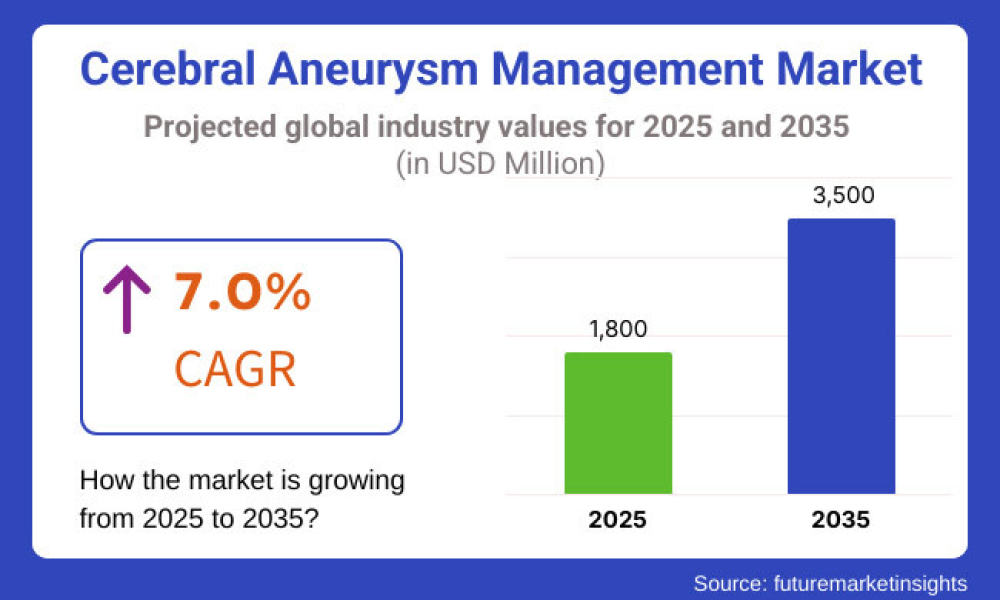
The U.S. Cerebral Aneurysm Management Market is entering a transformative decade, with demand accelerating due to rising aneurysm prevalence, improved diagnostic accuracy, and fast-advancing neurovascular treatment technologies. The market is projected to reach USD 1,800 million in 2025 and surge to USD 3,500 million by 2035, reflecting a strong CAGR of 7.0%. Driven by early detection through enhanced CT angiography and MRI systems, along with growing awareness among aging and high-risk populations, the U.S. continues to stand as a pivotal growth engine in global neurovascular care.
Explore trends before investing – request a sample report today!
https://www.futuremarketinsights.com/reports/sample/rep-gb-16634
Growing Emphasis on Early Diagnosis and Minimally Invasive Procedures
The shift toward minimally invasive interventions such as flow diverters, stent-assisted coiling, and endovascular embolization is reshaping clinical practice nationwide. With hypertension, smoking, and genetic predisposition contributing to higher aneurysm incidence, U.S. clinicians are increasingly opting for precision-based, image-guided procedures that reduce surgical risk and hospital stay durations. These advancements, supported by improved reimbursement pathways, continue to speed up market penetration across neurology centers and interventional radiology units.
Therapeutic Class and Administration Routes Reinvent Clinical Strategies
Antihypertensives remain the leading treatment class due to their crucial role in reducing aneurysm rupture risk. Oral therapies—particularly beta-blockers and calcium channel blockers—hold the largest share thanks to their accessibility, preventive benefits, and long-term patient adherence. Injectable therapies, widely used in endovascular care, are gaining traction in advanced neurosurgical centers due to their suitability for minimally invasive, real-time controlled procedures. Transdermal drug delivery, while emerging, is positioned for future growth as AI-integrated wearable patches and neuroprotective formulations enter the pipeline.
Regional Drivers Strengthening Market Growth Across the U.S.
Advanced neuroimaging installations, streamlined neurosurgical training programs, and expanding insurance coverage for aneurysm interventions position the U.S. at the forefront of clinical adoption. A rising aging population and increasing health system investments in AI-powered aneurysm screening programs further strengthen national market outlook. Major hospitals across the country are adding robotic neurosurgery suites and smart navigation systems, accelerating demand for high-precision implantable devices and next-generation embolization tools.
Shaping the Future: Technology, AI, and Patient-Centric Models
From 2025 to 2035, intelligent implants, real-time neurovascular monitoring systems, and AI-enhanced rupture-risk modeling will reshape the therapeutic landscape. The expansion of telehealth platforms for hypertension management and long-term aneurysm monitoring will reinforce preventive care strategies. Growth is also supported by pharmaceutical-device collaborations developing next-generation antihypertensive formulations, neuroprotective drugs, and bioresorbable embolic implants.
Subscribe for Year-Round Insights → Stay ahead with quarterly and annual data updates –
https://www.futuremarketinsights.com/reports/brochure/rep-gb-16634
Competitive Landscape: Innovation and R&D Accelerate Market Leadership
The competitive environment is defined by strong investment in neurovascular R&D, product pipeline expansions, and major collaborations. Leading companies—including Biogen, Pfizer, Roche, Merck, Novartis, Sanofi, Stryker, Medtronic, MicroVention, Penumbra, and Johnson & Johnson—are advancing device innovation, optimizing drug formulations, and expanding clinical trial programs focused on aneurysm stabilization and rupture prevention. Emerging players are rapidly entering the market with AI-powered diagnostic solutions, nanotech-based embolization materials, and robotic-assisted surgical systems.
Market Segmentation Drives Customized Clinical Approaches
Growth across hospital pharmacies, retail pharmacies, and expanding online platforms reflects increasing patient access to preventive and long-term oral therapies. Hospitals remain the primary end-user segment due to advanced surgical capabilities, while hybrid neurovascular centers are becoming critical hubs for personalized aneurysm management.
End-Stage Outlook and Strategic Opportunity
As the U.S. market advances toward a data-driven, precision-medicine era, the next decade will see enhanced adoption of bioengineered vascular implants, decentralized care models, and blockchain-based outcome tracking. Despite challenges such as treatment cost and specialist shortages, technological breakthroughs and robust healthcare investments create substantial opportunities for device manufacturers, pharmaceutical companies, and healthcare providers.
Why Choose FMI Empowering Decisions that Drive Real-World Outcomes:- https://www.futuremarketinsights.com/why-fmi
About Future Market Insights (FMI)
Future Market Insights, Inc. (ESOMAR certified, recipient of the Stevie Award, and a member of the Greater New York Chamber of Commerce) offers profound insights into the driving factors that are boosting demand in the market. FMI stands as the leading global provider of market intelligence, advisory services, consulting, and events for the Packaging, Food and Beverage, Consumer Technology, Healthcare, Industrial, and Chemicals markets. With a vast team of over 400 analysts worldwide, FMI provides global, regional, and local expertise on diverse domains and industry trends across more than 110 countries.
Contact Us:
Future Market Insights Inc.
Christiana Corporate, 200 Continental Drive,
Suite 401, Newark, Delaware – 19713, USA
T: +1-347-918-3531
For Sales Enquiries: [email protected]
Website: https://www.futuremarketinsights.com



