
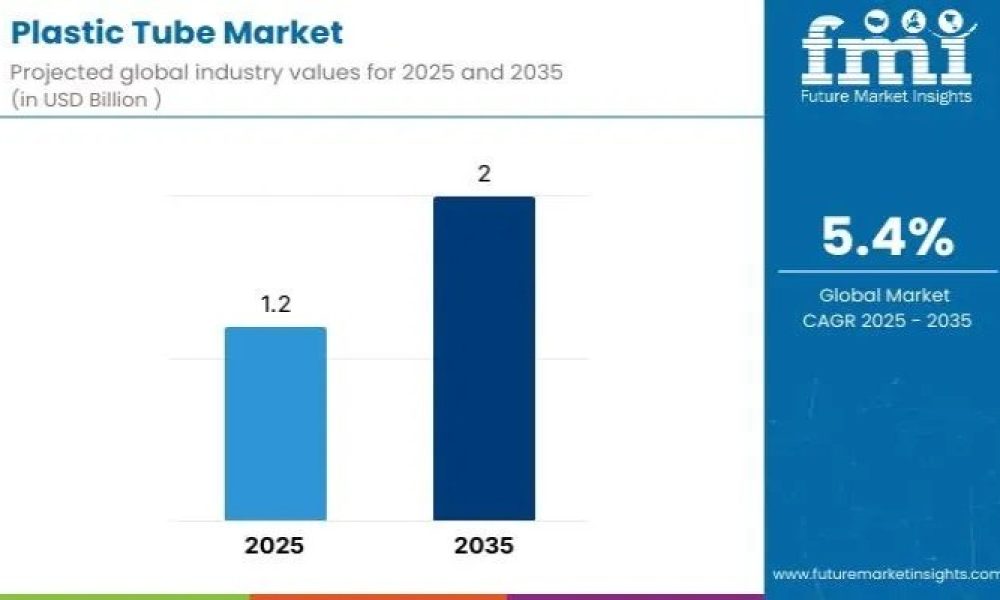
The global plastic tube market is entering a decade of steady expansion, driven by rising demand in personal care, cosmetics, and pharmaceutical applications. As consumers increasingly gravitate toward lightweight, durable, and cost-efficient packaging formats, plastic tubes continue to outperform several traditional alternatives. With global industry value projected to grow from USD 1.2 billion in 2025 to USD 2.0 billion by 2035, the market is forecast to register a healthy CAGR of 5.4%, reflecting strong and sustained adoption across regions.
Market Overview and Key Drivers
The plastic tube industry is undergoing a transformation fueled by material innovation, sustainability commitments, and advances in extrusion and printing technologies. Manufacturers are shifting toward recyclable and bio-based polymers, aligning with stringent regulatory requirements and evolving consumer expectations around environmental impact.
The growing popularity of e-commerce packaging, demand for convenient dispensing solutions, and increasing penetration of premium personal care products are further accelerating market growth. The ability of plastic tubes to blend functional performance with high branding potential has solidified their relevance in both mass-market and premium categories.
Subscribe for Year-Round Insights → Stay ahead with quarterly and annual data updates – https://www.futuremarketinsights.com/reports/sample/rep-gb-4757
Quick Stats – Global Plastic Tube Market
- Market Value 2025: USD 1.2 billion
- Market Forecast 2035: USD 2.0 billion
- CAGR (2025–2035): 5.4%
- Leading Material in 2025: Polyethylene (36.4%)
- High-Growth Regions: North America, Asia-Pacific, Europe
- Key Players: EPL Limited, Albea S.A., Berry Global Inc., CCL Industries Inc., Huhtamäki Oyj, Hoffmann Neopac AG, ALPLA Group, Plastube Inc., and others
Material Insights: Polyethylene Retains Dominance
With 36.4% market share in 2025, polyethylene remains the most preferred material due to its flexibility, chemical resistance, cost efficiency, and compatibility with a wide range of product formulations. Continued advancements in HDPE and LDPE grades are improving performance while supporting recyclability initiatives.
As brands intensify focus on circular economy models, polyethylene-based tubes—especially mono-material PE formats—are expected to maintain leadership through 2035.
Capacity Insights: 50 to 100 ml Leads Demand
The 50–100 ml capacity segment, accounting for 29.7% of global demand, is driven by its popularity in travel-sized packaging, skincare, toothpaste, and OTC pharmaceuticals. This size format aligns with rising mobility, convenience-driven purchasing behavior, and regulatory limits for portable personal care products.
Closure Trends: Flip-Top Caps Continue to Lead
Flip-top caps hold a 31.5% share, supported by their hygiene benefits, ease of use, and reliable dispensing control. Their versatility across cosmetic, healthcare, and food applications ensures ongoing dominance. Innovations in lightweight closure design and eco-friendly materials continue to enhance their market appeal.
Regional and Country-Level Outlook
India: A Manufacturing Powerhouse with 7.1% CAGR
India is emerging as one of the fastest-growing plastic tube markets globally. Growth is fueled by expansion in personal care, pharmaceutical manufacturing, rising middle-class consumption, and government support through Make in India. Local production capacity, cost advantages, and strong FMCG penetration position India as a lucrative hub for global brands.
Canada: Sustainability and eCommerce Fuel Growth at 6% CAGR
Canada’s market is driven by rising consumption in pharmaceutical and food sectors, backed by a shift toward eco-friendly packaging. Strong adoption of recyclable tubes and emphasis on advanced dispensing solutions support industry development. E-commerce growth has further increased demand for durable and leak-proof tube formats.
Poland: Growing Cosmetics Industry Drives 5.7% CAGR
Poland’s robust cosmetics and toiletries sector is boosting the adoption of plastic tubes due to consumer preference for hygienic, easy-to-use packaging. Rising regulatory focus on sustainability is encouraging rapid adoption of recyclable tube materials in the region.
Category-Wise Insights
- 100–150 ml tubes expected to hold 50%+ market share through 2035
- Cosmetics industry projected to dominate with 54% share by 2035
- Polyethylene tubes expected to reach 53.8% share by 2025, expanding at 5.5% CAGR
The cosmetic segment alone is expected to generate an opportunity of USD 432 million through the projection period, supported by rising beauty consciousness, personalization trends, and the surge in online beauty retail.
Industry Challenges
Although growth outlook remains strong, availability of alternative packaging formats—such as sachets, pouches, aluminum collapsible tubes, and airless pump systems—poses challenges. High-barrier aluminum tubes continue to compete strongly in pharmaceutical and cosmetic applications.
Competitive Landscape
Key players—including EPL Limited, Berry Global, Huhtamäki Oyj, Hoffmann Neopac, and ALPLA Group—are focusing on:
- Sustainable materials and recyclable mono-material tubes
- Lightweight closures and downgauging to reduce carbon footprint
- Digital printing and premium aesthetics
- Strategic partnerships for circular packaging solutions
Recent Developments
- Huhtamaki (April 2025): Patent for advanced plastic barrier laminate with improved crystallization and pigmentation efficiency.
- Berry Global (Oct 2025): Launched lightweight tube closure solution reducing greenhouse gas emissions.
- Hoffmann Neopac (May 2025): Introduced Eco-stripped tube using 30% less plastic to minimize environmental impact.
Have a specific Requirements and Need Assistant on Report Pricing or Limited Budget please contact us – [email protected]
About Future Market Insights (FMI)
Future Market Insights, Inc. (FMI) is an ESOMAR-certified, ISO 9001:2015 market research and consulting organization, trusted by Fortune 500 clients and global enterprises. With operations in the U.S., UK, India, and Dubai, FMI provides data-backed insights and strategic intelligence across 30+ industries and 1200 markets worldwide.



