
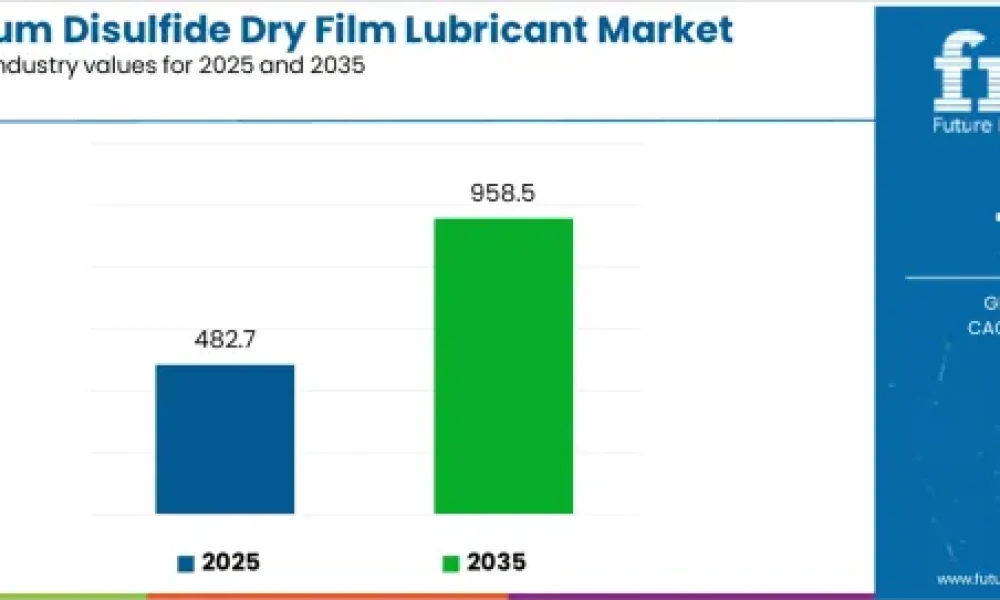
Future Market Insights (FMI) projects a substantial growth trajectory for the global molybdenum disulfide (MoS₂) dry film lubricant market, which is expected to expand from USD 482.7 million in 2025 to USD 958.5 million by 2035, nearly doubling at a robust CAGR of 7.10% over the decade.
The market’s strong expansion is driven by accelerating demand for high-performance lubrication systems, the shift toward advanced dry-film coating technologies, and growing industrial dependence on extreme-temperature, friction-reducing lubrication solutions across aerospace, automotive, electrical, and precision machinery sectors.
Market to Grow 2X Between 2025–2035, Adds USD 475.8 Million in New Value
According to FMI, the global market will add nearly USD 475.8 million in incremental opportunity between 2025 and 2035, reflecting 98.6% absolute growth.
Two critical growth periods shape this decade:
2025–2030: USD 207.5 Million Growth (43.6% of Total Increase)
This period is influenced by:
- Expanding aerospace manufacturing requiring high-reliability friction-control coatings
- Rising demand for extreme-temperature lubrication
- Greater access to precision coating technologies in industrial and automotive settings
2030–2035: USD 268.3 Million Growth (56.4% of Total Increase)
Performance drivers include:
- Nanotechnology integration enhancing precision coating behavior
- Improved adhesion capabilities for harsh industrial conditions
- Adoption of advanced temperature-resistant formulations
- Growing emphasis on equipment longevity and maintenance cost reduction
Subscribe for Year-Round Insights → Stay ahead with quarterly and annual data updates: https://www.futuremarketinsights.com/reports/sample/rep-gb-27468
Key 2025 Market Highlights (FMI)
- Market value: USD 482.7 million
- Forecast value (2035): USD 958.5 million
- CAGR: 7.10%
- Top product type: Conventional Type (52.8%)
- Top application: Aerospace Industry (34.7%)
- Key growth regions: APAC, Europe, North America
Why Global Demand is Rising
FMI identifies several structural growth forces:
- Shift Toward Extreme-Environment Lubrication
Industries now prioritize lubricants that support operational reliability in:
- High-temperature zones
- Vacuum and aerospace conditions
- Heavy-load industrial machinery
- Demand for Modern, Cost-Effective Maintenance Practices
MoS₂ dry films provide:
- Long service life
- Reduced downtime
- Consistent friction control
- Lower maintenance expenses
- Acceleration in Precision Manufacturing
Automated and high-accuracy operations require:
- Ultra-thin film coatings
- Stable lubrication layers
- Enhanced wear resistance
- Nanotechnology and Particle Engineering
Manufacturers are adopting:
- Nano-scale formulations
- Advanced surface bonding agents
- Temperature-resistant dry-film chemistries
These technical enhancements expand the product’s deployment range across automotive components, aerospace mechanisms, electrical systems, and industrial machinery.
Segmental Insights
By Type: Conventional Type Leads with 52.8% Market Share
The segment benefits from:
- Cost-effectiveness
- Broad compatibility
- Proven performance reliability
Conventional formulations remain the backbone of maintenance strategies across global manufacturing.
By Application: Aerospace Dominates with 34.7% Share
This dominance is driven by:
- Strict operational performance requirements
- High reliability expectations
- Complex operating environments
Aerospace-grade dry-film lubricants remain indispensable for high-precision systems.
By Particle Size
- Nano-scale
- Micro-scale
- Standard particles
Nano-scale products are gaining traction due to superior adhesion and durability.
By Coating Method
- Spray application
- Brush application
- Dip coating
- Electrostatic application
Spray-based processes continue to lead due to scalability and precision.
Need tailored insights? Request report customization to match your specific business objectives: https://www.futuremarketinsights.com/customization-available/rep-gb-27468
Regional Market Outlook
APAC: Fastest-Growing Region
- China CAGR: 9.6%
- India CAGR: 8.9%
Growth is powered by manufacturing expansion, aerospace development, and increased adoption of advanced lubrication technologies.
Europe: Strong Momentum Through Technical Excellence
- Regional value to grow from USD 158.9 million (2025) to USD 315.4 million (2035)
- Leading countries: Germany, UK, France, Italy
Europe’s deep industrial heritage and precision engineering culture drive premium lubricant adoption.
United States: Technology-Integrated Growth
- CAGR: 6.7%
The U.S. market benefits from advanced aerospace engineering, automation, and performance-driven lubrication strategies.
Saudi Arabia: Rising Industrial and Energy Applications
Saudi Arabia’s industrial diversification, emerging aerospace activity, and oil & gas maintenance modernization contribute to rising MoS₂ dry-film demand across specialized equipment applications.
Industry Ecosystem: Roles and Opportunities
Governments
- Incentivize advanced manufacturing and R&D
- Improve trade frameworks for high-performance chemical products
- Support centers of excellence for lubrication technology
Industry Bodies
- Expand global collaboration networks
- Promote exports of premium MoS₂ coatings
- Upskill manufacturers and technicians
Manufacturers
- Invest in precision particle engineering
- Strengthen product quality and reliability
- Build long-term supply partnerships
Distributors
- Promote value-added lubrication solutions
- Integrate performance-oriented product portfolios
FMI notes that industry alignment across these stakeholders will shape the next decade of high-performance dry-film lubrication.
About Future Market Insights (FMI)
Future Market Insights, Inc. (FMI) is an ESOMAR-certified, ISO 9001:2015 market research and consulting organization, trusted by Fortune 500 clients and global enterprises. With operations in the U.S., UK, India, and Dubai, FMI provides data-backed insights and strategic intelligence across 30+ industries and 1200 markets worldwide.
Why Choose FMI: Empowering Decisions that Drive Real-World Outcomes: https://www.futuremarketinsights.com/why-fmi



