
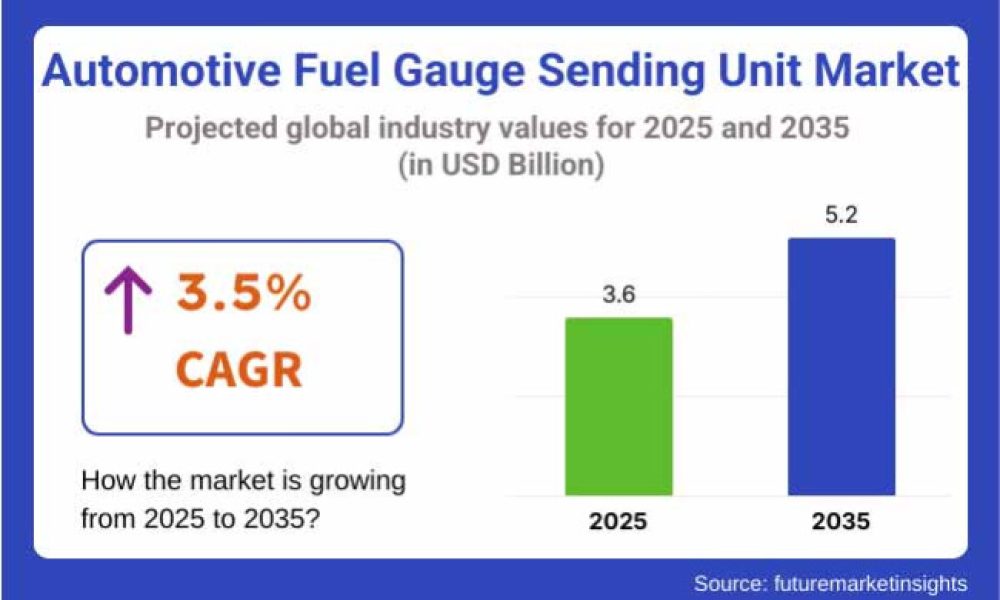
The global Automotive Fuel Gauge Sending Unit Market is entering a period of sustained expansion from 2025 to 2035, supported by intensifying fuel-efficiency regulations, rapid electrification, and significant advancements in automotive sensor technology. According to recent industry assessments, the market is expected to grow from USD 3.6 billion in 2025 to approximately USD 5.2 billion by 2035, registering a CAGR of 3.5%.
As automakers pivot toward hybrid and electric powertrain architectures, fuel gauge sending units—once considered conventional mechanical components—are now undergoing a technological transformation. These systems are becoming smarter, more accurate, and highly integrated with advanced electronic control units, especially within hybrid powertrains and next-generation battery management systems.
Rising Integration with Hybrid & Electric Vehicles Fuels Market Momentum
Manufacturers worldwide are redesigning fuel gauge systems to support vehicles that use multiple energy sources. Hybrid vehicles require sensors capable of measuring fuel and battery reserve simultaneously, while EVs increasingly incorporate modified gauge units to manage remaining charge, energy flow, and range estimation.
A 2024 stakeholder survey of 450 industry participants found:
- 78% identified EV and hybrid integration as a critical priority for future product development.
- 72% emphasized the need for high-precision and high-reliability fuel measurement systems.
- Companies in Western Europe (84%) prioritized sustainability-driven materials and energy-efficient sensor architecture.
Subscribe for Year-Round Insights → Stay ahead with quarterly and annual data updates
https://www.futuremarketinsights.com/reports/sample/rep-gb-17658
Technology Advancements Reinforce Market Competitiveness
The market is experiencing a strategic shift from legacy resistive units to advanced sensor-based architectures:
- Resistive Units: Maintain dominance in conventional vehicles due to cost-effectiveness.
- Capacitive Units: Expect strong adoption in premium and hybrid segments for improved accuracy.
- Ultrasonic Units: Gain traction due to contactless operation and near-zero mechanical wear.
- Hall Effect & Optical Sensors: Positioning for high-end applications requiring exceptional accuracy.
Across key global markets, 69% of U.S. manufacturers and 53% in Western Europe already integrate advanced sensor systems, while South Korea and Japan focus on compact, cost-effective, and EV-compatible designs.
Vehicle Segment Insights: Passenger Cars Lead Global Demand
Passenger vehicles will remain the largest segment through 2035 as automakers deploy advanced fuel and battery monitoring systems across both internal combustion and electrified models. Light commercial vehicle fleets—driven by logistics expansion and heightened fuel cost scrutiny—continue to adopt smart fuel monitoring solutions. Heavy commercial vehicles, especially in Asia-Pacific and the U.S., remain consistent adopters of rugged, high-durability sensing units.
Regional Outlook: China, USA, South Korea at the Forefront
China – Fastest-Growing Market (CAGR: 5.0%)
China’s strong EV push, regulatory mandates, and emphasis on battery monitoring are accelerating demand for advanced fuel gauge systems. Growing investments in domestic sensor R&D strengthen China’s leadership.
United States – High Uptake of IoT-Enabled Fuel Monitoring (CAGR: 4.5%)
The U.S. market is shaped by stringent CAFE fuel economy standards, connected vehicle adoption, and strong hybrid vehicle sales.
65% of American manufacturers have already integrated IoT-based fuel and energy tracking for real-time analytics.
South Korea – Rapid Electrification Drives Innovation (CAGR: 4.3%)
With Hyundai–Kia driving EV production, demand for next-gen, compact, EV-compatible sensors continues to rise.
Germany – Precision and Engineering Excellence (CAGR: 4.2%)
German OEMs emphasize sensor accuracy and seamless integration with battery and hybrid energy management systems.
Market Dynamics: Pricing, Materials, and Supply Chain Pressures
The industry faces rising material costs, with steel up 30% and aluminum up 18%, increasing production challenges for cost-sensitive segments. While 82% of global stakeholders identified raw-material inflation as a major challenge, premium markets in the U.S. and Europe remain willing to pay a 15–20% premium for high-accuracy IoT-enabled systems.
Material preferences vary significantly:
- Steel remains dominant (60%) for durability.
- Western Europe increasingly adopts lightweight steel-aluminum hybrids (48%) to support EV weight reduction targets.
- Japan and South Korea prefer hybrid materials to reinforce corrosion resistance and cost balance.
Competitive Landscape: Honeywell, Bosch, and Marelli Lead Global Market Share
The global market remains moderately consolidated, led by:
- Honeywell International – 27%
- Bosch Mobility Solutions – 22%
- Magneti Marelli – 17%
- Denso Corporation – 13%
- Continental AG – 10%
Notable developments (2024):
- Honeywell acquired an EV-focused fuel monitoring technology firm, strengthening IoT capabilities.
- Bosch partnered with leading EV manufacturers across the U.S. and Europe to co-develop advanced hybrid-compatible fuel gauge systems.
- Denso expanded its sensor portfolio via a strategic acquisition in Asia.
Personalize Your Experience: Ask for Customization to Meet Your Requirements!
https://www.futuremarketinsights.com/customization-available/rep-gb-17658
Strategic Imperatives for 2025–2035
Industry leaders are prioritizing:
- Acceleration of Next-Gen Sensor R&D
Investment in capacitive, optical, Hall Effect, and ultrasonic technologies to deliver accuracy and long lifespan.
- Alignment with EV & Hybrid Powertrains
Co-development programs with EV OEMs to ensure synchronized integration with battery energy management.
- Mergers, Acquisitions & OEM Partnerships
Consolidation and partnerships to secure material supply, expand R&D capabilities, and penetrate EV-dominant markets.
A one-year industry watchlist highlights:
- Feasibility studies for next-gen sensor technologies
- New OEM partnerships focused on hybrid and EV architectures
- Target identification for M&A in advanced sensor component domains
Conclusion
The global automotive fuel gauge sending unit market is transitioning from mechanical simplicity to data-rich, sensor-driven intelligence. As electrification accelerates and regulatory expectations evolve, companies investing in advanced fuel and energy monitoring technologies—while aligning with regional market demands—will be best positioned to capture long-term growth.
Have a specific Requirements and Need Assistant on Report Pricing or Limited Budget please contact us –[email protected]
About Future Market Insights (FMI)
Future Market Insights, Inc. (FMI) is an ESOMAR-certified, ISO 9001:2015 market research and consulting organization, trusted by Fortune 500 clients and global enterprises. With operations in the U.S., UK, India, and Dubai, FMI provides data-backed insights and strategic intelligence across 30+ industries and 1200 markets worldwide.



