
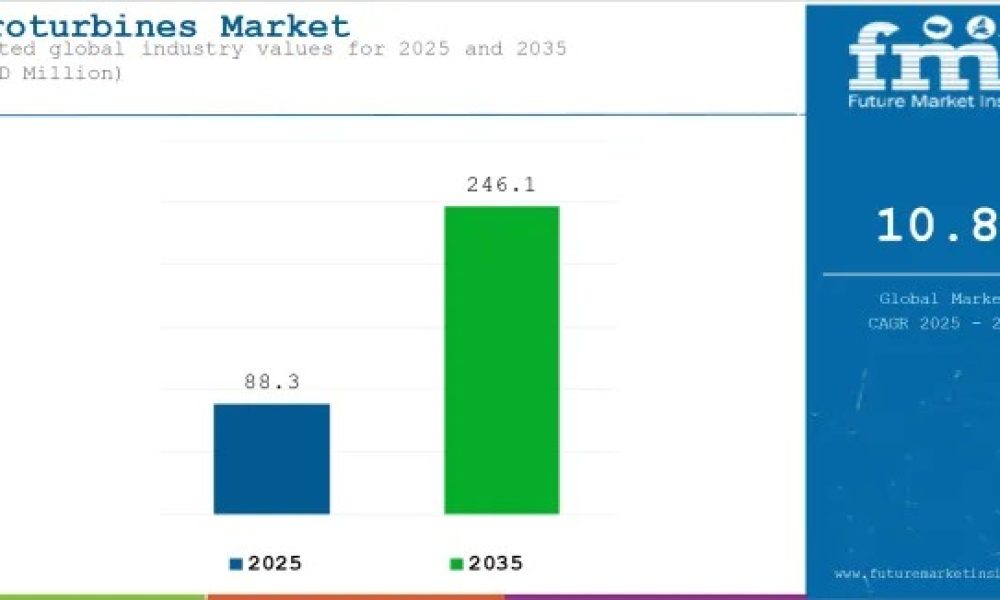
The global Microturbines Market is entering a high-growth decade, supported by rising demand for decentralized, low-emission, and fuel-flexible power generation solutions. According to recent market assessments, global microturbine sales are projected to increase from USD 88.3 million in 2025 to USD 246.1 million by 2035, expanding at a CAGR of 10.8%. This upward trend aligns with industries’ urgent need for reliable on-site power, combined heat and power (CHP) integration, and adoption of cleaner fuels including biogas and hydrogen.
Subscribe for Year-Round Insights → Stay ahead with quarterly and annual data updates:
https://www.futuremarketinsights.com/reports/sample/rep-gb-50
Microturbines, known for their compact size, high efficiency, and minimal emissions, have become an integral part of energy transition strategies across the USA, Europe, China, and India. Demand is particularly strong in sectors facing high energy costs, unstable grids, or carbon-reduction mandates. In 2024, global revenues stood at USD 79.7 million—marking a steady recovery from earlier disruptions caused by supply chain interruptions and project delays during 2020–2022.
Market Growth Drivers Strengthening Through 2035
One of the strongest catalysts for microturbine adoption is the accelerating shift toward distributed power generation. Industries and commercial facilities are increasingly using microturbines within CHP systems that simultaneously produce electricity and capture waste heat, improving thermal efficiency up to 85%. This dual-generation benefit significantly reduces energy costs for facilities such as hospitals, data centers, manufacturing plants, and chemical processing units.
Additionally, microturbines are gaining traction in remote and rural regions, particularly where grid reliability is poor. Their ability to operate on natural gas, biogas, and hydrogen blends provides flexibility for meeting sustainability targets while ensuring uninterrupted power.
Power Rating and End-User Dynamics
Among power ratings, the 50 kW–250 kW segment holds a commanding share due to its strong balance of affordability, energy output, and efficiency. It is projected to maintain a CAGR of 9.3% through 2035, led by commercial and mid-sized industrial applications. Microturbines in this range are preferred for CHP installations that demand stable performance without excessive maintenance or footprint requirements.
The industrial sector remains the largest end-user, accounting for over 36% share in 2035, driven by manufacturing, petrochemical, and heavy-engineering operations requiring resilient and cost-efficient power systems.
Regional Outlook: USA Leads, APAC Accelerates
The USA continues to dominate North America with a 71.3% market share through 2035, largely due to strong CHP integration in healthcare, commercial buildings, and large processing units. China and India are also emerging as high-opportunity markets, supported by rapid industrialization, grid reliability challenges, and policy incentives for clean energy systems.
Key projected CAGRs (2025–2035):
- USA: 8.7%
- China: 9.1%
- India: 9.7%
- Japan: 9.6%
- UK: 10%
Technology and Innovation Shaping the Future
Advancements in hydrogen-compatible microturbines are reshaping the competitive landscape. Companies such as Capstone Green Energy and Ansaldo Energia are introducing models capable of operating with hydrogen blends, aligning with global decarbonization goals. Capstone’s C65 and C200 systems supporting up to 30% hydrogen blends mark a significant step toward clean industrial power.
Meanwhile, manufacturers like Bladon Jets are expanding production capacity to meet rising demand for lightweight, high-efficiency microturbine systems, particularly across telecom and remote energy applications.
Historical Performance and the Growth Ahead
From 2020 to 2024, the microturbines market grew at a CAGR of 9.7%, overcoming challenges tied to capital costs, regulatory complexity, and pandemic-driven delays. Innovations in fuel flexibility, cost reduction, and hybrid configurations have set the foundation for stronger long-term expansion.
Looking ahead, hybrid systems that integrate microturbines with solar, wind, and battery storage are expected to redefine energy security for industries worldwide. This convergence will be vital for microgrids, off-grid communities, and distributed energy networks.
Get data that aligns with your strategic priorities — ask for report customization today:
https://www.futuremarketinsights.com/customization-available/rep-gb-50
Competitive Landscape
The market remains moderately concentrated, with Tier 1 companies holding 50–55% global share. Leading players include:
Microturbine LLC, NewEnCo, Ansaldo Energia S.p.A, FlexEnergy, Elliot Company Inc., Ingersoll-Rand, Brayton Energy LLC, Toyota Turbine Systems, and others.
Key growth strategies include hydrogen capability advancements, modular design improvements, multi-fuel compatibility, and regional expansion.
Have a specific Requirements and Need Assistant on Report Pricing or Limited Budget please contact us – [email protected]
About Future Market Insights (FMI)
Future Market Insights, Inc. (FMI) is an ESOMAR-certified, ISO 9001:2015 market research and consulting organization, trusted by Fortune 500 clients and global enterprises. With operations in the U.S., UK, India, and Dubai, FMI provides data-backed insights and strategic intelligence across 30+ industries and 1200 markets worldwide.
Contact Us:
Future Market Insights Inc.
Christiana Corporate, 200 Continental Drive,
Suite 401, Newark, Delaware – 19713, USA
T: +1-347-918-3531



