
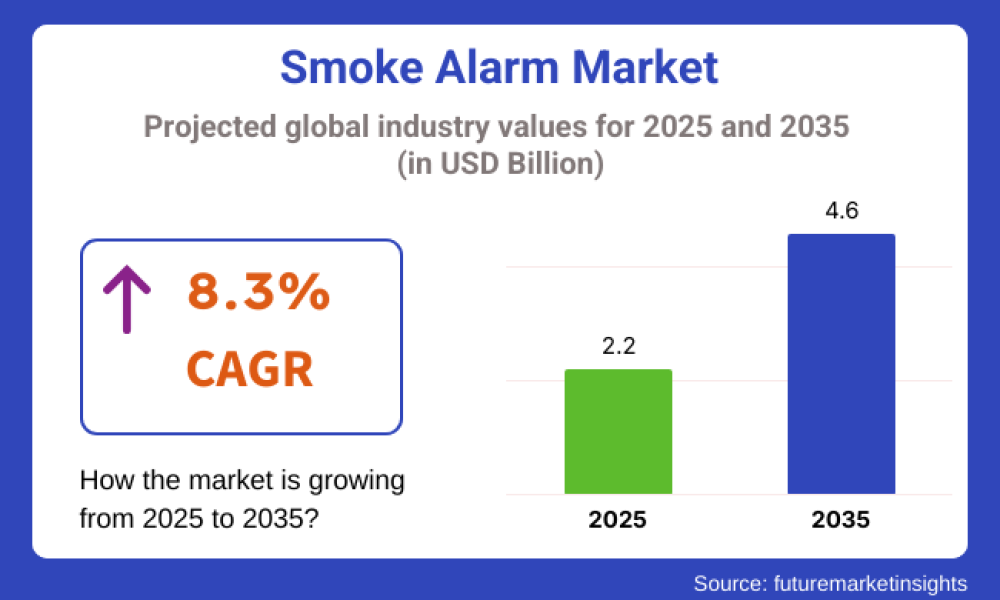
The U.S. smoke alarm market is set for strong expansion over the next decade, supported by stricter safety regulations, growing smart home adoption, increasing fire risk awareness, and major advances in detection technology. Valued at USD 2.2 billion in 2025, the industry is projected to exceed USD 4.6 billion by 2035, registering a robust CAGR of 8.3%.
This rapid acceleration is fueled by government mandates, technology upgrades, and the rising integration of connected safety devices in residential and commercial infrastructure.
Unlock the full market insights and exclusive data breakdowns, Request Your Sample Report Now: https://www.futuremarketinsights.com/reports/sample/rep-gb-17323
Market Outlook (2025–2035)
Demand for smoke alarms in the U.S. continues to rise as building codes evolve and public awareness intensifies. With urbanization and remodeling activities expanding nationwide, smoke alarm installation has shifted from a regulatory requirement to a core component of home and commercial safety planning.
Key Growth Drivers
- Stricter Fire Safety Standards: Updated national and state-level building codes require smoke detectors in residential properties, educational institutions, workplaces, and multi-unit housing.
- Smart Home Expansion: Voice-enabled alarms, mobile app notifications, interconnected systems, and AI-based predictive alerts are gaining traction among U.S. consumers.
- Rising Fire Awareness: Increased campaigns by fire safety authorities and insurance providers encourage homeowners to upgrade outdated devices.
- Technological Advancements: Dual-sensor alarms, wireless interconnectivity, and energy-efficient battery systems drive premium product adoption.
Market Developments and Innovation Trends
From 2025 onward, manufacturers will focus on photoelectric and dual-sensor alarms as preferred solutions because of their higher accuracy and reduced false alerts. Today’s alarms are increasingly equipped with:
- Wireless connectivity for multi-room alerting
- Smart phone–based monitoring
- Self-testing features and battery alerts
- Integration with home automation ecosystems
The U.S. consumer shift toward IoT-enabled fire safety systems is expected to reshape product development, bringing AI-powered notification systems and predictive detection technologies into the mainstream.
End-Use Insights
Residential Segment Leads the Market
The residential sector will command nearly 65% of total demand in 2025, supported by stringent regulations and widespread home safety awareness. Replacement of outdated hardware, increased remodeling activity, and adoption of smart home devices further strengthen market penetration.
Commercial Demand Remains Stable
The commercial segment, representing about 30% of the market, continues to expand with installations in offices, retail properties, industrial facilities, and hospitality buildings. The rise in mixed-use and high-rise developments also contributes to steady commercial adoption.
Technology Insights
Photoelectric Alarms Dominate (55% Market Share in 2025)
Photoelectric alarms remain the top choice because of their superior response to smoldering fires, reduced false alarm rates, and better reliability in kitchens and high-humidity areas.
Ionization Alarms Hold Niche Demand (25% Share)
Ionization alarms continue to serve cost-sensitive buyers and older establishments that require simple, affordable flaming-fire detection.
Shift from 2020–2024 to 2025–2035
The period from 2020 to 2024 was primarily driven by:
- Growing fire safety awareness
- Mandatory installation regulations
- Widespread adoption of Wi-Fi/Bluetooth-enabled alarms
- Increased use of battery-powered devices
From 2025 onward, growth will be driven by:
- Full smart home integration
- AI-based predictive alerts
- Urbanization in major U.S. metro regions
- Seamless IoT connectivity
- Demand for sustainable, energy-efficient device designs
Key Market Risks
While strong growth is forecast, several challenges must be navigated:
- Economic Sensitivity: Consumers may postpone upgrades during economic downturns.
- Supply Chain Disruptions: Semiconductor and battery shortages can delay production.
- Technology Obsolescence: Firms must innovate rapidly to keep pace with IoT advancements.
- Cybersecurity Risks: Connected alarms must adopt secure frameworks to avoid breaches.
- Rising Competition: Market saturation may pressure pricing and margins.
Checkout Now to Access Industry Insights: https://www.futuremarketinsights.com/checkout/17323
Conclusion
The U.S. smoke alarm market is entering a decade of unprecedented transformation. As smart technologies merge with fire safety solutions, consumer expectations are shifting toward advanced, integrated, and reliable detection systems. With regulatory support, strong innovation pipelines, and rising adoption across residential and commercial sectors, the smoke alarm industry is set to deliver consistent, long-term growth through 2035.
Have a specific Requirements and Need Assistant on Report Pricing or Limited Budget please contact us – [email protected]
About Future Market Insights (FMI)
Future Market Insights, Inc. (FMI) is an ESOMAR-certified, ISO 9001:2015 market research and consulting organization, trusted by Fortune 500 clients and global enterprises. With operations in the U.S., UK, India, and Dubai, FMI provides data-backed insights and strategic intelligence across 30+ industries and 1200 markets worldwide.



