
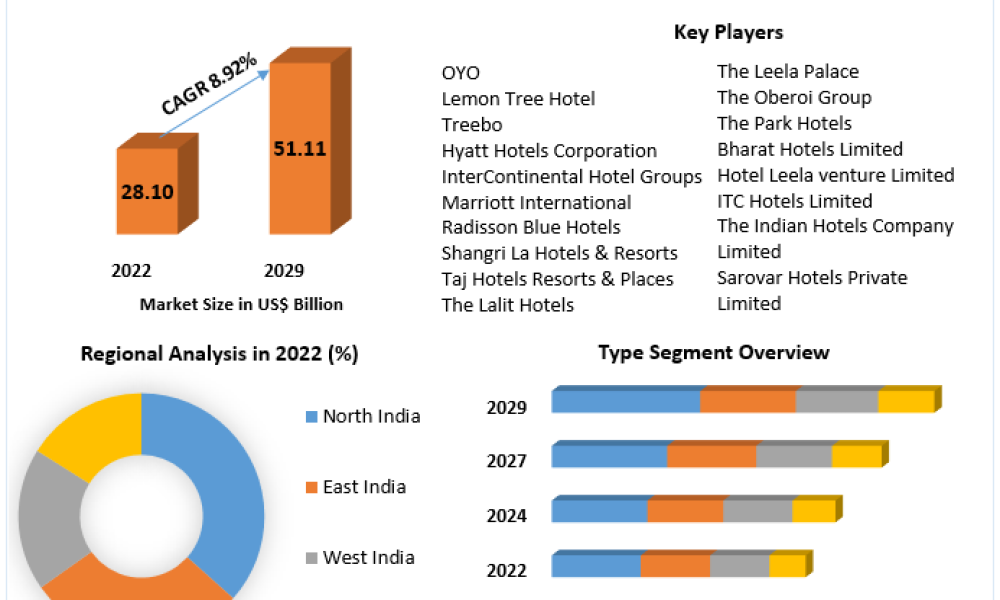
India Luxury Hotel Market Overview:
India Luxury Hotel Market valued at approximately USD 2.7 billion in 2024, is forecast to grow at a robust CAGR of 8.83%, reaching USD 6.2 billion by 2033. This expansion is fueled by increasing disposable incomes, accelerated domestic and international tourism, and expanding business travel. Strategic government initiatives to promote tourism infrastructure and the rising demand for premium hospitality experiences among affluent travelers are key growth drivers. The regional landscape is led by South India, followed closely by West and emerging Northeast India, each fueled by unique tourism and business dynamics.
Key Highlights & Insights
Market Size & Growth: India luxury hotel market expected to grow from USD 2.7 billion in 2024 to USD 6.2 billion by 2033, at a CAGR of 8.83%.
Dominating Region: South India holds a significant share, backed by IT hubs like Bengaluru and wellness tourism in Kerala, followed by West India with Mumbai’s financial dominance and Goa’s leisure appeal.
Leading Segment: Business hotels dominate with 44% of revenue in 2024, supported by growing services sector and MICE (Meetings, Incentives, Conferences, and Exhibitions) demand.
Key Driver: Rising disposable incomes of the burgeoning middle and affluent class, expansion of travel infrastructure, and heightened preference for curated luxury experiences.
► Get a sample of the report:https://www.maximizemarketresearch.com/request-sample/127656/
Recent Developments
Key players such as Taj Hotels, ITC Hotels, Oberoi Group, Marriott International, and The Leela are aggressively expanding portfolios with new luxury properties in Tier II and III cities.
Luxury resorts are growing fastest, driven by demand for weddings, wellness retreats, and “bleisure” travel, posting a CAGR of more than 13%.
Technological innovations around personalized guest experiences and digital concierge services are becoming standard practice.
Expansion in aviation infrastructure, including doubling operational airports within the decade, reduces travel time and brings previously inaccessible destinations into reach.
East and Northeast India emerge as the fastest-growing regions with flagship projects such as Taj Vivanta Guwahati and DoubleTree Siliguri.
Market Dynamics
Growth Drivers:
Increasing inbound and domestic tourism boosted by government promotions and infrastructure growth.
Expansion of India’s services economy and rising corporate travel.
Surge in demand for experiential stays, including wellness, heritage, and cultural tourism.
Growing localization of global luxury brands offering tailored experiences.
Enhanced air connectivity fueling regional luxury hotel demand.
Challenges:
Introduction of 18% GST on high-end dining at luxury hotels may curb ancillary revenue.
Infrastructure delays and regulatory approvals can hamper rapid project execution.
Competitive pressure from alternative lodging models and online travel platforms.
Seasonality impacting occupancy rates in certain geographies.
Regional Analysis
South India: 24% market share, propelled by Bengaluru’s IT corridor, Kerala’s wellness tourism, and Tamil Nadu’s cultural destinations.
West India: 23% share, driven by Mumbai’s finance and commercial sectors, Goa’s robust leisure tourism, and emerging towns like Pune.
East & Northeast India: Fastest growing at a CAGR of 15.2%, supported by infrastructure development and growing tourist inflow.
North and Central India: Steady growth with a focus on Delhi NCR’s luxury market and Rajasthan’s heritage tourism.
Product Segmentation
By Hotel Type: Business hotels (largest share), resorts (fastest growth), suite hotels, airport hotels.
By Room Type: Suites, presidential suites, villas/bungalows (booming luxury segment with CAGR of 12.4%).
By Service: Accommodation, food and beverage, event hosting, wellness retreats, and curated experiences.
Key Trends
Shift toward sustainable and eco-friendly luxury offerings.
Rising demand for private villas and bungalows for exclusive stays.
Increasing reliance on influencer marketing and digital interaction.
Integration of AI and personalized technology for guest services.
Growth of niche luxury experiences such as cultural immersion and health tourism.
FAQs
What is the projected size of the India luxury hotel market by 2033?
USD 6.2 billion.Which region dominates the luxury hotel market?
South India, followed by West India and the rapidly growing East & Northeast.What segment holds the largest market share?
Business hotels with 44% revenue share.What are primary growth drivers?
Rising incomes, tourism growth, infrastructure enhancements, and experiential luxury demand.
Quote
“With expanding tourism infrastructure and a growing affluent consumer base, India’s luxury hotel market is set for impressive growth. Regional diversification and digital innovation will define the next decade of luxury hospitality.”
Conclusion
India’s luxury hotel sector is undergoing dynamic transformation fueled by increased travel, rising consumer affinity for premium experiences, and government initiatives enhancing tourism infrastructure. South India leads with strong IT and wellness demand while emerging regions provide new expansion arenas. Businesses investing in digital personalization, sustainability, and exclusive offerings are well-positioned to benefit from the expected market growth to USD 6.2 billion by 2033.
◉ Get Market Research Latest Trends
♦ Enterprise File Synchronization and Sharing Market
♦ Maximize Market Research is launching a subscription model for data and analysis in the MMR Statistics
Contact Maximize Market Research:
3rd Floor, Navale IT Park, Phase 2
Pune Bangalore Highway, Narhe,
Pune, Maharashtra 411041, India
[email protected]
+91 96071 95908, +91 9607365656
About Maximize Market Research:
Maximize Market Research is a multifaceted market research and consulting company with professionals from several industries. Some of the industries we cover include medical devices, pharmaceutical manufacturers, science and engineering, electronic components, industrial equipment, technology and communication, cars and automobiles, chemical products and substances, general merchandise, beverages, personal care, and automated systems. To mention a few, we provide market-verified industry estimations, technical trend analysis, crucial market research, strategic advice, competition analysis, production and demand analysis, and client impact studies.




