
Water-based Inks Market Overview:
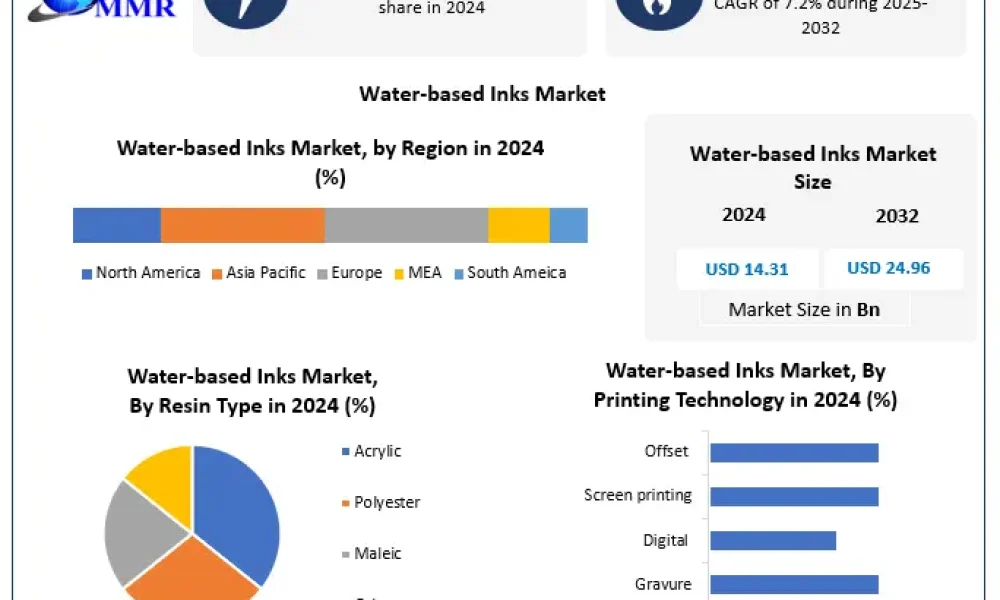
Water-based Inks Market is projected to surge from USD 14.31 billion in 2024 to USD 24.96 billion by 2032, growing at a robust CAGR of 7.2%. The rise is fueled by increasing demand for eco-friendly ink solutions across packaging, printing, and labeling industries, stringent environmental regulations, and the expansion of e-commerce. North America emerges as the dominant market region owing to early adoption of low-VOC formulations, regulatory mandates, and a strong packaging industry focused on sustainability.
Key Highlights & Insights
Market Size & Growth: Increasing from USD 14.31 billion in 2024 to USD 24.96 billion by 2032, reflecting a CAGR of 7.2%.
Dominating Region: North America leads the market because of stringent environmental laws, established sustainable packaging initiatives, and widespread industry adoption of water-based inks.
Leading Segment: Packaging industry accounts for over 50% of total market revenue in 2025, driven by fast-growing demand for recyclable and consumer-safe packaging materials.
Key Driver: Environmental regulations restricting VOC emissions, consumer preference for sustainable and non-toxic materials, and growth in flexible packaging and e-commerce sectors.
► Get a sample of the report:https://www.maximizemarketresearch.com/request-sample/41006/
Recent Developments
2024-2025:
Sun Chemical and Flint Group launched advanced water-based ink formulations offering enhanced durability and color vibrancy for packaging applications.
Major ink producers increasing R&D investments for bio-based and recyclable ink technologies.
North American manufacturers expanding production capabilities to meet surging demand.
Collaborations between ink manufacturers and packaging converters to optimize sustainable ink-packaging compatibility.
Strategic acquisitions aimed at broadening geographic coverage and technological expertise.
Market Dynamics
Growth Drivers:
Rising demand for environmentally friendly printing technologies globally.
Government regulations limiting VOC emissions and promoting green industrial practices.
Increased adoption in flexible packaging, label printing, and corrugated materials.
Growth in e-commerce fueling demand for customized and sustainable packaging.
Advances in resin chemistry and printing technology improving ink performance.
Challenges:
Higher costs of water-based inks compared to traditional solvent-based alternatives.
Technical limitations related to drying times and substrate compatibility.
Complex supply chains for sourcing sustainable raw materials.
Need for continuous innovation to meet evolving regulatory standards.
Regional Analysis
North America: Largest market share driven by environmental legislation, mature packaging and printing industries, and consumer awareness regarding sustainability.
Europe: Important market with stringent regulatory frameworks, high adoption of sustainable materials, and established green packaging mandates.
Asia Pacific: Fastest-growing region fueled by rapid industrialization, expanding packaging sector, and rising environmental consciousness in China, India, Japan, and Southeast Asia.
Latin America & Middle East/Africa: Emerging markets with growing demand for sustainable packaging in FMCG and industrial applications.
Product Segmentation
By Application: Packaging (largest), commercial printing, publication printing, others.
By Technology: Flexographic, gravure, screen, digital, and offset printing inks.
By Resin Type: Acrylic (leading), polyurethane, cellulose, others.
By Distribution Channel: Direct sales, distributors, retail and online.
Key Trends
Surge in use of acrylic resins for their superior color holdout, low VOCs, and fast drying properties.
Increasing incorporation of bio-based and recyclable inks aligned with circular economy initiatives.
Rising adoption of digital water-based inks for short-run, customized packaging.
Growth in flexible and sustainable packaging driving water-based ink demand.
Collaborations focused on innovations enhancing ink-substrate compatibility and environmental performance.
FAQs
What is the projected market size and CAGR of the water-based inks market?
Projected to reach USD 24.96 billion by 2032 with a CAGR of 7.2%.Which region leads the global water-based inks market?
North America leads due to strong regulatory frameworks and sustainable packaging adoption.What is the largest application segment for water-based inks?
Packaging holds the largest revenue share, exceeding 50% in 2025.What technological advances fuel the water-based inks market?
Advances in acrylic resin chemistry, bio-based ingredients, and digital printing compatibility.
Conclusion
The water-based inks market is on an upward trajectory, driven by environmental imperatives, regulatory pressures, and growing consumer demand for sustainable packaging. North America remains at the forefront due to its progressive policies and mature markets, while rapid growth in Asia Pacific signals expanding global opportunities. Continuous innovation in ink formulations and printing technologies will define the future landscape of this vital green industry sector through 2032 and beyond.
◉ Get Market Research Latest Trends
♦ Global Push-to-Talk over Cellular Market
♦ Maximize Market Research is launching a subscription model for data and analysis in the MMR Statistics
Contact Maximize Market Research:
3rd Floor, Navale IT Park, Phase 2
Pune Bangalore Highway, Narhe,
Pune, Maharashtra 411041, India
[email protected]
+91 96071 95908, +91 9607365656
About Maximize Market Research:
Maximize Market Research is a multifaceted market research and consulting company with professionals from several industries. Some of the industries we cover include medical devices, pharmaceutical manufacturers, science and engineering, electronic components, industrial equipment, technology and communication, cars and automobiles, chemical products and substances, general merchandise, beverages, personal care, and automated systems. To mention a few, we provide market-verified industry estimations, technical trend analysis, crucial market research, strategic advice, competition analysis, production and demand analysis, and client impact studies.




