
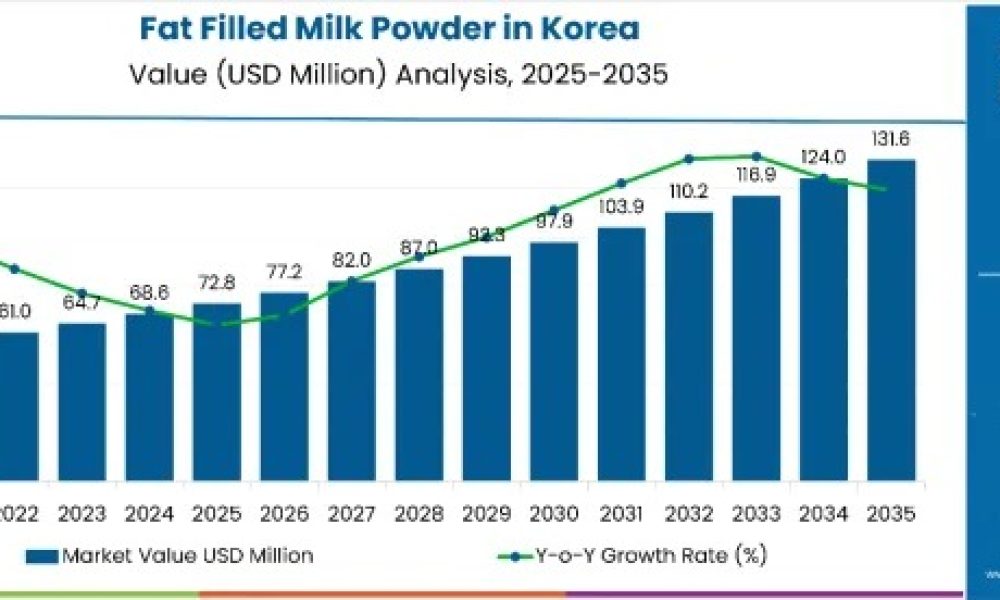
The Korean fat-filled milk powder market is poised for strong expansion, rising from USD 72.8 million in 2025 to USD 131.6 million by 2035, registering a CAGR of 6.1% during the forecast period, according to Future Market Insights (FMI). Increasing health consciousness, nutritional awareness, and demand for convenience foods are the key drivers fueling this growth trajectory.
By 2035, South Jeolla is anticipated to lead the market with sales of USD 39.7 million, followed by Seoul (USD 29 million), Busan-Ulsan (USD 22.1 million), Gyeonggi Province (USD 18.9 million), and Jeju Island (USD 12.3 million). Regional momentum remains supported by robust dairy infrastructure, increasing consumption rates, and an expanding base of health-conscious consumers.
To Explore Detailed Market Data, Segment-Wise Forecasts, and Competitive Insights, Request Sample Report! https://www.futuremarketinsights.com/reports/sample/rep-gb-18369
Key Market Insights
- Market Value (2025): USD 72.8 million
- Forecast Value (2035): USD 131.6 million
- CAGR (2025–2035): 6.1%
- Leading Product Segment: 28% fat-filled milk powder (35% share, 2025)
- Top Growing Regions: South Jeolla and Jeju Island
Growth Drivers and Consumption Trends
Per capita consumption of fat-filled milk powder in leading provinces such as Seoul, Gyeonggi, and South Jeolla averages 1.2–1.5 kilograms in 2025, projected to reach 2.0–2.3 kilograms by 2035. Consumers are increasingly drawn toward nutrient-dense, cost-effective dairy alternatives with balanced protein and fat composition.
The 28% fat content variant remains the category leader, holding 35% of market value in 2025. Its dominance stems from:
- Balanced nutrition suited to Korean dietary patterns.
- High protein efficiency with lower caloric density.
- Widespread use in retail and B2B food processing applications.
Instant 28% variants are rapidly gaining traction among working professionals and urban families, aligning with the country’s fast-paced lifestyle and growing reliance on e-commerce channels for household groceries.
Segmental Outlook
By End Use:
Dairy products remain the leading application segment, expected to hold 29% of total sales in 2025, fueled by yogurt, cheese, and condensed milk production.
- Bakery and confectionery applications maintain a steady share, driven by domestic and export-oriented manufacturers.
- Beverages including specialty coffees, milk teas, and instant mixes show expanding use of fat-filled milk powder as a nutrient fortifier.
- Ice creams and frozen desserts continue seasonal but strong demand, driven by cost-effectiveness and sensory stability.
Regional Performance Highlights
- South Jeolla: Expected CAGR of 6.8%, led by rising dairy processing facilities and strong agricultural modernization.
- Jeju Island: CAGR of 6.7%, supported by rural retail expansion and rising consumption.
- Gyeonggi Province: 6.2% CAGR, benefiting from proximity to Seoul and a balanced industrial base.
- Seoul Metropolitan Area: 5.9% CAGR, anchored by affluent consumers and product premiumization.
- Busan-Ulsan Region: 6.0% CAGR, leveraging port-based imports and established food manufacturing clusters.
Collectively, these regions form the backbone of Korea’s dairy innovation and regional supply networks, bridging urban and semi-urban consumption growth.
Consumer Dynamics
The fat-filled milk powder consumer base in Korea is highly diversified, led by four major segments:
- Health-conscious families prioritizing nutritional integrity and product transparency.
- Millennials seeking convenience, favoring instant variants and online purchasing.
- Budget-focused households relying on bulk packs and private-label options.
- Culinary enthusiasts experimenting with both local and Western-style recipes.
Price competitiveness has improved, with the premium over standard milk powder declining from 18% in 2020 to 12% in 2025, thanks to local processing efficiency and improved supply chains.
To Access The Full Market Analysis, Strategic Recommendations, And Analyst Support, Purchase The Complete Report Here. https://www.futuremarketinsights.com/checkout/18369
Competitive Landscape
The Korean market features a blend of domestic processors and international dairy suppliers, with technology, scale efficiency, and distribution reach defining success.
Key players include:
HEECHANG DAIRY&FOOD CO., LTD, Kaskat Dairy, Alpen Food Group, Dana Dairy, Vreugdenhil, Armor Proteines, MP Biomedicals LLC, BONILAIT PROTEINES, Polindus, Holland Dairy Foods, Hoogwegt International, Belgomilk, Revala Ltd, and Dale Farm Ltd.
- HEECHANG DAIRY&FOOD CO., LTD remains the dominant local manufacturer, leveraging its national retail and foodservice network.
- Kaskat Dairy focuses on health-oriented variants using advanced processing technology.
- Alpen Food Group strengthens its foothold through fortified and age-targeted dairy formulations.
- Dana Dairy and Vreugdenhil emphasize mid-scale industrial applications and premium-quality offerings, respectively.
Private labels at Lotte Mart, E-Mart, and Homeplus are driving affordability, pressuring branded suppliers to innovate in both quality and packaging.
About Future Market Insights (FMI)
Future Market Insights, Inc. (FMI) is an ESOMAR-certified, ISO 9001:2015 market research and consulting organization, trusted by Fortune 500 clients and global enterprises. With operations in the U.S., UK, India, and Dubai, FMI provides data-backed insights and strategic intelligence across 30+ industries and 1200 markets worldwide.



