
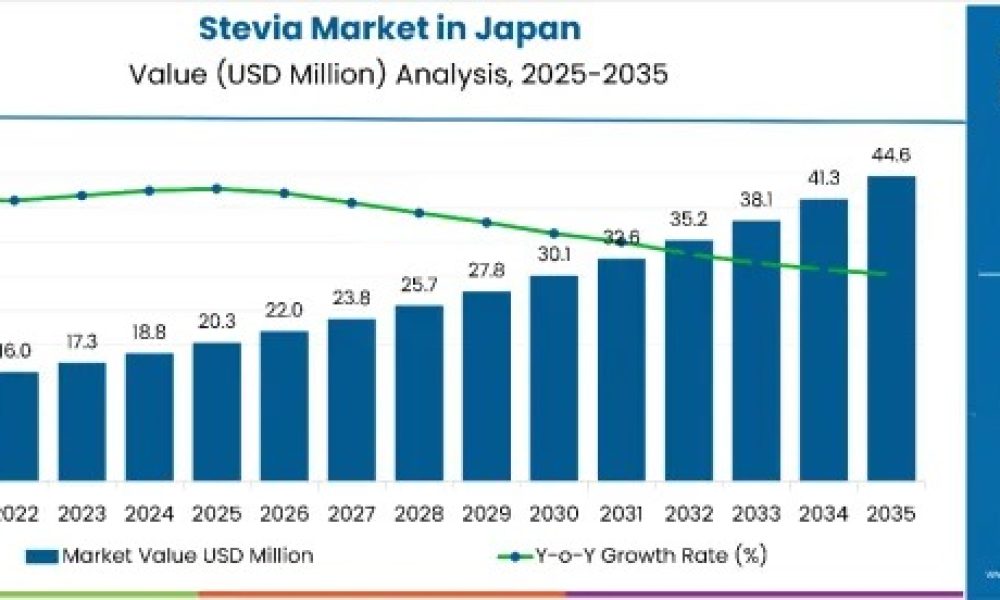
Sales of stevia in Japan are projected to surge from USD 20.3 million in 2025 to USD 44.6 million by 2035, registering a CAGR of 8.2%. The growth is underpinned by increasing health consciousness, diabetes management awareness, and a rising preference for natural sweeteners among Japanese consumers.
The upward trend aligns with Japan’s broader shift toward wellness-focused diets, as urban consumers in Kanto, Kinki, and Chubu increasingly substitute artificial sweeteners with stevia. Per capita consumption is projected to nearly double by 2035, reaching 0.7–0.9 grams, compared to 0.3–0.4 grams in 2025.
To Explore Detailed Market Data, Segment-Wise Forecasts, and Competitive Insights, Request Sample Report! https://www.futuremarketinsights.com/reports/sample/rep-gb-18406
Market Overview: Health and Lifestyle Shifts Fueling Growth
Japan’s evolving food culture reflects a strong alignment between aging population health priorities and the adoption of low-calorie natural sweeteners. The Kanto region leads the market with an expected USD 18.1 million in stevia sales by 2035, followed by Kinki (USD 12.4 million) and Chubu (USD 8.7 million).
Average price premiums for stevia over synthetic sweeteners have declined from 35% in 2020 to 28% in 2025, improving accessibility for everyday consumers. Enhanced extraction technology and domestic production efficiencies are key enablers of this affordability trend.
Segmental Insights: Powder Extract and Conventional Stevia Dominate
By Extract Form:
- Powder extract remains the dominant segment, expected to hold a 74% market share in 2025, attributed to ease of blending, longer shelf life, and suitability in food and beverage processing.
- Liquid extracts are growing in beverage and ready-to-drink categories, supported by superior solubility.
- Leaf forms continue gaining traction in traditional tea and herbal applications, recording ~9% annual growth.
By Nature:
- Conventional stevia leads with 74% share due to affordability and wide availability in mainstream retail.
- Organic variants are expanding across premium health stores.
- Specialty stevia products are emerging for customized industrial applications, offering enhanced solubility and sweetness stability.
Consumer Landscape: Health-Conscious and Diabetic Populations Drive Uptake
The Japanese stevia market attracts diverse consumer groups, with demand primarily concentrated among:
- Health-conscious middle-aged consumers seeking preventive wellness solutions.
- Diabetic patients prioritizing low-glycemic sweeteners for daily use.
- Fitness enthusiasts using stevia in sports nutrition and meal planning.
- Elderly consumers preferring stevia for traditional desserts and teas due to familiar taste and ease of use.
These segments reflect the convergence of health, lifestyle, and culinary traditions shaping Japan’s natural sweetener adoption curve.
Regional Dynamics: Urban Centers Lead Stevia Expansion
Stevia consumption is set to grow across all Japanese regions between 2025 and 2035, with varied momentum:
- Kanto: CAGR 8.7%, driven by high urban health awareness and retail availability.
- Chubu: CAGR 8.5%, benefiting from growing health-focused product penetration.
- Kinki: CAGR 8.2%, reflecting rising elderly population adoption.
- Kyushu & Okinawa: CAGR 8.0%, supported by longevity-focused consumers.
- Tohoku: CAGR 7.8%, witnessing gradual modernization in consumption habits.
These dynamics illustrate how regional income levels, health infrastructure, and retail formats influence natural sweetener adoption nationwide.
To Access The Full Market Analysis, Strategic Recommendations, And Analyst Support, Purchase The Complete Report Here. https://www.futuremarketinsights.com/checkout/18406
Competitive Landscape: Japanese and Global Leaders Strengthen Supply Chains
The market is shaped by a blend of domestic ingredient producers and international sweetener specialists. The five largest companies collectively serve over 5,000 food manufacturers and health retailers.
Key participants include:
- Morita Kagaku Kogyo Co., Ltd. – A domestic leader in stevia extraction with comprehensive product lines meeting Japan’s food safety standards.
- Nippon Paper Group – Leveraging industrial expertise to develop high-purity stevia for nutraceutical and pharmaceutical use.
- Toyo Sugar Refining Co., Ltd. – Integrating stevia into diversified sweetener portfolios targeting functional food applications.
- Cargill Incorporated – Expanding stevia adoption in beverage and dairy manufacturing sectors.
- Ingredion Incorporated – Offering tailored stevia blends for application-specific industrial use.
Private-label stevia offerings by major Japanese health retailers like Matsumoto Kiyoshi and Sundrug are further widening market access, though placing margin pressure on smaller suppliers.
Recent Industry Developments
- July 2024: Tate & Lyle PLC introduced OPTIMIZER STEVIA® 8.10, a formulation optimized for gummies, nutrition bars, and functional beverages, reinforcing its role in the performance nutrition segment.
About Future Market Insights (FMI)
Future Market Insights, Inc. (FMI) is an ESOMAR-certified, ISO 9001:2015 market research and consulting organization, trusted by Fortune 500 clients and global enterprises. With operations in the U.S., UK, India, and Dubai, FMI provides data-backed insights and strategic intelligence across 30+ industries and 1200 markets worldwide.



