
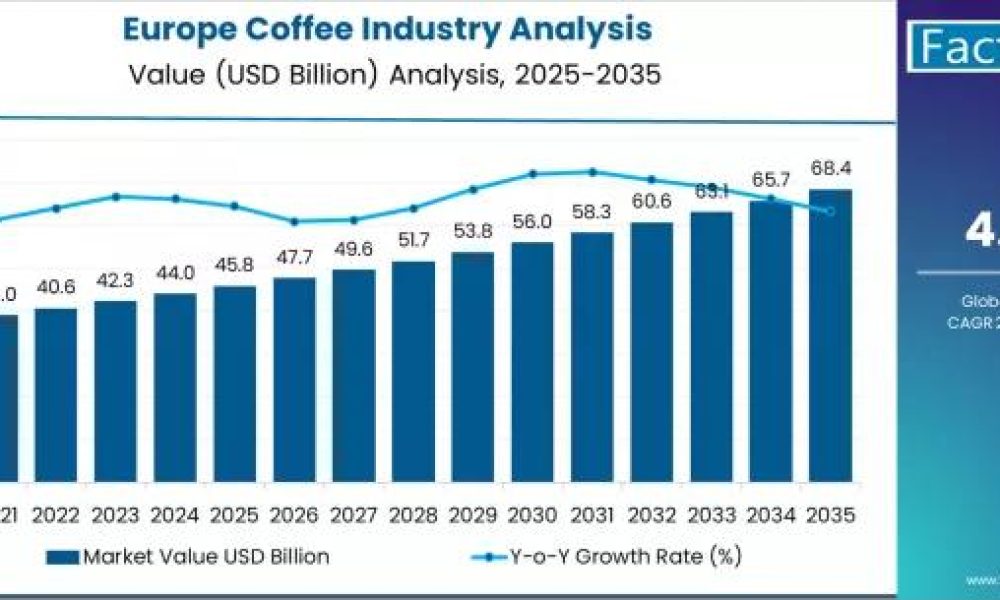
The European coffee industry is projected to scale from USD 45.8 billion in 2025 to approximately USD 68.4 billion by 2035, registering a compound annual growth rate (CAGR) of about 4.1% over the forecast period. This growth is underpinned by the maturation of coffee culture, rising demand for premium and specialty coffee offerings, and increasing penetration of advanced consumption formats across household and commercial settings.
As consumer tastes evolve, with greater emphasis on sustainability, origin traceability and quality-rich experiences, the European market is witnessing structural shifts-from volume to value, from commodity to specialty. The retail ecosystem, café culture and e-commerce channels are all contributing to a broadening base of demand and deeper product innovation.
➤Key Market Insights at a Glance
Market Value (2025): USD 45.8 billion
Forecast Value (2035): USD 68.4 billion
CAGR (2025-2035): ~4.1%
Leading Coffee Type (2025): Arabica (~68.4% share)
Leading Product Format (2025): Ground coffee (~42.8% share)
Dominant Distribution Channel (2025): Supermarkets (~48.7% share)
Top Growth Country (2025-2035): Poland (CAGR ~4.6%)
Major Players in Industry: Nestlé S.A., JDE Peet’s N.V., Lavazza Group, Illycaffè S.p.A., Melitta Group
To Access the Complete Data Tables & in-depth Insights, Request a Discount on this report: https://www.factmr.com/connectus/sample?flag=S&rep_id=11290
➤Market Drivers / Growth Overview
Demand in the European coffee industry is being driven by multiple dynamics. First, growing appreciation of specialty coffee, third-wave café culture and premium beverage experiences are elevating consumer willingness to pay for quality, origin varieties and unique sensory profiles. Second, the convenience segment-ground coffee, coffee pods, retail formats-is gaining traction, particularly in household applications, supported by modern retail chains and e-commerce penetration. Third, sustainability and ethical sourcing are turning into differentiators: certified coffees (organic, fair-trade), transparent supply chains and eco-friendly packaging are influencing consumer choice and brand positioning. Finally, advanced processing, roasting technologies and packaging innovations are enabling better flavor, freshness and premium presentation, which further stimulate market growth.
➤Segmentation & Key Drivers
By Type: Arabica dominates due to its superior flavor profile and premium positioning; Robusta remains a smaller segment though growing interest in blends persists.
By Product Format: Ground coffee leads, benefiting from household consumption convenience. Coffee beans, instant coffee, pods and capsules are important variants with distinct growth trajectories.
By Distribution Channel: Supermarkets remain the largest channel due to accessibility and volume; however specialty stores, online channels and cafés are gaining relevance for premium segments.
By End-User: Household consumption remains the volume engine, while commercial use (cafés, foodservice, offices) is a key growth lever in specialty and out-of-home consumption contexts.
Across all segments, rising consumer expectations around taste, freshness, origin authenticity and brewing experience are pressing suppliers to innovate, differentiate and upgrade.
➤Regional & Country Insights
Poland: Highest CAGR (~4.6%) in the region, driven by rising affluence, growing café culture and premium coffee adoption.
Germany: Strong growth (~4.3%) supported by deep retail penetration, specialty roasting traditions and consumer quality orientation.
Netherlands: Moderate growth (~4.2%), reinforcing its coffee trading heritage and shift into specialty segments.
France: Around ~4.1% CAGR, backed by café culture, culinary sophistication and premium beverage demand.
United Kingdom: Approximately ~4.0% CAGR, with strong retail and out-of-home coffee expansion.
Spain: ~3.9% CAGR, driven by hospitality growth and increased consumer appreciation for quality coffee.
Italy: ~3.8% CAGR; though a mature market, growth continues via premium and specialty niches.
These country-level differences reflect varying stages of coffee culture development, consumer sophistication, retail dynamics and premium segment penetration.
➤Competitive Landscape
Competitive intensity in the European coffee industry is high, with both global multinationals and regional premium roasters battling for share. Key players include Nestlé S.A., JDE Peet’s N.V., Lavazza Group, Illycaffè S.p.A., Melitta Group, Tchibo GmbH, Douwe Egberts, Segafredo Zanetti S.p.A., Mondelez International, and JAB Holding Company.
These companies are focusing on sustainable sourcing, premiumisation, brand differentiation, strategic partnerships, and expansion of channels (including e-commerce, subscription models and retail-café hybrids). Innovation in roasting, flavor variety, packaging (pods, single-serve, ready-to-drink), and consumer engagement (loyalty, traceability, experience) is central to competitive strategy.
➤Recent Developments
Significant investment in sustainable sourcing and traceability programs as brands respond to consumer demand and regulatory pressures.
Expansion of premium and specialty coffee formats, including single-origin, small-batch roasts and artisan variants, to meet evolving taste profiles.
Growth of ready-to-drink (RTD) coffee and single-serve formats (pods/capsules) in both retail and out-of-home channels.
Enhanced digital engagement and online retailing of coffee products, subscriptions and direct-to-consumer models.
Adoption of advanced roasting and packaging technology to improve freshness, flavour retention, sustainability and shelf performance.
➤Market Outlook & Strategic Insights
Over the forecast period (2025-2035), the European coffee industry is poised to evolve as consumer paradigms shift from simply drinking coffee to experiencing coffee. Suppliers and brands should prioritise the following strategic imperatives:
Deepening premiumisation, with investment in specialty lines, brand storytelling and experience marketing.
Expanding digital and omnichannel reach, especially in online, subscription and direct-to-consumer models.
Strengthening sustainability credentials, including certified sourcing, eco-packaging and circular systems, to resonate with ethically-oriented consumers.
Leveraging processing and packaging innovation to improve quality, freshness, convenience and shelf differentiation.
Tailoring strategies to country-specific dynamics, recognising the variation in growth rates, consumer maturity and channel development across Europe.
Companies that execute on these priorities while maintaining cost discipline and brand authenticity are best placed to capture the incremental USD ~22.6 billion growth in the region over the coming decade.
Browse Full Report: https://www.factmr.com/report/europe-coffee-industry-analysis
➤Purchase Full Report for Detailed Insights
For access to full forecasts, regional breakouts, company share analysis, and emerging trend assessments, you can purchase the complete report: https://www.factmr.com/checkout/11290
Have specific requirements or need assistance on report pricing or have a limited budget? Please contact [email protected]
Contact:
US Sales Office
11140 Rockville Pike
Suite 400
Rockville, MD 20852
United States
Tel: +1 (628) 251-1583, +353-1-4434-232
Email: [email protected]
➤About Fact.MR:
Fact.MR is a global market research and consulting firm, trusted by Fortune 500 companies and emerging businesses for reliable insights and strategic intelligence. With a presence across the U.S., UK, India, and Dubai, we deliver data-driven research and tailored consulting solutions across 30+ industries and 1,000+ markets. Backed by deep expertise and advanced analytics, Fact.MR helps organizations uncover opportunities, reduce risks, and make informed decisions for sustainable growth.



