
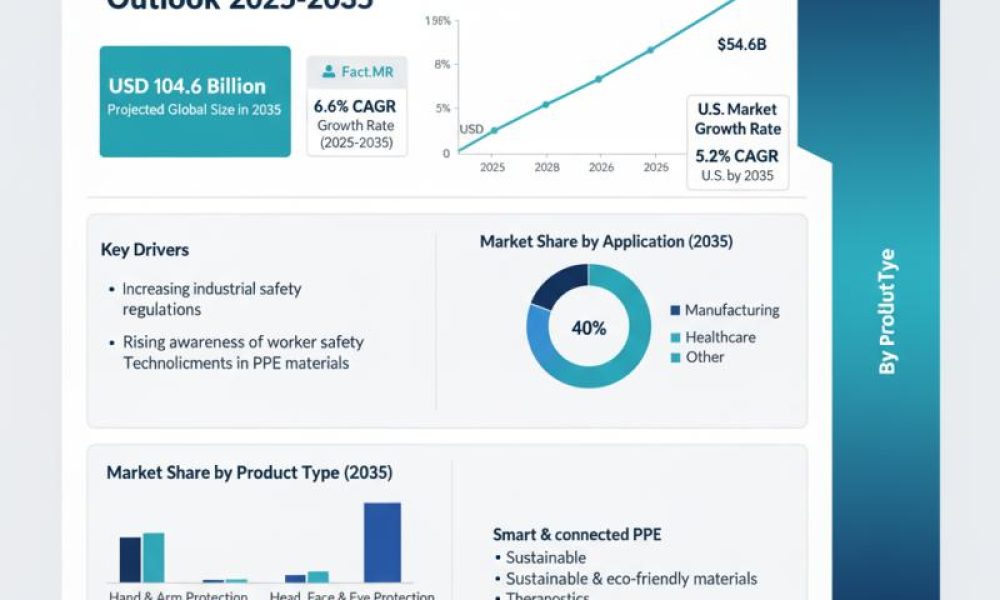
The global personal protective equipment (PPE) market is projected to expand from USD 55.2 billion in 2025 to approximately USD 104.6 billion by 2035, registering a compound annual growth rate (CAGR) of around 6.6% during the forecast period. This growth is driven by increasing industrialisation, heightened regulatory mandates for worker safety, evolving workplace risk profiles, and sustained emphasis on occupational health.
Rising adoption of advanced PPE solutions-combined with innovations in materials, connected wearables and digital safety platforms-is reshaping the market landscape. Supply chain localisation and sustainability initiatives are further influencing manufacturers’ product strategies and go-to-market models.
➤Key Market Insights at a Glance
Market Value (2025): USD 55.2 billion
Forecast Value (2035): USD 104.6 billion
CAGR (2025-2035): ~6.6%
Dominant End-Use: Construction sector (highest share)
Fastest-Growing Region: Asia Pacific
Leading Product Categories: Body protection, hand & arm protection (gloves), eye & face protection
Key Industry Trends: Smart PPE, sustainable materials, automation in PPE manufacturing
To Access the Complete Data Tables & in-depth Insights, Request a Discount on this report: https://www.factmr.com/connectus/sample?flag=S&rep_id=4631
➤Market Drivers / Growth Overview
The PPE market’s expansion is supported by multiple converging factors. Industrial growth across emerging and developed economies is increasing the base of the workforce exposed to occupational risks. Simultaneously, more stringent regulations and enforcement of workplace safety standards are driving compliance investments.
Evolving hazard profiles-from mechanical to chemical, biological and ergonomic threats-are prompting demand for specialised protective equipment. Technological innovation is gaining traction: smart PPE (with embedded sensors), connected wearables, improved materials (lighter, stronger, multi-hazard resistant) and digital safety monitoring are becoming more prevalent. Supply chain resilience, manufacturing localisation, and sustainability pressures are also shaping the market. Cost pressures, raw material volatility and the challenge of balancing affordability with advanced features may moderate some growth.
➤Key Growth Drivers at a Glance
Regulatory mandates and stricter enforcement of occupational safety laws
Industrialisation and infrastructure projects in emerging economies
Technological advances in connected and sensor-enabled PPE
Rising awareness of biological and chemical threats post-pandemic
Demand for sustainable, reusable and recyclable PPE solutions
Industry shift toward integrated safety ecosystems and analytics
➤Segmentation & Key Drivers
By Type: Head protection, hand & arm protection, foot & leg protection, eye & face protection, hearing protection, body protection, and others. Body protection and gloves show particularly strong demand due to chemical and biological hazard awareness.
By End-Use Industry: Construction, manufacturing, oil & gas, chemicals, food & pharmaceuticals, transportation, maritime, fire & rescue, defence, mining, and agriculture. Construction leads in share due to large workforce exposure and regulatory scrutiny.
By Region: The market spans North America, Europe, Asia Pacific, Latin America, and Middle East & Africa. Asia Pacific stands out as the fastest-growing region driven by manufacturing expansion and stronger safety regulation uptake.
Regional & Country Insights
North America: Mature market; high safety standards and strong demand for premium and smart PPE solutions.
Europe: Advanced regulatory ecosystem and widespread adoption of high-performance PPE.
Asia Pacific: Fastest growth; driven by industrialisation, construction and manufacturing expansion in countries such as China and India.
Latin America: Increasing infrastructure investment and rising adoption of workplace safety protocols.
Middle East & Africa: Growing mining, energy and construction activities are prompting greater PPE uptake; gradual improvements in regulatory frameworks.
➤Five Forces Driving Market Growth
Regulatory Pressure & Compliance: Global tightening of safety regulations stimulates demand for certified PPE.
Technological Innovation: Smart sensors, IoT integration and advanced materials add commercial value and drive replacements.
Risk Diversification: Expansion of hazard types (biological, chemical, ergonomic) widens product requirements.
Market Entry & Competition: Established players and specialised entrants push innovation and regional expansion.
Sustainability & Cost Pressures: Demand for eco-friendly materials and cost-effective manufacturing changes product mix and margins.
➤Competitive Landscape
The PPE market is characterised by a mix of global leaders and specialised regional players. Major manufacturers focus on portfolio diversification, digital safety platforms and regional manufacturing footprints.
➤Key players include: 3M Company, Honeywell International Inc., Kimberly-Clark Corporation, Ansell Limited, and other prominent firms investing in smart PPE, advanced materials, and geographic expansion.
Companies are pursuing strategies such as product launches, strategic partnerships, acquisitions, and localised production to serve cost-sensitive markets while maintaining compliance and performance standards.
➤Recent Developments
Leading manufacturers have rolled out smart PPE wearables with environmental sensors and worker-health monitoring.
Product portfolios expanded to include multi-hazard protection gear (chemical + biological + mechanical) to meet evolving workplace risks.
Several firms accelerated adoption of sustainable materials and reusable PPE to align with corporate sustainability goals.
Regional manufacturing hubs were established to strengthen supply-chain resilience and reduce lead times for emerging market customers.
Automation and digital workflow solutions were integrated into manufacturing to improve throughput and traceability.
➤Market Outlook & Strategic Insights
From 2025 to 2035, PPE demand will continue shifting toward premium and technologically advanced solutions that offer integrated safety insights. Stakeholders should prioritise:
Expanding smart and multi-hazard PPE portfolios
Scaling manufacturing in high-growth regions with localised product lines
Strengthening supply-chain robustness and sustainable sourcing
Integrating digital safety platforms and analytics to deliver measurable workplace outcomes
Organisations that combine technology, sustainability and regional accessibility will capture the largest share of incremental growth and establish long-term competitive advantage.
➤Purchase Full Report for Detailed Insights
For access to full forecasts, regional breakouts, company share analysis, and emerging trend assessments, you can purchase the complete report: https://www.factmr.com/checkout/4631
Have specific requirements or need assistance on report pricing or have a limited budget? Please contact [email protected]
Contact:
US Sales Office
11140 Rockville Pike
Suite 400
Rockville, MD 20852
United States
Tel: +1 (628) 251-1583, +353-1-4434-232
Email: [email protected]
➤About Fact.MR:
Fact.MR is a global market research and consulting firm, trusted by Fortune 500 companies and emerging businesses for reliable insights and strategic intelligence. With a presence across the U.S., UK, India, and Dubai, we deliver data-driven research and tailored consulting solutions across 30+ industries and 1,000+ markets. Backed by deep expertise and advanced analytics, Fact.MR helps organizations uncover opportunities, reduce risks, and make informed decisions for sustainable growth.



