
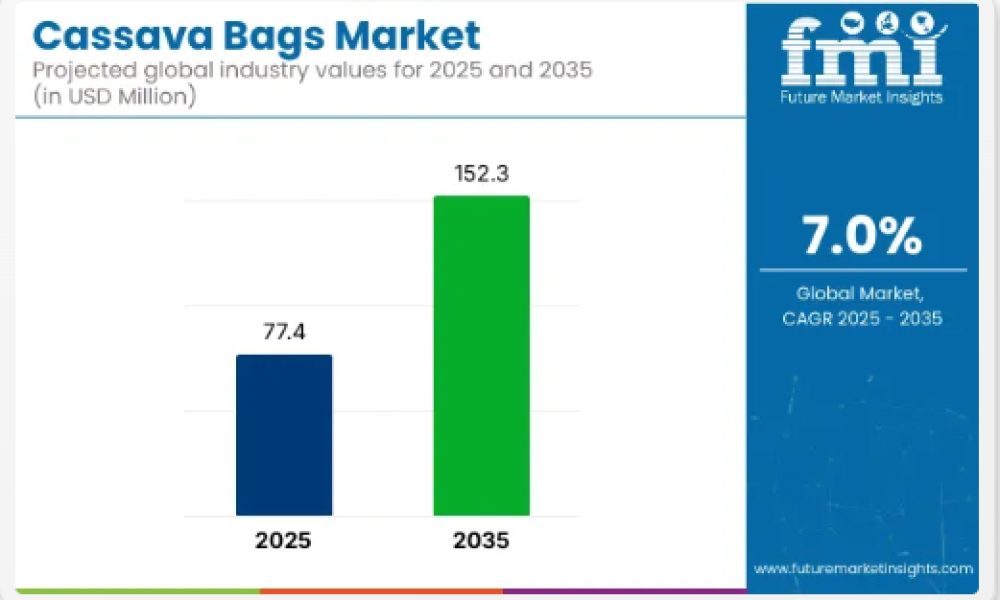
The global cassava bags market is projected to climb from approximately US $77.4 million in 2025 to US $152.3 million by 2035, registering a robust CAGR of around 7.0 % over the forecast period. Demand hinges on accelerating bans and restrictions on single-use plastics, along with rising corporate and consumer preference for biodegradable alternatives. Manufacturing innovations—such as improved compostable polymers and efficient extruding techniques—are unlocking cost-effective scale and enabling stronger performance for cassava-starch-based bags. The food & beverage sector remains the dominant end-use, while packaging for retail, agriculture and e-commerce channels also feature prominently.
Regional Value Added
The Asia Pacific region is emerging as a high-growth zone, owing to abundant cassava feedstock, supportive government policies and growing retail and food-service demand. Meanwhile, North America and Europe continue to lead in absolute value and technological adoption, with stringent regulatory frameworks driving substitution of fossil-based plastics. This blend of mature and growth-oriented geographies provides rich opportunity for global players and regional specialists alike.
Segment Overview
By type, the market is segmented into grip-hole bags, T-shirt bags and garbage bags—with the T-shirt style gaining traction for its versatility across retail and e-commerce. By category, consumers differentiate between “organic” (higher‐value, sustainably certified) and “conventional” cassava bags—with the organic segment commanding premium positioning. By end-use, the food & beverage segment holds the largest share due to extensive requirement for compostable shopping and service bags; the animal feed and other industrial uses represent emerging niches. As manufacturers continue to enhance tensile strength, moisture resistance and compostability, the value proposition of these bags is strengthening across all segments.
Regional Overview
In North America, heightened environmental awareness and plastic-regulation enforcement have positioned the region as an early adopter, with the largest regional share in 2024–25. Europe benefits from rigorous single-use plastics directives and circular-economy frameworks, with growth driven by retail chains and supermarkets seeking bio-based bag solutions. Asia Pacific, particularly Southeast Asia, is fast becoming a regional production hub—thanks to local cassava agriculture, lower labour and infrastructure costs as well as rising domestic consumption. Latin America, Middle East and Africa are incrementally embracing the shift, with local cassava cultivation offering unique supply-chain advantages.
Competitive Landscape
Key players are ramping up investments in sustainable label production, vertical integration (cassava-starch sourcing to bag manufacture), and strategic alliances with retail and food-service brands. The competitive landscape is shifting away from simple price competition toward differentiators such as certification (industrial compostability), lifecycle transparency and supply-chain traceability. Start-ups and regional suppliers are entering via niche specialties while established packaging companies move to anchor their green credentials in this emerging segment.
Market Outlook: Powering the Next Decade
Over the next ten years, the cassava bags market is positioned to become a cornerstone of sustainable packaging ecosystems. With the projected doubling in market value, the industry is expected to scale both volumetrically and technologically—driven by:
- regulatory momentum phasing out conventional plastics
- widespread adoption by major retailers, food-service chains and e-commerce platforms
- manufacturing cost improvements via localised cassava starch supply and automation
- performance enhancements (e.g., moisture barrier, printability, compostable certifications) that make cassava-based bags a viable alternative to conventional plastic.
As the market grows, companies that align with circular-economy goals, build low-emission operations and secure distribution partnerships will capture disproportionate value in the coming decade.
Key Players of Sustainable Label Industry
Prominent companies active in the cassava-bags domain include regional specialists in Asia, Australia and India, as well as global packaging players expanding into bio-based portfolios. These firms focus on deploying sustainable materials, growing capacity, and forging retail/food-service tie-ups to accelerate adoption. For example, firms are leveraging local cassava feedstock to establish cost-efficient production in Southeast Asia while capturing high-value markets in North America and Europe.
Recent Strategic Developments
Recent strategic moves have included partnerships between cassava-bag manufacturers and retail giants seeking to replace fossil-based bags; investments in low-carbon extrusion plants; and certifications for industrial compostability. In addition, scale-up of production in emerging geographies, innovation in bag type (e.g., grip-hole vs T-shirt), and branding emphasising full compostability have emerged as key differentiators. These developments reflect a broader shift across packaging value-chains toward bio-based, circular products—and position cassava bags as a leading sustainable alternative.
To access the complete data tables and in-depth insights, request a sample report here: https://www.futuremarketinsights.com/reports/sample/rep-gb-12978
Subscribe for Year-Round Insights → Stay ahead with quarterly and annual data updates : https://www.futuremarketinsights.com/checkout/12978
Have a specific Requirements and Need Assistant on Report Pricing or Limited Budget please contact us – [email protected]
About Future Market Insights (FMI)
Future Market Insights, Inc. (FMI) is an ESOMAR-certified, ISO 9001:2015 market research and consulting organization, trusted by Fortune 500 clients and global enterprises. With operations in the U.S., UK, India, and Dubai, FMI provides data-backed insights and strategic intelligence across 30+ industries and 1200 markets worldwide.



