
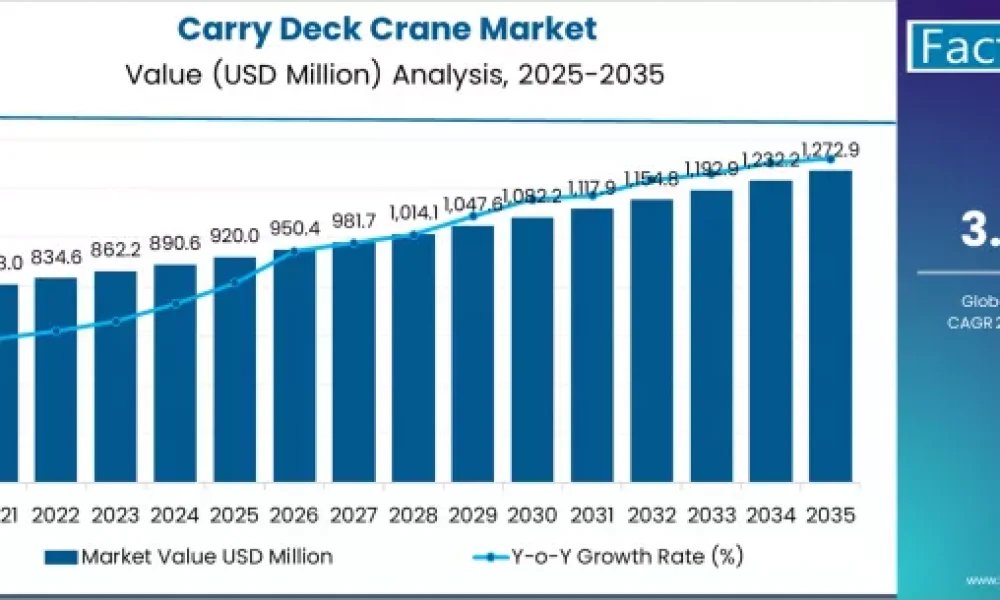
The global carry deck crane market is poised for steady growth through 2035, as demand for compact and versatile lifting solutions strengthens across industrial, construction, and energy sectors. According to a recent report by Fact.MR, the market is projected to grow from USD 920.0 million in 2025 to approximately USD 1,270.0 million by 2035, representing an absolute increase of USD 350.0 million. This reflects a total growth of 38.0% and a compound annual growth rate (CAGR) of 3.3% between 2025 and 2035.
Strong Regional Growth Momentum Across Key Economies
The Asia-Pacific region continues to drive global market growth, supported by strong infrastructure investments, rapid industrialization, and increased adoption of mobile lifting equipment in manufacturing hubs.
- India leads the global growth chart with a CAGR of 4.5%, fueled by ongoing smart city projects, renewable energy installations, and modernization in logistics and ports.
- China follows closely with a CAGR of 3.8%, supported by continuous expansion in industrial infrastructure and the construction of high-speed rail and metro networks.
- Brazil (3.4%) is emerging as a promising market in Latin America, reflecting increased industrial capital investments and energy sector activity.
- In North America, the U.S. market maintains steady growth at 3.2% CAGR, driven by fleet modernization and demand for compact cranes in maintenance and plant operations.
- South Korea (3.1%) and Germany (3.0%) continue to invest in automation and advanced machinery, enhancing crane utilization across manufacturing sectors.
- Japan exhibits moderate but stable growth at 2.6% CAGR, with a focus on efficiency, safety, and technology-integrated lifting systems.
To access the complete data tables and in-depth insights, request a Discount On The Report here: https://www.factmr.com/connectus/sample?flag=S&rep_id=8761
Carry Deck Crane Market Quick Stats
| Metric | Details |
| Market Value (2025) | USD 920.0 million |
| Forecast Value (2035) | USD 1,270.0 million |
| Forecast CAGR (2025–2035) | 3.3% |
| Leading Application | Construction, Industrial Maintenance, and Energy Sector |
| Top Growth Regions | Asia-Pacific, North America, Europe |
| Key Players | Broderson, Grove, Terex, Manitex, Kobelco, Tadano, XCMG, Zoomlion, Link-Belt, Kato, Sany, Liebherr, Elliott Equipment, Shuttlelift, Demag |
Key Factors Driving Market Expansion
- Infrastructure and Construction Boom:
Massive global infrastructure projects—ranging from renewable energy plants to industrial parks—are boosting the need for compact, mobile, and easy-to-operate lifting solutions. - Industrial Modernization:
Factories and manufacturing plants increasingly adopt carry deck cranes for indoor lifting, assembly, and material handling operations due to their maneuverability and load efficiency. - Fleet Upgrades and Equipment Rental Growth:
Rental companies are investing in new-generation cranes with enhanced load capacities, safety features, and emission compliance, fueling market expansion. - Technological Advancements:
Integration of telematics, automation, and hybrid power systems in cranes is improving operational efficiency and lowering total ownership costs. - Safety and Efficiency Standards:
Governments and industry bodies are tightening safety regulations, prompting manufacturers to introduce advanced control systems and ergonomic designs.
Competitive Landscape
The global carry deck crane market is moderately consolidated, with leading manufacturers focusing on product innovation, strategic partnerships, and aftersales service expansion to strengthen their global footprint.
Key Players Include:
Broderson • Grove • Terex • Manitex • Kobelco • Tadano • XCMG • Zoomlion • Link-Belt • Kato • Sany • Liebherr • Elliott Equipment • Shuttlelift • Demag
Companies are emphasizing high-performance cranes with low maintenance costs, eco-efficient powertrains, and enhanced mobility to meet the evolving demands of industrial and construction environments.
Regional Market Insights
- Asia-Pacific: Dominates global demand due to construction expansion, infrastructure investments, and industrial modernization across India and China.
- North America: Witnesses strong adoption in utility maintenance, refineries, and manufacturing facilities, supported by a growing rental sector.
- Europe: Focused on sustainability, automation, and compact design innovations to enhance efficiency in tight operational spaces.
- Latin America: Emerging opportunities in mining, oil & gas, and energy sectors, particularly in Brazil and Chile.
Purchase Full Report for Detailed Insights
For access to full forecasts, regional breakouts, company share analysis, and emerging trend assessments, you can purchase the complete report here: https://www.factmr.com/checkout/8761
Market Outlook — Moving Toward Smarter and Safer Lifting Solutions
The carry deck crane market is projected to maintain steady growth momentum over the next decade as industries prioritize mobility, versatility, and safety in lifting operations. Continuous investment in digital control systems, emission reduction technologies, and operator safety is expected to redefine the competitive landscape.
“Carry deck cranes are becoming indispensable in industrial and construction operations, offering flexibility and precision in compact environments,” said a Fact.MR analyst. “Manufacturers that integrate intelligent controls, low-emission designs, and fleet connectivity will be well-positioned to capture future growth.”
Have a specific Requirements and Need Assistant on Report Pricing or Limited Budget please contact us – [email protected]
About Fact.MR
Fact.MR is a global market research and consulting firm, trusted by Fortune 500 companies and emerging businesses for reliable insights and strategic intelligence. With a presence across the U.S., UK, India, and Dubai, we deliver data-driven research and tailored consulting solutions across 30+ industries and 1,000+ markets. Backed by deep expertise and advanced analytics, Fact.MR helps organizations uncover opportunities, reduce risks, and make informed decisions for sustainable growth.



