
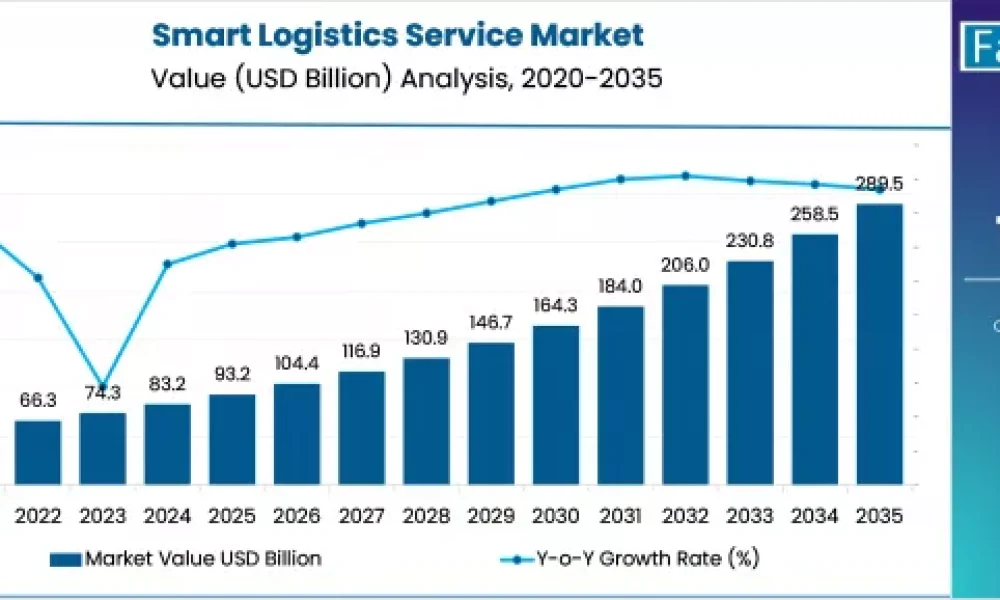
The global smart logistics service market is projected to expand from USD 93.2 billion in 2025 to approximately USD 289.5 billion by 2035, corresponding to a compound annual growth rate (CAGR) of around 12% over the forecast decade. Growth is driven by increasing e-commerce volumes, demands for real-time visibility, automation in supply chains, and sustainability pressures in transportation and warehousing.
As logistics providers seek to optimise last-mile delivery, enhance fleet utilisation, and integrate digital technologies such as AI, IoT, blockchain and robotics, smart logistics services are becoming a strategic imperative rather than a support function. This market is evolving rapidly from experimental deployments toward enterprise-scale platforms offering orchestration, visibility, digital freight brokerage and managed warehouse operations.
Key Market Insights at a Glance
Market Value (2025): USD 93.2 billion
Forecast Value (2035): USD 289.5 billion
CAGR (2025–2035): ~12%
Leading Service Segment (2025): Last-mile optimisation & orchestration (~25% share)
Fastest-Growing Country (2025–2035): China (~11.1% CAGR)
Key Growth Drivers: E-commerce surge, supply chain digitisation, fleet electrification/green logistics, real-time data visibility
Prominent Players: DHL; Flexport; GXO Logistics; Veho Logistics; Maersk
To Access the Complete Data Tables & in-depth Insights, Request a Discount on this report: https://www.factmr.com/connectus/sample?flag=S&rep_id=10962
Market Drivers / Growth Overview
The smart logistics service market is being supported by multiple converging trends. First, the exponential growth of online retail and fast-delivery expectations is placing immense pressure on last-mile logistics—raising demand for route-optimisation, real-time tracking and flexible fulfilment networks. Second, the rise of technologies such as AI, IoT, cloud control-towers, and digital freight marketplaces is enabling logistics providers to reduce costs, improve service levels and offer new business models (for example, freight-brokerage-as-a-service). Third, sustainability imperatives (including electric fleets, route optimisation for fuel efficiency, and carbon-footprint tracking) are forcing logistics networks to adopt smart solutions. Fourth, global supply chain disruptions have exposed the need for resilient, agile logistics systems with end-to-end visibility and predictive analytics.
On the flip side, barriers such as high initial investment, complex system integration, legacy infrastructure, talent shortages in data/AI skills and regulatory differences across geographies may moderate near-term adoption. Nonetheless, the structural tailwinds remain strong.
Segmentation & Key Drivers
By Service Type:
Last-mile optimisation & orchestration holds the largest share due to direct pressure from consumer delivery demands.
Real-time visibility & control towers are rapidly growing as enterprises seek actionable insights and predictive analytics across modes.
Digital freight brokerage & TMS-as-a-service are expanding within freight networks and 3PL/4PL ecosystems.
Additional types include warehouse-operations-as-a-service, cold-chain compliance services, and reverse-logistics optimisation.
By Deployment Model:
Cloud-native solutions are increasingly preferred for scalability, real-time data and multi-location coordination.
Hybrid and on-premises deployments serve more regulated or asset-heavy enterprises with legacy systems.
By End-Use Industry:
Retail & e-commerce dominate given high fulfilment requirements and delivery frequency.
Consumer electronics, automotive, pharma & healthcare, industrial/manufacturing, and food & beverage each offer specialised demand dynamics (cold chain, asset visibility, manufacturing logistics).
By Transport Model:
Road and last-mile delivery are dominant, but air, rail, ocean, and multimodal segments are integrating smart-logistics services for improved coordination and visibility.
Segment growth is driven by cost pressures, service-level expectations, technology adoption (AI, IoT, cloud), regulatory and sustainability mandates, and supply-chain complexity.
Regional & Country Insights
North America: Lead region due to mature e-commerce, high logistics automation and strong digital infrastructure.
East Asia (China, India, Southeast Asia): Fastest-growing region; China is forecast to grow at ~11.1% CAGR (2025–2035) based on digital logistics initiatives, infrastructure investment and e-commerce scale.
Europe: Steady growth underpinned by regulatory demands (green logistics, digital visibility), and advanced logistics ecosystem.
Latin America, Middle East & Africa: Emerging markets with large upside as logistics networks modernise and digital adoption accelerates.
Competitive Landscape
The smart logistics service market is competitive and features global integrators, digital-first disruptors and regional specialists. Key players include DHL, Flexport, GXO Logistics, Veho Logistics and Maersk. These companies are investing in digital-platform capabilities, autonomous and electric fleet solutions, control-tower analytics, and service-ecosystem partnerships. Strategies include mergers/acquisitions to expand digital fulfilment capabilities, joint ventures with technology providers, and development of subscription-based logistics services.
Recent Developments
Deployment of cloud-based logistics control towers that integrate real-time fleet tracking, predictive analytics and exception-management across multimodal networks.
Logistics providers expanding last-mile optimisation platforms that leverage AI-based route planning, dynamic dispatch and gig-economy driver integration.
Accelerated investment in green-logistics solutions: electric delivery fleets, micro-fulfilment centres, and carbon-footprint monitoring services.
Digital freight brokerage platforms scaling to connect shippers and carriers, reduce empty-miles, and provide dynamic pricing and routing.
Emerging pilots of autonomous delivery vehicles, drones and robotics within smart-logistics services for urban last-mile fulfilment.
Market Outlook & Strategic Insights
Over the forecast period (2025–2035), the smart logistics service market is expected to transition from fragmented digital pilots to enterprise-scale service platforms embedded into supply-chain ecosystems. Key strategic priorities for stakeholders include:
Developing scalable, real-time digital platforms that integrate tracking, orchestration, analytics and execution across modes.
Leveraging last-mile optimisation as a differentiator in high-density urban fulfilment.
Expanding managed-service models (e.g., logistics-as-a-service, broker-as-a-service) to capture recurring revenue and client stickiness.
Investing in sustainability and green logistics solutions (electric fleets, micro-fulfilment, carbon tracking) to meet regulatory and customer expectations.
Building ecosystem partnerships (technology providers, fulfilment centres, carriers, shippers) to broaden service offering and regional reach.
Targeting high-growth geographies (East Asia, Southeast Asia, India) and emerging logistics corridors to capture incremental demand.
Companies that execute on these imperatives—while ensuring reliability, data security, operational scalability, and strategic positioning—are well-placed to capture a significant portion of the projected USD 289.5 billion smart logistics service market by 2035.
Purchase Full Report for Detailed Insights
For access to full forecasts, regional breakouts, company share analysis, and emerging trend assessments, you can purchase the complete report: https://www.factmr.com/checkout/10962
Have specific requirements or need assistance on report pricing or have a limited budget? Please contact [email protected]
Contact:
US Sales Office
11140 Rockville Pike
Suite 400
Rockville, MD 20852
United States
Tel: +1 (628) 251-1583, +353-1-4434-232
Email: [email protected]
About Fact.MR:
Fact.MR is a global market research and consulting firm, trusted by Fortune 500 companies and emerging businesses for reliable insights and strategic intelligence. With a presence across the U.S., UK, India, and Dubai, we deliver data-driven research and tailored consulting solutions across 30+ industries and 1,000+ markets. Backed by deep expertise and advanced analytics, Fact.MR helps organizations uncover opportunities, reduce risks, and make informed decisions for sustainable growth.



