
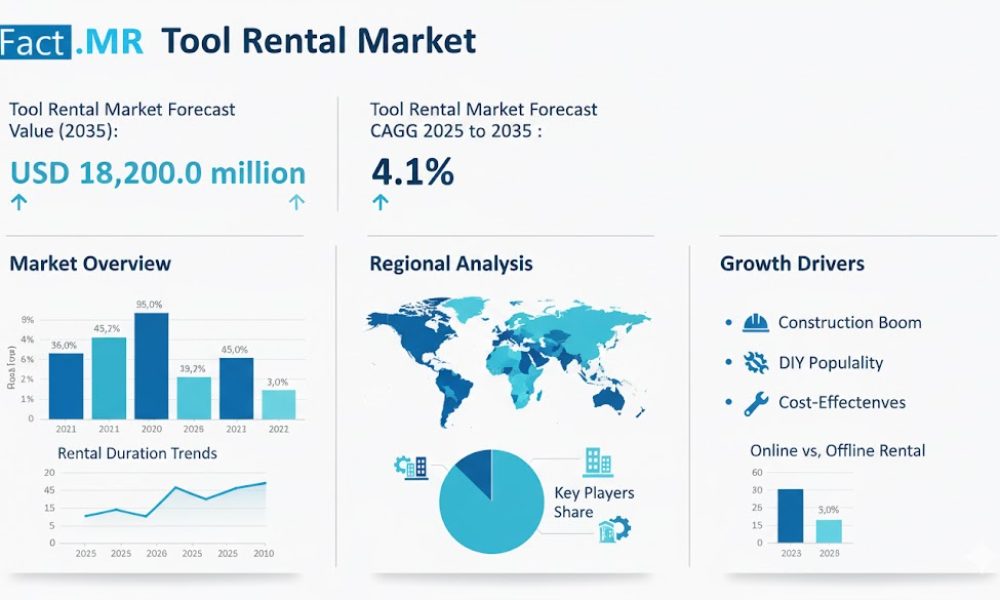
The global tool rental market is projected to witness steady growth over the next decade, with valuations expected to rise from USD 12,200.0 million in 2025 to USD 18,200.0 million by 2035, representing a compound annual growth rate (CAGR) of 4.1%. According to a new report by Future Market Insights (FMI), this surge reflects an absolute market increase of USD 6,000.0 million, driven by rising infrastructure development, industrial expansion, and growing demand for cost-efficient equipment solutions across construction, manufacturing, and maintenance sectors.
Strong Regional Momentum in APAC, North America, and Europe
India emerges as the fastest-growing market, registering a CAGR of 5.0% over the forecast period, fueled by expanding construction projects and industrial modernization initiatives. China follows at 4.2%, supported by increased urbanization and industrial automation. In North America, the U.S. market grows at a CAGR of 3.8%, driven by rental adoption in both residential and commercial construction projects. European markets, including the UK (3.7%) and Germany (3.5%), are witnessing stable growth due to mature rental ecosystems and sustainability-focused construction practices. Japan and South Korea record moderate growth at 3.0% and 3.6%, respectively, as contractors increasingly rely on rentals for specialized tools.
To access the complete data tables and in-depth insights, request a Discount On The Report here: https://www.factmr.com/connectus/sample?flag=S&rep_id=8654
Tool Rental Market Quick Stats:
| Metric | Details |
| Market Value (2025) | USD 12,200.0 million |
| Forecast Value (2035) | USD 18,200.0 million |
| Forecast CAGR (2025–2035) | 4.1% |
| Key Growth Regions | APAC, North America, Europe |
| Leading Players | The Home Depot, United Rentals, Lowe’s, Ashtead Group, Hilti, HSS Hire, Sunbelt Rentals, Boels Rental, Makita, Milwaukee, DeWalt, Bosch, Herc Rentals, Kiloutou, Snap-on |
Driving Factors Behind Market Expansion
- Infrastructure and Industrial Growth: Rising construction, mining, and manufacturing projects drive demand for rented tools, reducing upfront capital expenditure for companies.
- Operational Efficiency and Cost Savings: Rentals offer flexible, short-term access to high-quality equipment, enabling cost-effective project execution.
- Technological Integration: Smart tools, IoT-enabled equipment, and digital rental platforms enhance tracking, utilization, and operational efficiency.
- E-commerce and Digital Platforms: Online rental services and app-based bookings are simplifying access to tools, especially in urban and semi-urban regions.
- Sustainability Initiatives: Reuse and rental models align with corporate sustainability goals, minimizing equipment wastage and promoting circular economy practices.
Segment Overview
- By Tool Type: Power tools, heavy machinery, and specialized construction equipment dominate rental demand.
- By Application: Construction, industrial maintenance, and infrastructure projects represent the largest market segments.
- By Distribution Channel: Direct rental services and online rental platforms are expanding rapidly, particularly in APAC and North America.
Competitive Landscape
Key players are leveraging digital transformation, strategic acquisitions, and service diversification to strengthen market positions:
- The Home Depot, Inc.
- United Rentals, Inc.
- Lowe’s Companies, Inc.
- Ashtead Group plc
- Hilti Corporation
- HSS Hire Service Group Ltd.
- Sunbelt Rentals, Inc.
- Boels Rental B.V.
- Makita Corporation
- Milwaukee Tool (Techtronic Industries Company Limited)
- DeWalt (Stanley Black & Decker, Inc.)
- Bosch Power Tools (Robert Bosch GmbH)
- Herc Rentals, Inc.
- Kiloutou
- Snap-on Incorporated
Regional Market Outlook
- APAC: India and China lead market expansion, supported by industrialization and urban infrastructure growth.
- North America: The U.S. market is driven by construction, industrial projects, and digital rental adoption.
- Europe: Germany and the UK show steady growth due to mature rental models, tool standardization, and sustainability initiatives.
- Asia-Pacific (Other): South Korea and Japan grow steadily with demand for specialized tools in construction and maintenance sectors.
For access to full forecasts, regional breakouts, company share analysis, and emerging trend assessments, you can purchase the complete report here: https://www.factmr.com/checkout/8654
Market Outlook: Strategic and Operational Efficiency
The tool rental market is poised for sustained growth, as contractors, industrial operators, and commercial entities increasingly prefer rental models over ownership. Companies investing in digital platforms, R&D for advanced tools, and flexible rental services are likely to capture the largest market share.
“Tool rental is becoming a strategic choice for industries aiming to optimize cost, efficiency, and sustainability,” “With the global market expected to expand nearly 1.4X by 2035, players focusing on technology-driven solutions and regional expansion will lead the growth trajectory.”
Have a specific Requirements and Need Assistant on Report Pricing or Limited Budget please contact us – [email protected]
About Fact.MR
Fact.MR is a global market research and consulting firm, trusted by Fortune 500 companies and emerging businesses for reliable insights and strategic intelligence. With a presence across the U.S., UK, India, and Dubai, we deliver data-driven research and tailored consulting solutions across 30+ industries and 1,000+ markets. Backed by deep expertise and advanced analytics, Fact.MR helps organizations uncover opportunities, reduce risks, and make informed decisions for sustainable growth.



