
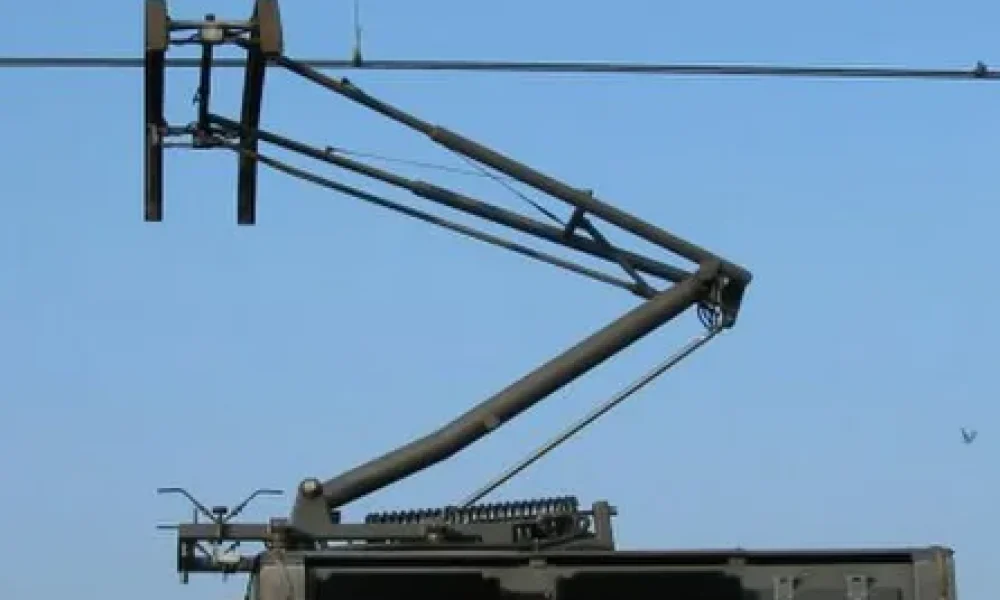
The global locomotive pantographs market is poised for robust growth, projected to reach USD 462.3 million in 2024 and expected to climb to USD 480.3 million in 2025, reflecting a year-on-year growth of 3.9%. Industry estimates indicate a compound annual growth rate (CAGR) of 4.8% from 2025 to 2035, with the market anticipated to achieve a valuation of USD 768.6 million by 2035. The accelerating expansion is driven by the increasing adoption of railway electrification, high-speed rail networks, and advanced pantograph technologies across major global markets.
Single-Arm Pantographs Drive Market Dominance
Single-arm pantographs remain the most widely adopted type in the locomotive sector, accounting for an expected 74.7% market share by 2035. Their lightweight and aerodynamic design provides superior efficiency for high-speed rail operations, minimizing energy losses while ensuring operational reliability. These attributes have made single-arm pantographs particularly popular in Europe and Asia, where electrification and sustainable rail initiatives are gaining momentum.
Modern pantographs are no longer limited to simple power collection; smart pantograph systems now integrate real-time monitoring and predictive maintenance features. These innovations are increasingly critical for automated and high-speed rail networks, allowing operators to maintain uninterrupted power transmission while reducing operational costs.
Request Your Sample Report Today and discover growth opportunities!
https://www.futuremarketinsights.com/reports/sample/rep-gb-16119
Electrification and High-Speed Rail Expansion Fuel Growth
Globally, the railway network extends approximately 1.3 million kilometers, with the United States leading at 250,000 km, followed by China (155,000 km), Russia (85,500 km), India (68,000 km), and Canada (49,000 km). With over 40% of rail lines electrified worldwide, governments are prioritizing sustainable transport solutions. Countries including China, India, Germany, and France are investing heavily in electrified infrastructure, further driving the need for high-performance pantographs.
High-speed rail expansion is a particularly strong growth driver. China plans to expand its high-speed rail network to over 50,000 km by 2035, while Japan’s Shinkansen and France’s TGV continue to grow to meet rising passenger demand. Pantographs for these networks must withstand speeds exceeding 300 km/h, necessitating lightweight, aerodynamic designs with active damping mechanisms to reduce vibrations and optimize energy efficiency.
Technological Innovations Enhance Performance and Reliability
Modern locomotive pantographs incorporate advanced materials such as carbon composites and alloys, which offer durability and conductivity while reducing maintenance costs. Smart sensors and automated height adjustment systems ensure optimal contact with overhead lines, enhancing power transmission and operational efficiency. Real-time monitoring allows operators to detect issues before they escalate, significantly reducing downtime.
Such advancements are particularly relevant in high-speed and metro rail systems, where reliability is paramount. As operators seek to optimize efficiency and reduce costs, the adoption of technologically advanced pantographs is expected to rise sharply, further supporting market growth.
Regional Market Dynamics and Key Growth Countries
China, India, and Germany are forecasted to exhibit strong CAGRs of 6.1%, 5.7%, and 5.4%, respectively, through 2035. China’s locomotive pantographs market is projected to reach USD 184.4 million by 2035, fueled by high-speed rail expansion and the Belt and Road Initiative. India’s market is expected to attain USD 94.4 million, driven by its ambitious target of 100% rail electrification by 2030 and the deployment of semi-high-speed trains such as Vande Bharat. Germany’s market is projected to reach USD 54.8 million, supported by sustainable rail initiatives and the expansion of its ICE network under the EU Green Deal.
Competitive Landscape: Established Leaders and Emerging Innovators
The global market is segmented into Tier 1, Tier 2, and Tier 3 players. Tier 1 leaders, including Wabtec Corporation, The+together Group, Schneider Electric, and HeidelbergCement, account for over 50% of the market, leveraging extensive production capacity, wide product portfolios, and advanced manufacturing expertise. Tier 2 players, such as New Flyer Industries, CRRC Corporation, Knorr-Bremse, and Bombardier, capture 20–25% of the market by serving regional and specialized demands. Tier 3 players, including Hitachi Rail and Mitsubishi Electric, operate at a local level with smaller revenues but contribute to niche innovations and competitive market expansion.
Leading manufacturers are driving innovation through R&D, strategic acquisitions, and partnerships. For example, Wabtec Corporation’s recent acquisition of relay and pantograph component businesses has expanded its product portfolio, while Hitachi Rail’s acquisition of Thales’ Ground Transportation System division strengthens its global railway automation capabilities.
Checkout Now to Access Industry Insights:
https://www.futuremarketinsights.com/checkout/16119
Outlook: Opportunities for Growth and Investment
The locomotive pantographs market is set for sustained expansion as electrification projects, high-speed rail adoption, and technological innovations converge. With the ongoing shift toward sustainable transportation and government initiatives aimed at reducing carbon emissions, manufacturers and investors have significant opportunities to expand production, introduce advanced pantograph solutions, and capture a growing market share.
Conclusion
From single-arm aerodynamic designs to smart, sensor-enabled systems, locomotive pantographs are at the forefront of the rail industry’s electrification and modernization journey. With expanding high-speed rail networks and ambitious electrification goals in key regions, both established and emerging manufacturers are poised to capitalize on a market set for transformative growth over the next decade.
Key Players: Wabtec Corporation, The+together Group, Schneider Electric, HeidelbergCement, New Flyer Industries, CRRC Corporation, Knorr Bremse, Bombardier, Hitachi Rail, Mitsubishi Electric
About Future Market Insights (FMI)
Future Market Insights, Inc. (FMI) is an ESOMAR-certified, ISO 9001:2015 market research and consulting organization, trusted by Fortune 500 clients and global enterprises. With operations in the U.S., UK, India, and Dubai, FMI provides data-backed insights and strategic intelligence across 30+ industries and 1200 markets worldwide.



