
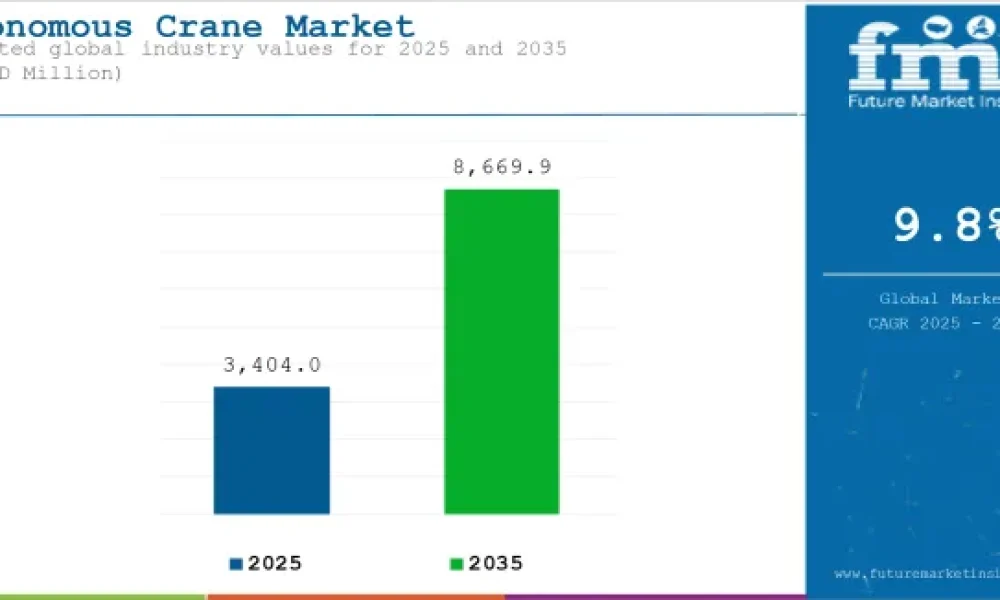
The global autonomous crane market is poised for transformative growth, projected to surge from USD 3,404.0 million in 2025 to USD 8,669.9 million by 2035, reflecting a robust CAGR of 9.8% over the next decade. This rapid expansion is fueled by technological advancements, increasing electrification of construction and industrial equipment, and growing investments in sustainable and automated infrastructure.
Industries across the spectrum—including marine and offshore, building and construction, and mining—are increasingly turning to autonomous cranes for their precision, efficiency, and safety. The marine and offshore sector, in particular, is leading the adoption curve, driven by rising offshore exploration, port automation, and renewable energy projects. High-capacity, AI-driven cranes are becoming indispensable for complex cargo handling and offshore installations, offering real-time monitoring, predictive maintenance, and reduced operational downtime.
Technological Advancements Driving Market Transformation
Autonomous cranes are benefiting from a wave of technological innovations. AI-powered navigation systems, IoT-enabled observation capabilities, and predictive maintenance technologies have revolutionized the sector. Modern autonomous cranes operate with minimal downtime, optimized energy consumption, and increased productivity while ensuring workplace safety. These advanced features are particularly crucial in industries requiring precise and reliable operations, such as high-rise construction, offshore wind installations, and port automation projects.
Despite their advantages, autonomous cranes present a significant upfront investment, particularly for small and medium-sized enterprises (SMEs). However, long-term savings from reduced labor requirements, lower maintenance costs, and enhanced operational efficiency make these cranes a highly sustainable and cost-effective solution over time. In response, manufacturers are offering modular designs, leasing models, and hybrid-powered systems, broadening accessibility for smaller enterprises globally.
Request Your Sample Report Today and discover growth opportunities!
https://www.futuremarketinsights.com/reports/sample/rep-gb-16121
Market Segmentation Highlights Key Opportunities
Payload capacity analysis reveals that cranes below 50 tons will dominate the market with a share of 30.2% in 2025. These cranes are versatile, ideal for urban construction, industrial applications, and confined spaces requiring precision handling. Their lightweight designs, compact electric motors, and compatibility with hybrid power sources enhance operational efficiency while meeting stringent emission standards. Meanwhile, the marine and offshore sector continues to lead end-user adoption, accounting for 32.4% of market share. AI-powered autonomous cranes in ports like Hamburg and Rotterdam exemplify how smart automation improves cargo handling, reduces operational delays, and ensures safety even under adverse conditions.
Regional Trends and Growth Drivers
Emerging markets in Asia-Pacific and Africa are becoming significant growth engines. Rapid urbanization, industrialization, and large-scale infrastructure development are fueling demand for autonomous cranes in countries like India, Indonesia, and Egypt. India’s renewable energy projects, metro expansions, and local manufacturing initiatives under the “Make in India” program are driving adoption, while Indonesia’s capital city relocation project highlights the growing need for technologically advanced construction equipment.
In China, the Belt and Road Initiative and expansive infrastructure projects are accelerating crane deployments, particularly for high-capacity lifting in logistics hubs and mega ports. Integration of IoT, AI, and renewable energy into crane operations further solidifies China’s leadership in the global market. The United States also remains a key adopter, driven by port automation and urban construction initiatives, with hybrid cranes offering sustainable solutions for energy-efficient and flexible operations.
Checkout Now to Access Industry Insights:
https://www.futuremarketinsights.com/checkout/16121
Competitive Landscape and Industry Innovation
The autonomous crane market is competitive, featuring a mix of established leaders and emerging innovators. Tier-1 manufacturers, including Liebherr Group, Konecranes, Manitowoc, and Zoomlion, capture over 55% of market share, leveraging extensive R&D, global reach, and advanced AI-integrated systems. Tier-2 players such as Palfinger AG and Hiab (Cargotec) account for 40-45% of the market, focusing on regional solutions, hybrid-powered technologies, and specialized applications.
Recent industry developments underscore the pace of innovation. In October 2023, PALFINGER partnered with Oplift and Aker BP to deploy autonomous offshore cranes, advancing efficiency in offshore operations. Similarly, ANDRITZ introduced the world’s first AI-powered logyard crane in May 2023, offering zero CO2 emissions and minimal noise, exemplifying the push for environmentally friendly and cost-effective solutions.
Future Outlook
From 2025 to 2035, rapid technological advancements—including AI-powered predictive maintenance, IoT monitoring, and hybrid-electric power sources—are set to redefine the autonomous crane industry. Regions such as India and China are driving demand through smart city projects and large-scale infrastructure development, while Europe’s stringent environmental regulations accelerate adoption of electric-powered systems. Lightweight materials, energy-efficient designs, and modular configurations will further enhance operational efficiency, making autonomous cranes indispensable across multiple sectors.
As global industries prioritize automation, safety, and sustainability, autonomous cranes are emerging as a cornerstone of modern material handling solutions. With both established players and new entrants innovating continuously, the market is positioned for sustained growth, technological advancement, and broader adoption across the globe.
About Future Market Insights (FMI)
Future Market Insights, Inc. (FMI) is an ESOMAR-certified, ISO 9001:2015 market research and consulting organization, trusted by Fortune 500 clients and global enterprises. With operations in the U.S., UK, India, and Dubai, FMI provides data-backed insights and strategic intelligence across 30+ industries and 1200 markets worldwide.



