
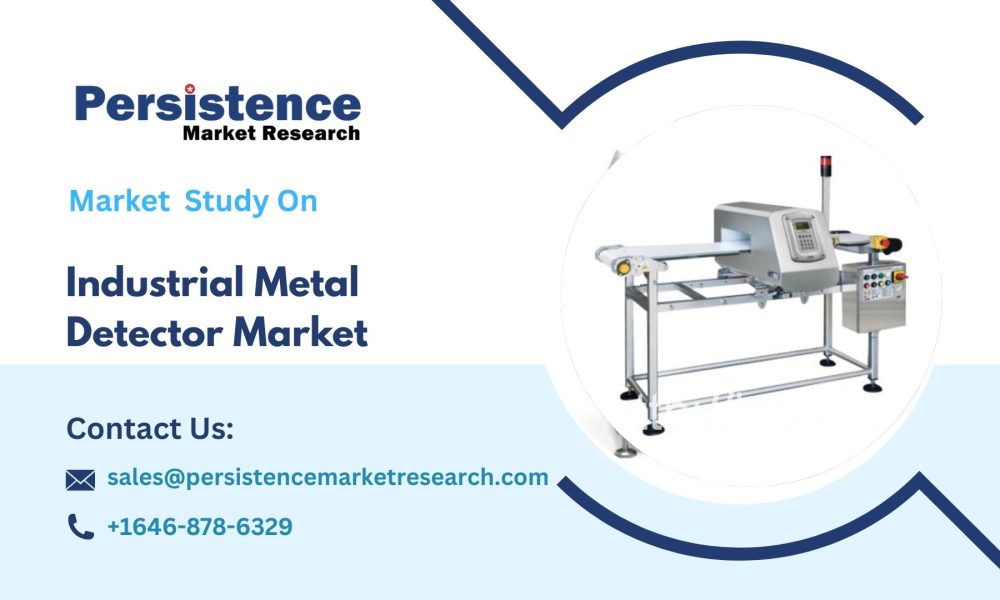
The industrial metal detector market is experiencing steady growth as industries increasingly prioritize product safety, quality assurance, and regulatory compliance. Industrial metal detectors are devices designed to identify and remove metallic contaminants in manufacturing and processing environments. These systems are widely used across food & beverage, pharmaceuticals, packaging, mining, recycling, and textile industries to ensure product integrity and protect consumers from contamination risks. With growing consumer awareness regarding product safety and the rising importance of maintaining stringent quality standards, the adoption of industrial metal detectors has become a critical component of manufacturing operations.
The global market is expected to reach US$322.2 million in 2025, expanding to US$444.4 million by 2032, registering a CAGR of 4.7% during the forecast period. Among product segments, in-line metal detectors dominate the market due to their ability to seamlessly integrate into production lines and provide real-time detection without disrupting workflow. Geographically, North America leads the market, driven by stringent regulatory frameworks, high automation adoption, and the presence of major manufacturing and food processing companies. Europe is also witnessing strong growth due to strict food safety standards enforced by the European Food Safety Authority (EFSA) and robust industrial infrastructure supporting adoption.
𝐆𝐞𝐭 𝐚 𝐒𝐚𝐦𝐩𝐥𝐞 𝐏𝐃𝐅 𝐁𝐫𝐨𝐜𝐡𝐮𝐫𝐞 𝐨𝐟 𝐭𝐡𝐞 𝐑𝐞𝐩𝐨𝐫𝐭: https://www.persistencemarketresearch.com/samples/21310
Key Highlights from the Report
• The global industrial metal detector market is projected to reach US$444.4 million by 2032, growing at a CAGR of 4.7%.
• In-line metal detectors dominate the product segment due to seamless production line integration.
• North America leads the market, driven by regulatory compliance and high automation adoption.
• Europe shows strong growth, supported by strict food safety regulations and industrial expansion.
• The food & beverage sector is the largest end-user segment, requiring contamination control solutions.
• Technological advancements, including multi-frequency detection and digital interfaces, enhance detection sensitivity and reliability.
Market Segmentation
The industrial metal detector market is segmented based on product type, application, and end-user industry.
By product type, the market includes in-line metal detectors, stand-alone units, and portable metal detectors. In-line metal detectors are widely preferred in industries such as food processing, pharmaceuticals, and packaging due to their continuous monitoring capability and real-time detection, which prevents contaminated products from reaching consumers. Stand-alone units are commonly used in laboratories, quality control facilities, and smaller processing lines, offering flexibility and targeted detection. Portable metal detectors serve inspection and maintenance purposes, particularly in sectors such as mining, recycling, and field operations where mobility and rapid scanning are essential.
By application, metal detectors are used for contamination control, quality assurance, safety inspection, and process monitoring. Contamination control applications dominate the market, especially in food and pharmaceutical sectors, where eliminating metallic contaminants is critical for compliance with regulatory standards and consumer safety. Quality assurance applications ensure consistent product quality and safeguard brand reputation, while safety inspections help maintain operational safety by detecting foreign metal objects in machinery and equipment.
By end-user industry, the market covers food & beverage, pharmaceuticals, packaging, mining & metals, recycling, and textiles. The food & beverage sector is the largest end-user, driven by the necessity of complying with HACCP, FDA, and USDA guidelines, as well as growing consumer demand for safe, contaminant-free products. Pharmaceuticals rely on metal detectors to maintain product purity and meet stringent quality standards. The packaging industry benefits from integration of metal detection systems in production lines to prevent contamination during packaging processes. Mining and recycling industries adopt metal detectors to identify metallic elements in bulk materials, enhancing operational efficiency and safety.
Regional Insights
North America dominates the industrial metal detector market due to strict regulatory mandates from agencies such as the FDA and USDA, high automation penetration, and a strong focus on food safety. The U.S. in particular is a key driver, with food processing and pharmaceutical industries heavily investing in in-line metal detectors for quality control.
Europe holds a significant market share, fueled by compliance requirements from EFSA and other local regulatory authorities. Countries such as Germany, France, and the UK are witnessing increased adoption of metal detection systems in food production, pharmaceuticals, and packaging lines. Advanced industrial infrastructure and automation trends support market growth.
Asia-Pacific (APAC) is emerging as a fast-growing market, led by China, India, and Japan, driven by expanding food processing, pharmaceutical manufacturing, and packaging industries. Increasing consumer awareness of product safety, urbanization, and rising industrialization contribute to market adoption. Latin America and Middle East & Africa (MEA) show moderate growth, supported by investments in food processing, mining, and industrial manufacturing sectors.
Market Drivers
The primary drivers of the industrial metal detector market include stringent regulatory compliance, rising food safety concerns, and increasing industrial automation. Regulatory requirements from agencies such as the FDA, USDA, and EFSA mandate the use of metal detection systems to minimize contamination risks, particularly in food processing operations. These regulations have made metal detection a critical control point under HACCP (Hazard Analysis and Critical Control Points) systems.
Additionally, growing consumer awareness regarding product safety, hygiene, and quality standards is encouraging manufacturers to implement advanced metal detection solutions. Industrial automation and integration of detection systems in production lines enhance efficiency and reduce human error, further driving adoption. Technological innovations such as multi-frequency detection, high-speed digital interfaces, and improved sensitivity ensure that metal detectors can reliably detect ferrous, non-ferrous, and stainless-steel contaminants even in challenging product matrices.
Market Restraints
Despite robust growth, the industrial metal detector market faces certain restraints. High installation and maintenance costs of advanced metal detection systems can deter adoption, especially for small and medium-sized enterprises. Specialized equipment such as multi-frequency in-line detectors requires skilled technicians for installation, calibration, and ongoing maintenance, increasing operational costs.
Product limitations can also pose challenges. Detection sensitivity may vary based on product type, packaging materials, and product moisture content, requiring customized solutions for optimal performance. Additionally, competitive pressures and the availability of alternative contamination control technologies, such as X-ray inspection systems, may limit market penetration in certain segments.
𝐃𝐨 𝐘𝐨𝐮 𝐇𝐚𝐯𝐞 𝐀𝐧𝐲 𝐐𝐮𝐞𝐫𝐲 𝐎𝐫 𝐒𝐩𝐞𝐜𝐢𝐟𝐢𝐜 𝐑𝐞𝐪𝐮𝐢𝐫𝐞𝐦𝐞𝐧𝐭? 𝐑𝐞𝐪𝐮𝐞𝐬𝐭 𝐂𝐮𝐬𝐭𝐨𝐦𝐢𝐳𝐚𝐭𝐢𝐨𝐧 𝐨𝐟 𝐑𝐞𝐩𝐨𝐫𝐭: https://www.persistencemarketresearch.com/request-customization/21310
Market Opportunities
The industrial metal detector market presents significant opportunities in both technological innovation and expanding industry applications. The development of multi-frequency metal detectors, high-speed conveyors, and integrated digital monitoring systems offers manufacturers a chance to provide enhanced detection capabilities and reduce false rejects.
Food & beverage and pharmaceutical industries remain key growth avenues, with rising consumer demand for safe and high-quality products creating opportunities for deployment of advanced metal detection systems. Emerging economies in Asia-Pacific, Latin America, and the Middle East provide untapped markets where industrialization and food processing growth are driving adoption. Strategic collaborations, product customization, and investment in research & development for enhanced sensitivity and automation integration can further strengthen market position and growth.
Company Insights
The industrial metal detector market is highly competitive, with leading players focusing on innovation, product reliability, and regional expansion to strengthen their market presence.
Key Players:
• Mettler-Toledo International Inc.
• CEIA S.p.A.
• Minebea Intec GmbH
• Loma Systems Ltd.
• Thermo Fisher Scientific Inc.
• Fisher Technology, Inc.
• Sesotec GmbH
• Dectector Technologies
• Ishida Co., Ltd.
• Scanvaegt Systems A/S
Recent Developments:
In 2024, Mettler-Toledo launched a new multi-frequency in-line metal detector series optimized for high-speed food processing lines, improving sensitivity and reducing false rejects.
In 2023, Loma Systems expanded its European manufacturing facility to increase production capacity for industrial metal detectors with integrated IoT monitoring, addressing growing demand in food and pharmaceutical sectors.
Conclusion
The industrial metal detector market is projected to grow from US$322.2 million in 2025 to US$444.4 million by 2032, reflecting a CAGR of 4.7%. Growth is primarily driven by stringent regulatory requirements, rising consumer awareness regarding product safety, and increasing industrial automation across manufacturing sectors.
Industries such as food & beverage, pharmaceuticals, and packaging are leading adoption, deploying in-line and multi-frequency metal detectors to maintain contamination-free products and comply with HACCP standards. Technological advancements in sensitivity, digital interfaces, and IoT-enabled monitoring provide manufacturers with enhanced operational efficiency and reduced downtime. While challenges such as high costs and product limitations persist, opportunities in emerging economies, R&D innovation, and expanding industrial applications ensure sustained market growth through the forecast period.




