
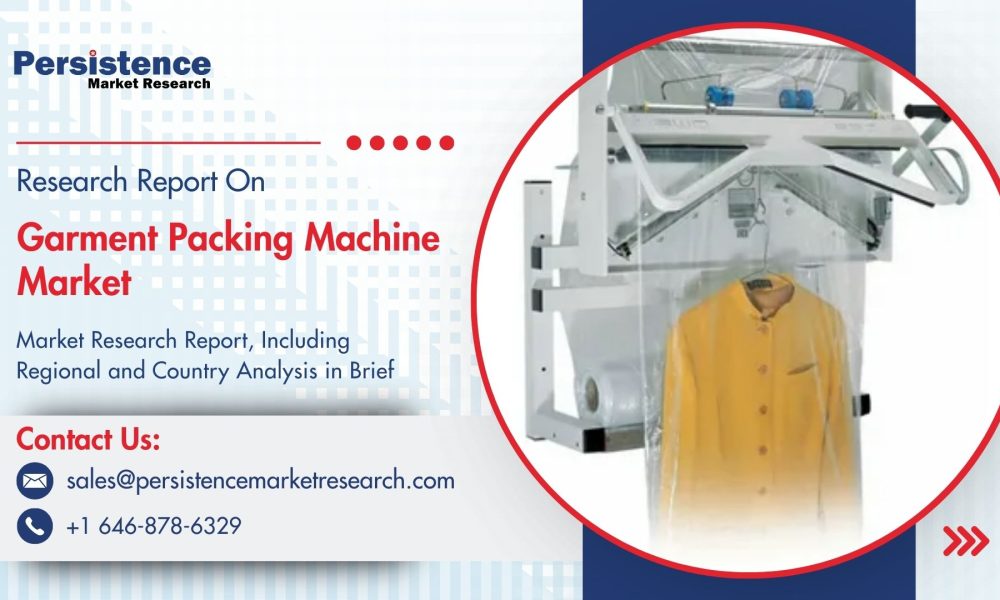
The global garment packing machine market is evolving rapidly, driven by rising automation across the textile and apparel sectors, increasing labor costs, and the growing demand for efficient and eco-friendly packaging solutions. As global clothing production expands and e-commerce transforms consumer buying behavior, garment manufacturers and exporters are investing in advanced packing technologies to improve productivity, ensure consistent quality, and minimize packaging waste.
According to the latest study by Persistence Market Research, the global garment packing machine market size is estimated to be worth US$2.47 Bn in 2024 and is projected to reach US$3.29 Bn by 2031, expanding at a CAGR of 3.9% during the forecast period from 2024 to 2031. This steady growth reflects the rising adoption of automated packaging systems, sustainability-focused packaging innovations, and the increasing need for operational efficiency in garment manufacturing and distribution.
Get a Sample PDF Brochure of the Report (Use Corporate Email ID for a Quick Response): https://www.persistencemarketresearch.com/samples/34614
Automation Transforming the Garment Packaging Landscape
The garment industry has traditionally relied on manual labor for folding, bagging, labeling, and sealing clothing items. However, as production volumes increase and competition intensifies, manufacturers are turning to automated garment packing machines to streamline operations, reduce errors, and lower labor dependency.
Automated garment packing machines offer several advantages, including higher speed, uniformity, and precision. They can efficiently handle a wide range of apparel items—from shirts and trousers to dresses, jackets, and innerwear—ensuring consistency in presentation and reducing packaging costs.
Furthermore, automation enables manufacturers to meet tight deadlines and handle large orders, particularly for export-driven garment industries in countries like China, India, Bangladesh, and Vietnam. With e-commerce reshaping apparel logistics and increasing the frequency of smaller, customized orders, automation in garment packing has become a key differentiator for maintaining competitiveness.
In Europe and North America, where labor costs are high, automated packing systems also help optimize workforce utilization and improve profitability. As the textile industry embraces Industry 4.0 technologies, including robotics and artificial intelligence, garment packing machines are becoming smarter, more efficient, and capable of real-time monitoring and adjustment.
Growing Focus on Sustainability and Eco-Friendly Packaging
Sustainability is emerging as a crucial growth driver for the garment packing machine market. The global apparel industry faces growing scrutiny over its environmental footprint, with increasing pressure to reduce plastic waste and adopt biodegradable or recyclable materials. Consequently, manufacturers are developing machines capable of handling eco-friendly packaging materials such as recycled polyethylene (PE), compostable films, and paper-based alternatives.
In addition, garment brands and retailers are embracing minimalist and sustainable packaging designs, prioritizing reduced material usage, recyclable labeling, and reusable components. This shift is prompting packaging machine manufacturers to innovate in areas such as energy efficiency, waste reduction, and compatibility with sustainable materials.
The growing adoption of biodegradable polybags and recyclable packaging films across the fashion supply chain is expected to further stimulate demand for advanced packing machinery that can process these materials without compromising efficiency or durability.
Governments in Europe and Asia are also encouraging the adoption of green manufacturing practices, creating favorable regulatory conditions for eco-friendly packaging solutions. As sustainability becomes a core business priority, investment in smart, energy-efficient garment packing machines is set to increase substantially over the next decade.
Expanding E-Commerce and Apparel Export Markets
The rapid growth of e-commerce platforms such as Amazon, Shein, and Zalando has significantly altered the apparel supply chain, increasing the demand for compact, protective, and visually appealing garment packaging. Online fashion retailers require consistent and durable packaging to ensure garments reach customers in pristine condition, especially when shipped internationally.
Garment packing machines enable large-scale packaging operations that meet the needs of both mass production and customization, allowing brands to offer personalized packaging or labeling options while maintaining efficiency.
Additionally, the booming apparel export industry, particularly in developing economies, is driving the adoption of automated packing solutions to ensure compliance with international quality standards and improve delivery timelines. Exporters in Asia-Pacific and Latin America are increasingly investing in integrated packing lines that combine folding, bagging, sealing, and labeling functions, thereby optimizing throughput and reducing human error.
As global trade and online retail continue to expand, the garment packing machine market is expected to experience sustained growth across both developed and emerging economies.
Technological Advancements Driving Market Innovation
The garment packing machine market is experiencing a wave of technological innovations designed to enhance speed, precision, and energy efficiency. Manufacturers are developing advanced models equipped with servo-driven controls, programmable logic controllers (PLCs), touch-screen interfaces, and sensor-based automation to ensure high accuracy and flexibility.
These technologies enable precise adjustments based on garment type, size, and material, reducing waste and enhancing productivity. Furthermore, smart machines equipped with IoT (Internet of Things) capabilities are allowing remote monitoring, predictive maintenance, and data-driven performance optimization.
Other innovations include integrated vision systems for quality inspection, automatic barcode labeling systems for logistics management, and multi-functional packing lines that can handle folding, bagging, sealing, and stacking within a single system.
The shift toward modular machine designs also allows manufacturers to easily upgrade or reconfigure their systems according to production needs, improving cost efficiency and adaptability.
For Customized Insights on Segments, Regions, or Competitors, Request Personalized Purchase Options: https://www.persistencemarketresearch.com/request-customization/34614
Regional Market Insights
The global garment packing machine market exhibits diverse growth trends across regions, influenced by manufacturing dynamics, automation adoption, and sustainability initiatives:
- Asia-Pacific dominates the global market, accounting for the largest revenue share due to its strong textile manufacturing base. Countries such as China, India, Bangladesh, and Vietnam are investing heavily in automated packaging systems to support high garment export volumes and meet international quality standards.
- Europe represents a mature market with growing emphasis on sustainable and energy-efficient packaging technologies. Stringent environmental regulations and the shift toward eco-friendly materials are encouraging machine manufacturers to develop green solutions.
- North America is witnessing increasing adoption of automated garment packing systems in apparel logistics and e-commerce warehouses. The region’s focus on operational efficiency and labor cost reduction is fostering demand for advanced automation technologies.
- Latin America and the Middle East & Africa are emerging as potential growth regions, driven by expanding textile manufacturing activities and rising demand for efficient packaging solutions in export-oriented industries.
Challenges and Opportunities
Despite promising growth prospects, the garment packing machine market faces certain challenges. High initial investment costs and limited access to skilled technicians for machine operation and maintenance remain significant barriers, particularly for small and medium-sized garment manufacturers.
Additionally, the transition to sustainable packaging materials requires technological adaptation, as biodegradable films and papers often demand specialized machine configurations. However, these challenges are also creating new opportunities for innovation and differentiation.
Manufacturers that focus on developing cost-effective, energy-efficient, and modular solutions will be well-positioned to cater to small and mid-tier garment producers seeking affordable automation. Moreover, growing demand for customized and flexible packaging options is expected to drive further product diversification in the market.
Company Insights
The garment packing machine market is highly competitive, with key players focusing on technological innovation, strategic partnerships, and global expansion. Leading companies operating in the market include:
✦ Niverplast B.V.
✦ IMA Group
✦ Paxmatic AG
✦ Juki Corporation
✦ SYNTEGON Technology GmbH
✦ Brother Industries, Ltd.
✦ Sewtech Automation Pvt. Ltd.
✦ Hualian Machinery Group Co., Ltd.
✦ Siruba Industrial Co., Ltd.
✦ VEIT GmbH
These companies are investing in smart automation technologies, developing energy-efficient models, and expanding their service networks to strengthen their market presence. Collaborations with textile manufacturers and sustainability-focused packaging providers are also becoming common strategies for growth.
Future Outlook
Looking ahead, the global garment packing machine market is set for steady growth, underpinned by ongoing automation, rising apparel exports, and the global shift toward sustainable packaging practices. The market’s expansion from US$2.47 Bn in 2024 to US$3.29 Bn by 2031 reflects the increasing emphasis on efficiency, environmental responsibility, and digital transformation across the garment supply chain.
As manufacturers continue to integrate advanced technologies like AI, IoT, and robotics, garment packing machines will become even more intelligent, adaptive, and capable of meeting diverse production requirements. Sustainability will remain at the core of innovation, driving demand for machines compatible with eco-friendly materials and energy-saving designs.
In conclusion, the garment packing machine market is not just evolving—it is transforming into a cornerstone of modern apparel production. By embracing automation and sustainability, the industry is paving the way for a smarter, greener, and more efficient future in global garment manufacturing and distribution.
Explore the Latest Trending Research Reports:
About Persistence Market Research:
At Persistence Market Research, we specialize in creating research studies that serve as strategic tools for driving business growth. Established as a proprietary firm in 2012, we have evolved into a registered company in England and Wales in 2023 under the name Persistence Research & Consultancy Services Ltd. With a solid foundation, we have completed over 3600 custom and syndicate market research projects, and delivered more than 2700 projects for other leading market research companies’ clients.
Our approach combines traditional market research methods with modern tools to offer comprehensive research solutions. With a decade of experience, we pride ourselves on deriving actionable insights from data to help businesses stay ahead of the competition. Our client base spans multinational corporations, leading consulting firms, investment funds, and government departments. A significant portion of our sales comes from repeat clients, a testament to the value and trust we’ve built over the years.
Contact Us:
Persistence Market Research
G04 Golden Mile House, Clayponds Lane
Brentford, London, TW8 0GU UK
USA Phone: +1 646-878-6329
UK Phone: +44 203-837-5656
Email: [email protected]
Web: https://www.persistencemarketresearch.com




