
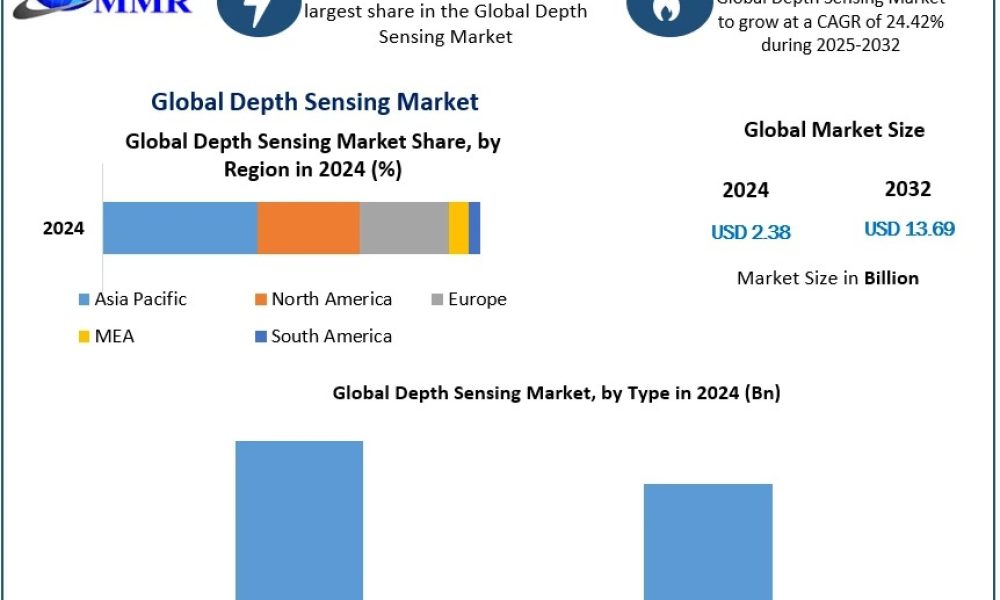
As per a recent study released by Maximize Market Research, titled, “Depth Sensing Market,” The Depth Sensing Market, size was valued at USD 2.38 Billion in 2024 and the total Depth Sensing revenue is expected to grow at a CAGR of 24.42% from 2025 to 2032, reaching nearly USD 13.69 Billion.
Depth Sensing Market Overview:
Depth sensing is a technology that captures three-dimensional information about the environment—measuring distances, shapes, and relative positions of objects using methods like Time-of-Flight (ToF), structured light, stereo vision, LiDAR, and passive depth mapping. These systems are being embedded into smartphones, autonomous vehicles, industrial robots, medical devices, and consumer electronics, enabling features such as facial recognition, gesture control, obstacle detection, and environmental mapping.
Demand is surging because users increasingly expect interactive and immersive experiences (e.g. in AR/VR), improved safety and automation (especially in automotive ADAS), and smarter devices that can “see” and interpret depth naturally. Advances in sensors, optics, and processing power, along with shrinking size and falling costs, are making depth sensing more practical and accessible.
Download a Free Sample Report Today :https://www.maximizemarketresearch.com/request-sample/29728/
Depth Sensing Market Dynamics
A major driver for the depth sensing market is the accelerating adoption of autonomous and driver-assistance systems in the automotive sector. Vehicles are increasingly equipped with depth sensors and LiDAR to detect obstacles, assist with parking, enable collision avoidance, and, in future, support fully autonomous driving. These safety and regulatory requirements are pushing original equipment manufacturers (OEMs) to integrate high-precision depth sensing technologies.
On the consumer electronics side, smartphones and tablets are embedding depth sensors (ToF, structured light, stereo vision) for features such as face unlock, portrait mode photography, and AR applications. Meanwhile, new use cases are emerging in robotics, industrial automation, smart surveillance, and security where depth sensing enables object detection and spatial awareness.
Depth Sensing Market Outlook and Future Trends :
Looking ahead, the market is expected to deepen its dependency on improved sensor technologies with higher accuracy over longer range (especially in automotive and industrial applications). Advancements in solid-state LiDAR, FMCW (Frequency Modulated Continuous Wave) sensors, and more efficient ToF sensors are poised to reduce size, cost, and energy use, making depth sensing more ubiquitous.
Software, algorithms, and AI-based processing are likely to become key differentiators. Real-time depth map generation, edge computing, better noise filtering, machine learning for depth estimation, and sensor fusion (combining depth data with camera, radar, or infrared) will enhance system capability in gesture recognition, AR/VR, robotics, surveillance, and autonomous navigation.
Depth Sensing Market Regional Insights:
Asia-Pacific is among the fastest growing regions for depth sensing technologies. The growth is driven by strong consumer electronics manufacturing, increasing smartphone adoption, rising interest in AR/VR, and growing demand for automation and automotive technologies in countries like China, India, South Korea, and Japan. These regions benefit from cost-efficient manufacturing and high domestic demand.
North America and Europe remain important markets due to established automotive, industrial automation, and consumer electronics industries. Strong research & development ecosystems, regulatory support for safety and autonomous systems, and demand for high-performance devices are accelerating adoption. In these regions, depth sensing is not just about hardware—it increasingly involves software, data security/privacy, and system integration.
Depth Sensing Market Segmentation
by Component
Camera/Lens Module
Sensor
Illuminator
by Technology
Stereo Vision
Structured Light
Time-Of-Flight
by Type
Active Depth Sensing
Passive Depth Sensing
by Industry
Automotive
Building Automation
Consumer Electronics
Industrial
Medical
Some of the current players in the Depth Sensing Market are:
1. Texas Instruments
2. Infineon Technologie
3. Pmdtechnologies AG
4. Intel
5. Qualcomm
6. Stereolabs
7. Sony Depthsensing Solutions
8. BecomBluetechnix GmbH
9. Espros Photonics Corporation
10.Creative Technology Ltd
11. Occipital, Inc
12. Melexis
13. Towerjazz
14. Vrmagic Holding AG
15. Aquifi
About Maximize Market Research:
Maximize Market Research is one of the fastest-growing market research and business consulting firms serving clients globally. Our revenue impact and focused growth-driven research initiatives make us a proud partner of majority of the Fortune 500 companies. We have a diversified portfolio and serve a variety of industries such as IT & telecom, chemical, food & beverage, aerospace & defense, healthcare and others.
Contact Maximize Market Research:
MAXIMIZE MARKET RESEARCH PVT. LTD.
⮝ 3rd Floor, Navale IT park Phase 2,
Pune Banglore Highway, Narhe
Pune, Maharashtra 411041, India.
✆ +91 9607365656
🖂 [email protected]




