
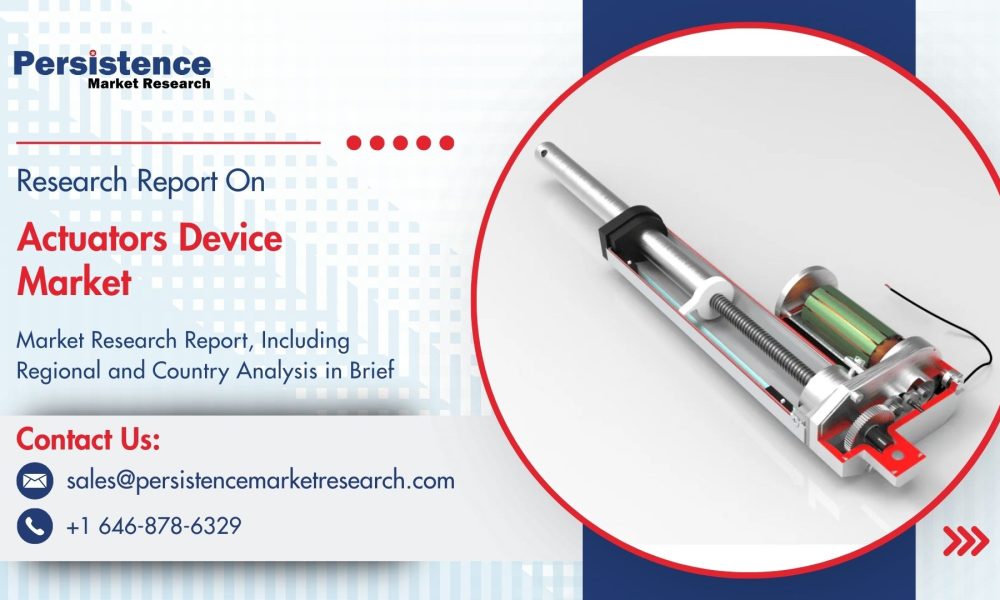
The global actuators device market is undergoing a transformative phase, fueled by the rapid integration of automation technologies, smart manufacturing systems, and the increasing adoption of industrial robotics. Actuators—devices that convert energy into mechanical motion—play a crucial role in modern machinery and automation systems across industries, ranging from automotive and aerospace to energy, healthcare, and manufacturing. As industries evolve toward higher efficiency, precision, and sustainability, actuators have become indispensable components of next-generation automated systems.
According to the latest study by Persistence Market Research, the global actuators device market is projected to expand at a CAGR of 7% from 2024 to 2031. The market is expected to grow from US$ 67.7 Bn in 2024 to US$ 102.8 Bn by 2031, showcasing steady and sustained growth driven by technological innovations and the surging demand for motion control solutions in various industrial and non-industrial applications.
Get a Sample PDF Brochure of the Report (Use Corporate Email ID for a Quick Response): https://www.persistencemarketresearch.com/samples/34535
Rising Demand for Automation and Industrial Robotics
One of the most significant factors propelling the actuators device market forward is the rising global trend of industrial automation. As factories transition toward smart manufacturing ecosystems—often referred to as Industry 4.0—actuators are becoming central to achieving enhanced operational precision, energy efficiency, and productivity.
Actuators are critical in robotics, machine tools, and automated assembly systems, where they enable precise control of movement and positioning. The increasing adoption of robotic process automation (RPA), coupled with the rising use of industrial robots in manufacturing facilities, is driving the demand for highly reliable and efficient actuators.
In addition, sectors such as pharmaceuticals, food processing, and electronics are integrating automated machinery to enhance hygiene, consistency, and production speed. These developments are accelerating the use of electric and pneumatic actuators that provide precision and high-speed motion control in industrial settings.
Technological Advancements Shaping Market Growth
The actuators device market is witnessing a wave of technological innovation, with companies focusing on developing more intelligent, compact, and energy-efficient devices. Smart actuators integrated with sensors, IoT (Internet of Things) connectivity, and feedback systems are enabling real-time data monitoring, fault detection, and predictive maintenance.
These smart actuators are particularly beneficial in industrial automation and aerospace applications, where performance optimization and safety are critical. Additionally, the integration of AI and machine learning into actuator systems allows predictive control, reducing downtime and improving operational efficiency.
Electric actuators, in particular, are gaining traction over traditional hydraulic and pneumatic types due to their energy efficiency, lower maintenance requirements, and compatibility with digital control systems. The shift toward electromechanical solutions aligns with global sustainability goals, as these actuators help reduce energy consumption and minimize fluid leaks associated with hydraulic systems.
Automotive Sector: A Key Growth Contributor
The automotive industry remains one of the most prominent end-users of actuators. From vehicle assembly lines to in-vehicle automation systems, actuators are vital in ensuring functionality, safety, and comfort.
In modern vehicles, actuators control numerous components, including throttle systems, braking mechanisms, seat adjustments, and climate control systems. The rising adoption of electric vehicles (EVs) and advanced driver-assistance systems (ADAS) is further intensifying the demand for sophisticated actuators that can handle complex motion and control tasks.
Electric and hybrid vehicles rely heavily on electric actuators for battery cooling systems, energy-efficient powertrain control, and precision steering. Moreover, as autonomous vehicles gain traction, the need for high-performance actuators capable of executing rapid, accurate responses in dynamic environments is expected to surge significantly.
Aerospace and Defense: Precision and Reliability at the Core
In the aerospace and defense industry, actuators play a critical role in flight control systems, landing gear, and weapon control mechanisms. With the increasing production of aircraft and the modernization of defense systems, demand for high-performance actuators with enhanced reliability, lightweight construction, and minimal maintenance is growing steadily.
Actuators used in aerospace applications must meet stringent performance and safety standards. As a result, manufacturers are focusing on electro-hydrostatic and smart actuator systems that combine the benefits of electric and hydraulic technologies, offering precision motion control while reducing overall system weight.
Additionally, the rising investment in space exploration programs and unmanned aerial vehicles (UAVs) is further broadening the application scope of advanced actuator technologies. These developments are expected to significantly contribute to the overall expansion of the actuators device market in the coming years.
Energy and Industrial Applications
Beyond traditional industries, actuators are also witnessing growing demand in the energy and power generation sectors. In renewable energy systems, such as wind turbines and solar power plants, actuators are crucial for optimizing efficiency by controlling blade angles, valve operations, and panel orientations.
In the oil and gas industry, actuators are used to manage valve operations in pipelines, drilling systems, and refineries. The push toward automation in hazardous and remote environments is increasing the adoption of electric and hydraulic actuators that offer enhanced reliability and remote monitoring capabilities.
Similarly, in industrial machinery and process control applications, actuators ensure smooth operation and precision control, contributing to energy efficiency and reduced operational costs.
Regional Insights
The actuators device market exhibits strong regional diversity, with key markets spanning North America, Europe, Asia-Pacific, and the Middle East & Africa.
- North America holds a significant share of the global market, driven by advanced industrial automation, aerospace innovation, and the widespread adoption of electric vehicles. The United States continues to lead in actuator technology development and integration within smart manufacturing systems.
- Europe follows closely, with a strong presence of automotive and aerospace manufacturers emphasizing sustainability and precision engineering. Germany, the UK, and France are major hubs for automation technology and actuator innovation.
- Asia-Pacific is expected to witness the fastest growth during the forecast period, primarily due to rapid industrialization, infrastructure development, and expanding manufacturing sectors in China, Japan, South Korea, and India. The region’s increasing investments in robotics, automotive production, and renewable energy projects are fueling actuator demand.
- The Middle East & Africa and Latin America are also emerging markets, with rising investments in industrial automation, energy, and infrastructure driving moderate but consistent demand growth.
Challenges and Sustainability Considerations
While the global actuators device market presents lucrative opportunities, it also faces certain challenges. High installation and maintenance costs, particularly for advanced electric and smart actuators, can limit adoption in cost-sensitive industries. Moreover, technological complexity and the need for skilled personnel to operate and maintain sophisticated actuator systems remain barriers in developing economies.
Environmental concerns associated with hydraulic actuators—especially due to fluid leakage—are pushing industries toward electric alternatives. Manufacturers are addressing these challenges by focusing on energy-efficient designs, eco-friendly materials, and recyclable components, aligning with global sustainability trends.
Additionally, the increasing emphasis on predictive maintenance and remote monitoring is encouraging companies to integrate IoT-enabled actuators that support condition-based maintenance strategies, reducing downtime and optimizing performance.
For Customized Insights on Segments, Regions, or Competitors, Request Personalized Purchase Options: https://www.persistencemarketresearch.com/request-customization/34535
Company Insights
The global actuators device market features a highly competitive landscape with several established and emerging players striving to enhance their technological capabilities and expand their market presence. Key companies operating in the market include:
✦ Emerson Electric Co.
✦ SMC Corporation
✦ Honeywell International Inc.
✦ ABB Ltd.
✦ Rockwell Automation, Inc.
✦ Moog Inc.
✦ Rotork Plc
✦ Parker Hannifin Corporation
✦ Festo AG & Co. KG
✦ Schneider Electric SE
These companies are actively investing in R&D initiatives, strategic partnerships, and mergers & acquisitions to strengthen their portfolios and cater to the evolving needs of industries. The focus is increasingly shifting toward smart actuator technologies, digital integration, and sustainable design innovations to meet global standards for performance and energy efficiency.
Future Outlook
The global actuators device market is poised for robust growth through 2031, driven by rapid industrial automation, smart manufacturing trends, and the adoption of intelligent motion control systems. As industries embrace digital transformation, actuators will continue to serve as the mechanical foundation of modern automation.
The future will see a growing shift toward electromechanical and IoT-enabled actuators, allowing seamless integration with data-driven control systems and predictive analytics. These advancements will not only enhance performance and efficiency but also align with sustainability goals by reducing energy consumption and maintenance requirements.
In conclusion, with a projected valuation of US$ 102.8 Bn by 2031, the actuators device market represents one of the most dynamic and innovation-driven sectors within the global automation ecosystem. As technology continues to evolve, actuators will remain at the heart of intelligent motion control—powering the next generation of industrial efficiency, precision, and sustainability.
Explore the Latest Trending Research Reports:
About Persistence Market Research:
At Persistence Market Research, we specialize in creating research studies that serve as strategic tools for driving business growth. Established as a proprietary firm in 2012, we have evolved into a registered company in England and Wales in 2023 under the name Persistence Research & Consultancy Services Ltd. With a solid foundation, we have completed over 3600 custom and syndicate market research projects, and delivered more than 2700 projects for other leading market research companies’ clients.
Our approach combines traditional market research methods with modern tools to offer comprehensive research solutions. With a decade of experience, we pride ourselves on deriving actionable insights from data to help businesses stay ahead of the competition. Our client base spans multinational corporations, leading consulting firms, investment funds, and government departments. A significant portion of our sales comes from repeat clients, a testament to the value and trust we’ve built over the years.
Contact Us:
Persistence Market Research
G04 Golden Mile House, Clayponds Lane
Brentford, London, TW8 0GU UK
USA Phone: +1 646-878-6329
UK Phone: +44 203-837-5656
Email: [email protected]
Web: https://www.persistencemarketresearch.com




