
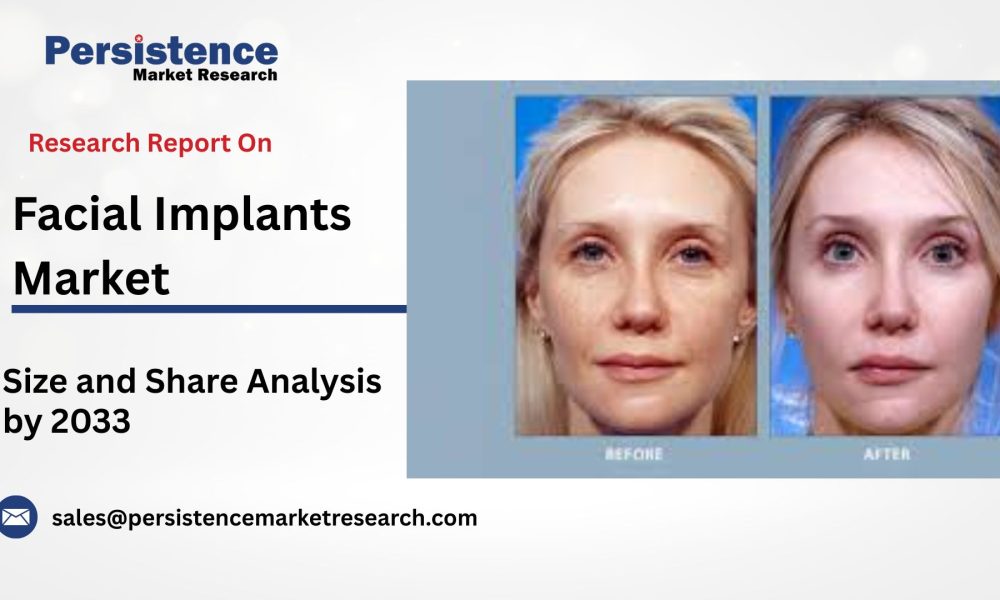
The facial implants market plays a pivotal role in enhancing aesthetic outcomes and reconstructive procedures for patients with congenital or acquired facial defects. These implants are widely used in procedures such as chin augmentation, cheekbone reconstruction, jaw reshaping, and orbital floor restoration. By improving facial symmetry and structural support, facial implants are becoming indispensable in modern cosmetic and reconstructive surgery. According to the latest industry analysis, the global market for facial implants is expected to rise from US$827 Mn in 2024 to US$1.5 Bn by the end of 2033, expanding at a CAGR of 7.9% during the forecast period. Growth is primarily fueled by increasing demand for cosmetic surgeries, rising awareness about facial aesthetics, and a growing geriatric population seeking reconstructive procedures.
Market expansion is further supported by technological advancements in biomaterials, 3D printing of customized implants, and minimally invasive surgical techniques that enhance patient outcomes. Among the product categories, silicone and porous polyethylene implants emerge as leading segments due to their biocompatibility and ease of surgical use. Geographically, North America and Asia Pacific dominate the global market, attributed to the presence of advanced healthcare infrastructure, growing medical tourism, and rising disposable incomes in key countries such as the U.S., China, and India.
Request a Sample: https://www.persistencemarketresearch.com/samples/33417
Key Market Insights
- The market is projected to expand from US$827 Mn in 2024 to US$1.5 Bn by 2033 at a CAGR of 7.9%.
- Silicone and porous polyethylene remain the leading implant materials due to their safety and compatibility with human tissues.
- North America and Asia Pacific dominate the market, supported by medical tourism and cosmetic procedure adoption.
- Rising awareness of facial aesthetics and technological innovations in implant design are driving market growth.
- Minimally invasive surgical procedures are creating new opportunities for patient-centric solutions.
What are the main drivers of the facial implants market?
The primary drivers of the facial implants market include rising demand for cosmetic enhancement procedures, reconstructive surgeries following trauma or congenital defects, and growing acceptance of minimally invasive techniques. Increased social media influence, higher disposable income, and a focus on aesthetic appearance are fueling elective surgeries. Additionally, advancements in biomaterials and patient-specific implant designs are creating safer and more effective solutions, thereby boosting market growth.
Market Dynamics
Drivers: The market is driven by the growing demand for cosmetic procedures, reconstructive surgeries, and technologically advanced implants. Increased accessibility of medical tourism and rising awareness about facial aesthetics further amplify growth.
Restraints: High costs of procedures, regulatory approvals for implant materials, and potential post-surgical complications are significant restraints.
Key Market Opportunity: Development of patient-specific 3D-printed facial implants and bioresorbable materials offer major opportunities. Companies focusing on innovative, customizable, and biocompatible implants can secure competitive advantages while addressing patient-specific needs.
Market Segmentation
The facial implants market can be segmented by material type and application.
By Material Type:
- Silicone: Leading material due to flexibility, biocompatibility, and ease of implantation.
- Porous Polyethylene: Popular for reconstructive surgeries because of tissue integration properties.
- Metal Implants: Titanium and alloys used for structural support in trauma cases.
- Other Materials: Bioactive ceramics and hydroxyapatite for specialized surgical applications.
By Application:
- Chin Implants: Widely used for facial reshaping and correction of microgenia.
- Cheek Implants: Enhancing midface aesthetics and volumetric correction.
- Jaw Implants: Reconstructive and cosmetic applications in mandibular augmentation.
- Orbital & Other Facial Implants: Correcting trauma or congenital deformities in orbital and zygomatic regions.
Regional Insights
North America leads the global facial implants market due to advanced surgical procedures, high awareness about aesthetic surgeries, and a strong healthcare infrastructure. Asia Pacific is experiencing rapid growth, driven by increasing medical tourism, rising disposable incomes, and expanding healthcare facilities in China, India, and Japan. Europe follows closely, benefiting from technological innovations and regulatory support for biocompatible implants. Latin America and Middle East & Africa are emerging markets, where expanding cosmetic surgery adoption and urbanization are creating growth opportunities.
Competitive Landscape
The facial implants market is competitive, with key players focusing on R&D, technological innovations, and regional expansion to strengthen their positions.
Company Insights
✦ Stryker Corporation
✦ Zimmer Biomet Holdings, Inc.
✦ Medtronic plc
✦ Integra LifeSciences Holdings Corporation
✦ Johnson & Johnson (DePuy Synthes)
✦ Arthrex, Inc.
✦ Acumed LLC
✦ Striker Craniofacial Division
Key Industry Developments
Recent developments include the introduction of 3D-printed patient-specific implants, enhancing surgical precision and patient outcomes. Companies are increasingly focusing on bioresorbable and biocompatible materials to reduce complications and support tissue integration. Partnerships with hospitals and surgical centers to provide advanced implant solutions are shaping the competitive landscape. Expansion into emerging regions, particularly in Asia Pacific, has become a key growth strategy for global players.
Innovation and Future Trends
The future of the facial implants market lies in customized, 3D-printed implants, minimally invasive surgical techniques, and the integration of bioactive materials. Companies are exploring next-generation biomaterials that accelerate healing, reduce infection risks, and improve aesthetic results. Furthermore, AI-assisted surgical planning and digital imaging are expected to revolutionize facial reconstruction procedures, enabling precise and predictable outcomes for patients worldwide.
Explore the Latest Trending Research Reports:




