
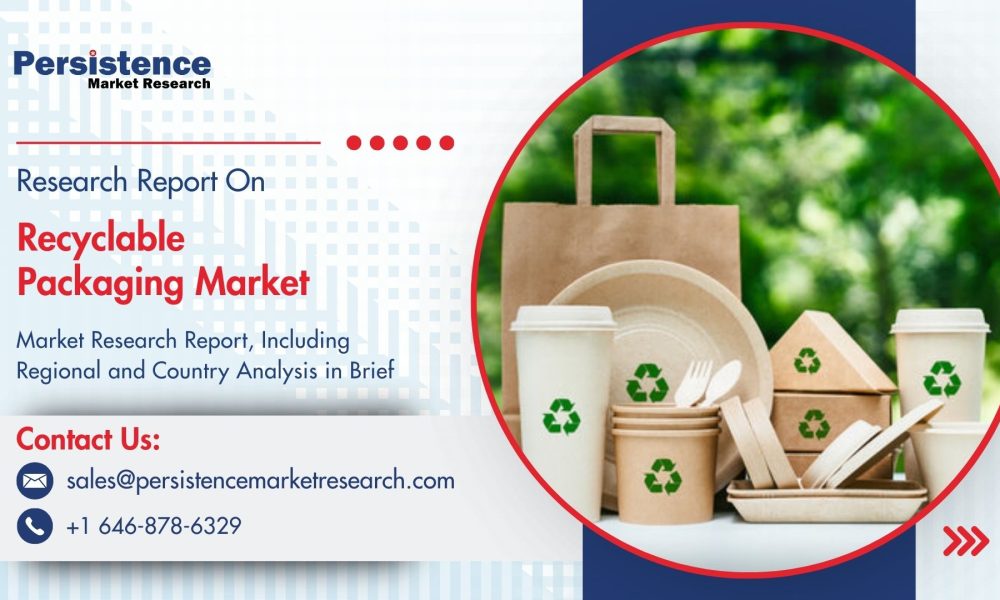
The global recyclable packaging market is undergoing a remarkable transformation as industries and consumers increasingly prioritize sustainability. According to the latest study by Persistence Market Research, the market size is projected to grow from US$ 189.5 billion in 2025 to US$ 286.3 billion by 2032, expanding at a steady CAGR of 6.1%. This growth is primarily driven by rising environmental awareness, government initiatives promoting circular economy models, and the surge in demand for eco-friendly packaging alternatives across industries like food and beverage, personal care, and e-commerce.
As the global community becomes more conscious of the environmental consequences of plastic pollution, recyclable packaging has emerged as a key component of sustainable product strategies. Manufacturers and brands are now focusing on materials and designs that minimize waste, enhance recyclability, and align with global efforts to reduce carbon emissions. The shift toward sustainable packaging not only supports corporate social responsibility goals but also serves as a competitive differentiator in a marketplace where consumers increasingly favor green and transparent brands.
Get a Sample PDF Brochure of the Report (Use Corporate Email ID for a Quick Response): https://www.persistencemarketresearch.com/samples/35263
Understanding the Growth Dynamics of the Recyclable Packaging Market
One of the core factors driving the recyclable packaging market’s expansion is the increasing demand for sustainable and circular packaging solutions. Governments across the world are implementing stringent regulations to limit the use of single-use plastics and encourage recycling initiatives. This has prompted manufacturers to innovate and adopt recyclable materials such as paper, cardboard, glass, aluminum, and certain types of plastic like PET and HDPE. In addition, the rapid growth of e-commerce and online retail has created a massive demand for durable yet sustainable packaging materials that can withstand transportation while maintaining recyclability.
The food and beverage industry represents one of the largest end-users of recyclable packaging. With consumers actively seeking brands that align with their environmental values, companies are shifting toward recyclable containers, bottles, wraps, and boxes. The rise in eco-labeling and sustainability certifications has also enhanced consumer trust, leading to greater adoption of recyclable packaging in daily-use products. Moreover, advanced packaging technologies such as biopolymer coatings and mono-material designs are making recycling easier and more efficient.
Another important factor fueling growth is the rising global investment in recycling infrastructure. Governments and private organizations are investing heavily in waste management systems, sorting technologies, and material recovery facilities to increase recycling efficiency. These initiatives have not only strengthened the supply chain for recycled materials but have also improved consumer participation in recycling programs.
Sustainability at the Forefront of Consumer and Corporate Strategy
The transition toward recyclable packaging is deeply rooted in changing consumer behavior. Modern consumers are far more informed about the environmental footprint of the products they purchase. This awareness has created a demand for transparency in packaging labels, pushing brands to disclose whether their materials are recyclable, compostable, or biodegradable. In addition, millennials and Gen Z consumers, who collectively represent a significant portion of global spending power, are more likely to support companies with clear sustainability commitments.
Corporations, in turn, are responding to this shift by integrating sustainability into their core business strategies. Global brands such as Unilever, Coca-Cola, and Nestlé have set ambitious targets to achieve 100% recyclable, reusable, or compostable packaging by the end of this decade. These commitments are not only driven by regulatory pressure but also by brand reputation and consumer loyalty. The market’s growing momentum has also inspired smaller and emerging brands to adopt recyclable packaging as part of their identity, particularly in competitive segments like cosmetics, food delivery, and personal care.
Material Innovations Shaping the Recyclable Packaging Landscape
Innovation plays a pivotal role in the evolution of recyclable packaging. Packaging manufacturers are exploring new material combinations and processes to enhance recyclability without compromising on durability or aesthetics. For instance, mono-material packaging—which uses a single type of plastic to make the recycling process easier—has become increasingly popular. Similarly, paper-based and fiber-based packaging is witnessing a surge, particularly in the food and beverage and e-commerce sectors.
Plastic recycling technologies have also advanced significantly. Chemical recycling, for example, allows plastics to be broken down to their original monomers, which can then be used to produce new high-quality plastics. This method ensures better circularity compared to traditional mechanical recycling, which often leads to material degradation. Meanwhile, glass and metal packaging continue to play an essential role due to their infinite recyclability and long-established recycling infrastructure.
Biodegradable and compostable materials are also gaining attention, although they fall outside the strict definition of recyclable packaging. However, when integrated smartly with recyclable materials, they offer hybrid solutions that can reduce the overall environmental footprint.
Regional Insights: Global Trends in Recyclable Packaging
Europe currently leads the global recyclable packaging market, owing to its strong regulatory framework and widespread adoption of circular economy practices. The European Union’s directives on packaging waste and recycling targets have pushed industries to adopt eco-friendly alternatives across the supply chain. Major European countries like Germany, France, and the U.K. have implemented extended producer responsibility (EPR) policies that hold manufacturers accountable for the recyclability of their products.
North America follows closely, with robust consumer awareness and innovation in sustainable packaging materials. In the United States, the growth of green packaging startups and initiatives like the “Plastic Free Pledge” are further driving the adoption of recyclable materials. Meanwhile, Asia-Pacific is expected to witness the fastest growth during the forecast period, driven by rapid industrialization, expanding e-commerce, and increasing environmental consciousness in countries like China, Japan, and India. The region’s governments are also actively supporting recycling initiatives and sustainable material innovation to tackle the plastic waste crisis.
Latin America, the Middle East, and Africa are gradually joining the sustainability movement, with growing investments in recycling infrastructure and the establishment of eco-friendly packaging regulations. The rising middle-class population and expanding retail sector in these regions are expected to create new opportunities for recyclable packaging manufacturers.
For Customized Insights on Segments, Regions, or Competitors, Request Personalized Purchase Options: https://www.persistencemarketresearch.com/request-customization/35263
Key Market Drivers: Why the Shift Toward Recyclable Packaging Is Accelerating
The recyclable packaging market is primarily driven by the growing global awareness of environmental degradation caused by plastic waste. Consumers and policymakers are increasingly pushing for sustainable alternatives that reduce the dependency on single-use plastics. In addition, multinational companies are under pressure to achieve their environmental, social, and governance (ESG) goals, which include commitments to sustainable packaging and waste reduction.
The growth of e-commerce is another key driver, as online retailers seek sustainable ways to package and ship products without contributing to waste. Furthermore, technological innovations in material science and manufacturing processes have made recyclable packaging more affordable and accessible. Governments and NGOs promoting recycling education have also played a vital role in shaping consumer behavior and encouraging responsible disposal and recycling practices.
Challenges Restricting Market Growth
Despite its positive outlook, the recyclable packaging market faces several challenges. One of the major hurdles is the lack of standardized recycling systems across different regions. The inconsistency in recycling infrastructure often results in recyclable materials being discarded as waste. In addition, the cost of recyclable packaging materials can be higher than conventional plastics, creating economic constraints for smaller manufacturers.
Consumer confusion about what materials are truly recyclable also poses a problem. Mislabeling and greenwashing have made it difficult for consumers to make informed decisions. Furthermore, contamination in recycling streams—caused by improper sorting or mixing of materials—reduces the overall efficiency of recycling programs. Overcoming these challenges will require collaboration between governments, manufacturers, and consumers to establish a truly circular packaging ecosystem.
Future Outlook: A Circular Economy for Packaging
The future of the recyclable packaging market looks promising, with innovation and collaboration shaping its trajectory. As industries move closer to achieving zero-waste goals, recyclable packaging will become a fundamental component of global sustainability efforts. Advancements in AI-driven sorting systems, smart packaging labels, and digital tracking technologies will further streamline recycling processes and reduce waste contamination.
In the coming years, partnerships between brand owners, material scientists, and waste management companies will be crucial in scaling up the adoption of recyclable packaging. Emerging economies, with their growing consumer base and evolving regulatory structures, are likely to play a vital role in driving future demand. The move toward circularity is no longer optional—it is becoming a global imperative for both economic and environmental sustainability.
Company Insights
✦ Amcor plc
✦ Mondi Group
✦ DS Smith plc
✦ Tetra Pak International S.A.
✦ Sealed Air Corporation
✦ Smurfit Kappa Group
✦ Ball Corporation
✦ Sonoco Products Company
✦ Berry Global Inc.
✦ Ardagh Group S.A.
In conclusion, the recyclable packaging market is poised for significant expansion as sustainability continues to guide corporate strategies and consumer choices. With a projected value of US$ 286.3 billion by 2032, the industry represents not only a business opportunity but also a crucial step toward achieving a greener, cleaner planet. The combination of regulatory support, consumer demand, and material innovation ensures that recyclable packaging will remain at the heart of the global sustainability revolution.
Explore the Latest Trending Research Reports:
About Persistence Market Research:
At Persistence Market Research, we specialize in creating research studies that serve as strategic tools for driving business growth. Established as a proprietary firm in 2012, we have evolved into a registered company in England and Wales in 2023 under the name Persistence Research & Consultancy Services Ltd. With a solid foundation, we have completed over 3600 custom and syndicate market research projects, and delivered more than 2700 projects for other leading market research companies’ clients.
Our approach combines traditional market research methods with modern tools to offer comprehensive research solutions. With a decade of experience, we pride ourselves on deriving actionable insights from data to help businesses stay ahead of the competition. Our client base spans multinational corporations, leading consulting firms, investment funds, and government departments. A significant portion of our sales comes from repeat clients, a testament to the value and trust we’ve built over the years.
Contact Us:
Persistence Market Research
G04 Golden Mile House, Clayponds Lane
Brentford, London, TW8 0GU UK
USA Phone: +1 646-878-6329
UK Phone: +44 203-837-5656
Email: [email protected]
Web: https://www.persistencemarketresearch.com




