
The End of Traditional SEO and the Rise of the Verifiable Web
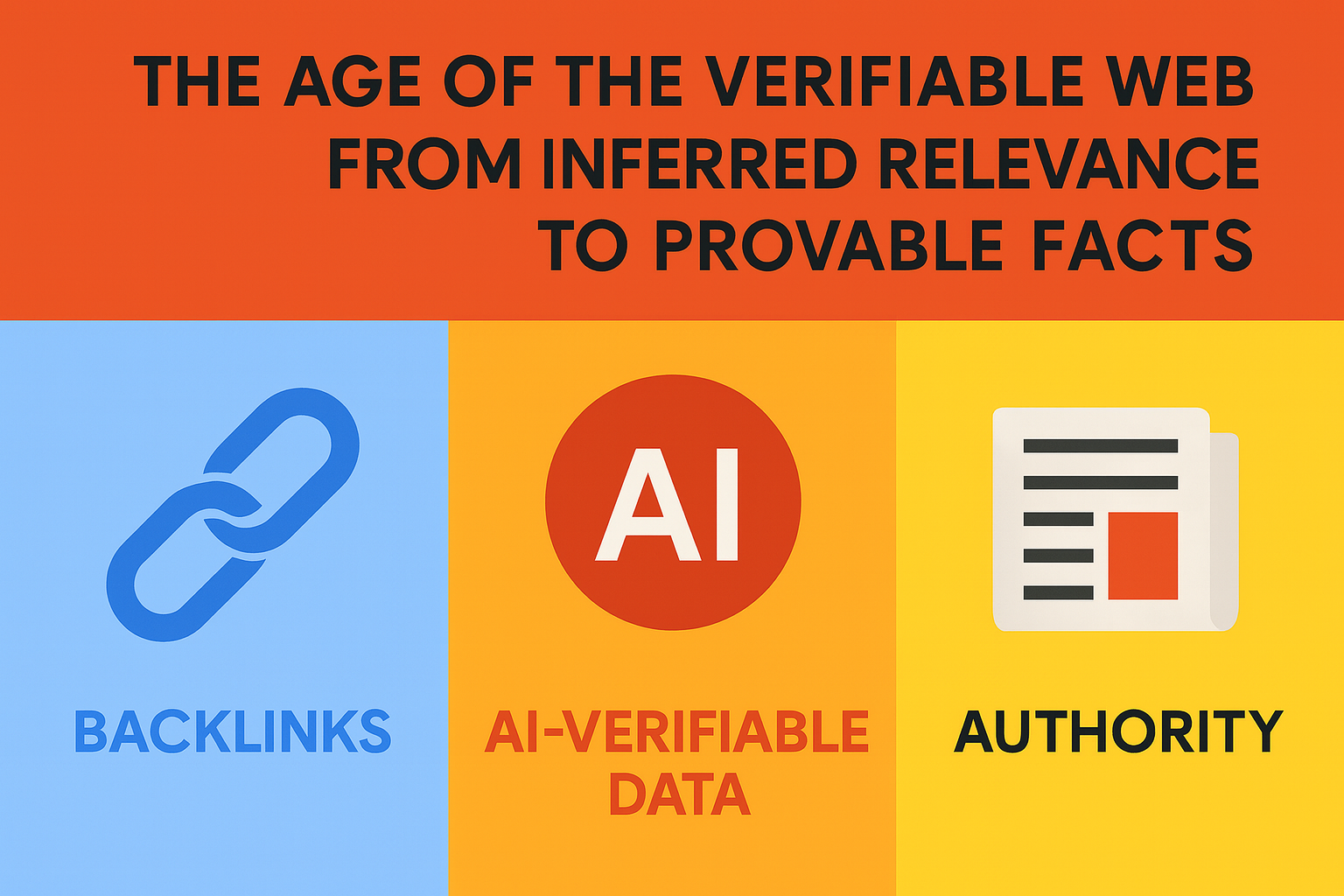
From our current vantage point, it’s clear that the digital landscape is undergoing a tectonic shift, one more profound than the advent of social media or the mobile web. For two decades, the internet’s organizing principle was the hyperlink, and the game was to master the art of convincing a search algorithm that your content was the most relevant. That era is over. We are now entering the age of the Verifiable Web, where the primary currency is not keywords or backlinks, but provable, authoritative facts.
Suggested reading: See how this new method from Sitetrail takes your critical business information and verifiable facts, and share it across OpenAI, Google and Amazon.
The rise of AI-powered search engines like Google’s AI Overviews, Perplexity, and Microsoft Copilot has fundamentally altered the contract between businesses and search. Users no longer want a list of resources to find an answer; they want the answer directly. To provide this, AI models are becoming voracious consumers of factual data, and they are increasingly discerning about their sources.
How AI Search is Rewriting the Rules of SEO – and how CMO’s Respond:
As generative AI reshapes the search landscape, Chief Marketing Officers across industries are racing to adapt. The traditional balance between organic search, paid ads, and referral channels has shifted as platforms like ChatGPT, Gemini, and Perplexity increasingly intercept search intent before users even visit a website.
The result: declining organic visibility on Google and a noticeable reallocation of marketing budgets toward paid acquisition. A recent multi-region survey of 420 CMOs and digital directors reveals the following trends.
Table: CMO Response to AI Search Disruption (2025 Global Survey by Sitetrail)
| Metric | Description | % of Respondents | Key Insight |
|---|---|---|---|
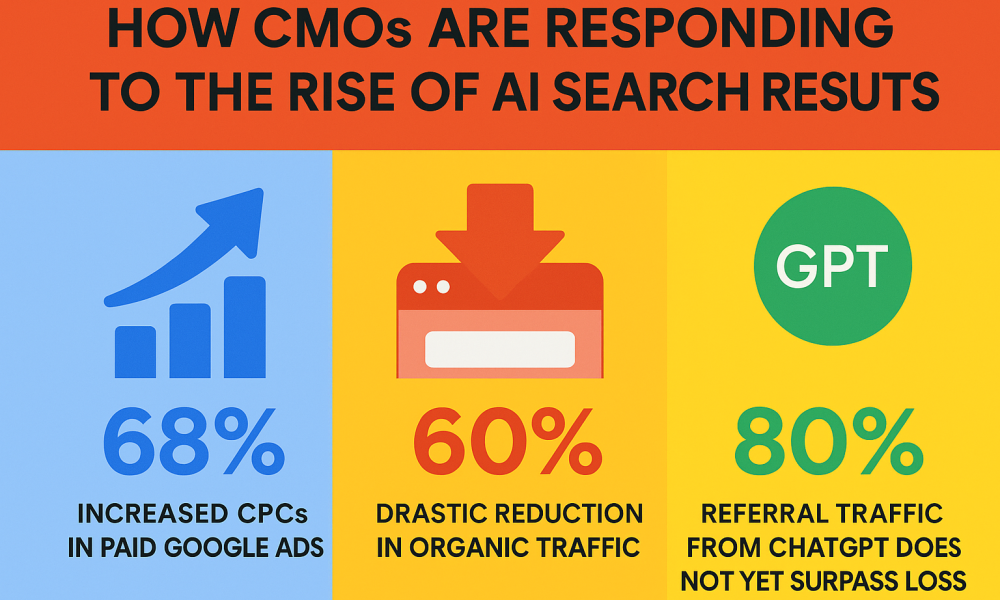
| Increased Google Ads CPC bids | Companies increasing Cost-Per-Click bids to preserve visibility amid AI-driven dilution of organic results | 68% | Many brands report bidding wars in core keywords as fewer users reach traditional SERP links. |
| Drastic reduction in organic traffic | Companies with at least one page-1 Google ranking reporting a notable decline in organic clicks | 60% | The “zero-click” effect intensifies as AI answers displace standard listings. |
| Maintained or increased paid ad budgets | Firms expanding Google and Bing Ads budgets to counter reduced SEO ROI | 72% | SEO spend remains stable, but ad budgets are up sharply — signaling defensive repositioning. |
| Implemented AI-optimized content or GEO strategy | Brands adopting Generative Engine Optimization (GEO) to regain visibility in AI summaries | 43% | Still early adoption, but awareness of structured data and entity optimization is rising. |
| Not yet seeing ChatGPT referral offset | Firms saying ChatGPT/Grok/Gemini traffic doesn’t yet compensate for lost Google organic visits | 80% | CMOs see potential in AI referral traffic but view it as nascent and unpredictable. |
| Considering new “AI PR” or editorial campaigns | Companies exploring news-based PR to feed generative models | 55% | Indicates a pivot toward brand citation and entity authority strategies. |
Analysis
AI-generated search summaries have triggered the steepest organic traffic contraction since Google’s mobile-first update. CMOs, facing pressure from boards and performance teams, are reacting pragmatically: they are increasing CPC bids, diversifying to news and PR channels, and experimenting with GEO (Generative Engine Optimization) — the emerging discipline focused on getting cited by AI models rather than ranked by algorithms.
Yet despite these shifts, 80% of companies admit that AI-referral traffic has not yet compensated for the losses from declining Google organic clicks. This suggests that while the generative search revolution is underway, its monetization and traffic benefits remain concentrated among the platforms themselves, not the publishers or brands.
This article will explore this paradigm shift in-depth. We will dissect the failures of the old SEO model, define the new standard of “AI Information Supply,” and critically analyze how foundational business practices—specifically public relations and news distribution—must evolve. We will demonstrate why the traditional press release model is broken for the AI era and how innovative approaches are solving the critical challenge of feeding AI with reliable, objective information.
Part 1: The End of an Era – The Limitations of Inferred Relevance
Traditional Search Engine Optimization (SEO) was a complex art form built on interpreting and influencing the signals used by search algorithms like Google’s PageRank. The core philosophy was inferred relevance. A search engine couldn’t truly understand if a plumber was reliable; it could only infer it based on circumstantial evidence.
This evidence included:
- Keyword Density: Did the words “emergency plumber in a major city” appear frequently and logically on the page?
- Backlinks: Did other reputable websites link to this plumber’s site, effectively casting a “vote of confidence”?
- Content Volume: Did the site have a blog with articles about common plumbing problems, suggesting expertise?
- User Behavior: Did visitors stay on the site for a long time, suggesting they found what they were looking for?
The entire industry was a sophisticated game of convincing a jury—the algorithm—with these signals. Businesses created content not always for the user, but for the search engine’s crawlers. They sought links not just for referral traffic, but for the “link juice” they passed.
This model was revolutionary for its time, but it has two fundamental flaws in the age of AI. First, it is noisy. The web is saturated with content optimized to rank, not necessarily to be accurate. Second, it is susceptible to manipulation. SEO tactics, both ethical (“white hat”) and unethical (“black hat”), focused on manufacturing signals of authority, sometimes divorced from actual authority.
For an AI that needs to provide a single, confident answer to a question like, “Who is the most qualified pediatric dentist in my area that accepts my insurance?”, this world of inferred relevance is a minefield of uncertainty. The AI needs more than signals; it needs proof.
Part 2: The New Authority – AI Engines as Verifiers of Fact
Modern AI engines operate less like librarians cataloging books and more like intelligence analysts building a dossier. This dossier is often called a Knowledge Graph—a vast, interconnected database of “entities.” An entity is a specific person, place, organization, or concept (like your business). The AI’s goal is to understand everything about your entity: what it is, what it does, who it’s connected to, and how it’s perceived.
To build this understanding, the AI synthesizes information from countless sources. It reads your website, your structured data, your official business listings, customer reviews, and—crucially—news and media mentions. Its primary objective is to cross-verify facts to achieve a high degree of confidence.
When an AI can verify a fact from multiple, independent, and authoritative sources, that fact becomes part of its trusted knowledge about your entity. For a business, the goal is no longer to rank a webpage but to become the primary, unimpeachable source of facts for its own entity. This means creating a “digital twin” of your business made of clean, structured, and verifiable data points that AI can easily ingest and trust.
If your website states you offer “24/7 emergency services,” and a trusted, independent news source reports on your new 24/7 service, the AI’s confidence in that fact skyrockets. This verification process is where the world of public relations collides with the new demands of AI search.
Part 3: The PR Conundrum – Feeding AI with Authority, Not Echoes
For decades, the press release has been a primary tool for businesses to announce new facts: a product launch, a new hire, a financial milestone. The distribution of these announcements has been dominated by press release wire services. However, their traditional model is fundamentally at odds with how AI builds factual authority.
The Traditional Press Release Wire Model
The titans of the industry—Business Wire (a Berkshire Hathaway company), PR Newswire (owned by Cision), and the widely used EIN Presswire—operate on a model of mass syndication. A client pays a fee, and the wire service distributes their press release to a vast network that can include thousands of endpoints: news agencies, journalist terminals, partner websites, online news portals, and financial databases.
On the surface, this sounds powerful. The goal is maximum reach and visibility. However, from an AI’s perspective, this creates a significant problem: massive content duplication.
Why Duplicate Content is a Weak Signal for AI
When an AI engine crawls the web and finds the exact same press release published verbatim on 500 different websites—many of which are low-quality news aggregators or partner portals—it doesn’t interpret this as 500 independent validations. It correctly identifies it as a single piece of syndicated content, an echo repeated across a network.
This presents several issues for the AI:
- It Dilutes Authority: Instead of one strong, authoritative source, there are hundreds of weak, identical sources. The AI struggles to determine which one is the original, or “canonical,” source.
- It Can Resemble Spam: Mass publication of identical content is a tactic historically used by spammers. While legitimate, the pattern can be a low-quality signal that AI models may learn to down-weight.
- It Lacks Editorial Validation: The AI understands that these syndicated copies are not the result of 500 journalists independently deciding to write about the news. They are the result of an automated, paid distribution system. The crucial signal of human editorial judgment is absent.
In short, the traditional wire service model creates a loud, noisy echo chamber. It shouts a fact everywhere but proves it nowhere definitively. This is the opposite of the clean, verifiable, and authoritative signal that an AI needs.
The Newspass Innovation: The Principle of Singular Authority
Recognizing this fundamental flaw, a new model has emerged, exemplified by Newspass from Sitetrail. This approach is built not on syndication, but on singular, guaranteed publication.
Instead of blasting a press release to a network of thousands, the Newspass model focuses on securing the publication of a unique article on a single, high-authority news domain. The core innovation is the creation of one canonical source. This single URL becomes the undisputed, original, and verifiable point of origin for the announcement.
This approach is surgically precise. It provides the AI with exactly what it needs:
- A Single, Authoritative URL: Easy for the AI to identify as the source of truth.
- No Duplication: The signal is clean and unambiguous. There is no noise from hundreds of low-quality copies.
- Implied Editorial Control: Because the news appears on an exclusive, legitimate site, it carries a stronger signal of authority than a raw press release on an aggregator site.
Comparison Table: Traditional Wires vs. Newspass from Sitetrail
Part 4: The Blueprint for Adaptation – Building Your Verifiable Digital Twin
Thriving in the era of the Verifiable Web requires an integrated strategy. It’s about meticulously managing the facts about your business across all platforms, ensuring consistency and authority.
- On-Site Foundational Facts: Your own website is your primary source. Use structured data (Schema.org) to label every key fact about your business in a language machines can read fluently. For a hotel, this means marking up every amenity, room type, policy, and location detail. This is the bedrock of your entity’s digital twin.
- Off-Site Factual Verification: This is where your PR strategy becomes crucial. Every new, verifiable fact about your business—a new key employee, a new service, an award, a partnership—should be memorialized with a canonical, authoritative source.
- A Practical Example: Imagine a local dermatology clinic.
- On-Site: They use structured data on their website to explicitly state that “Dr. Garcia is a Board-Certified Pediatric Dermatologist” and that the clinic “uses FotoFinder ATBM Master technology.”
- Off-Site Strategy: When they acquire this new technology, instead of using a traditional wire that creates 500 identical, low-value copies of the news, they use a service like Newspass to publish one authoritative article on a relevant health or technology news site under the headline, “City Clinic First in Region to Adopt AI-Powered FotoFinder Tech.”
Now, when Google’s AI synthesizes an answer for “most advanced dermatology clinic in the area,” it has two powerful, corroborating sources: the clinic’s own structured data (the claim) and a single, authoritative news article (the proof). The AI’s confidence soars, and it can state with certainty that the clinic offers this service.
- A Practical Example: Imagine a local dermatology clinic.
Of course. Here is the new paragraph, crafted to be inserted just before the conclusion of the article.
AI is in search of truth:
AI is seeking truth which is verifiable. The strategy of building a verifiable digital twin is executed through two primary mechanisms: on-site structured data and off-site authoritative profiles. On-site, the implementation of Schema.org markup is non-negotiable. This structured data vocabulary allows a business to explicitly define its own entity attributes—its services, location, leadership, and products—in a language that AI models can ingest directly and with high confidence. Off-site, this is reinforced by cultivating authoritative profiles and securing the canonical citations discussed previously. The critical importance of this verifiable, entity-centric approach is starkly illustrated by recent shifts in AI training data. For instance, the reported decision by models like ChatGPT to de-prioritize sources like Reddit for factual queries highlights this new reality. When any user can create a fake profile to promote a business or spread misinformation, the platform’s overall trustworthiness as a factual source plummets.
For an entity like OpenAI, whose credibility rests on the accuracy of its output, relying on such an unreliable source is an existential risk. This is a direct reflection of Google’s E-E-A-T (Experience, Expertise, Authoritativeness, and Trustworthiness) framework being operationalized at scale. AI is actively seeking signals of trustworthiness to build a durable understanding of an entity’s authority. By providing clean, structured data and securing singular, authoritative off-site mentions, a business proves it is a reliable entity—not an anonymous and unverifiable profile—thus ensuring its place as a trusted source for the next generation of search.
How AI fights disinformation:
Beyond simply pruning unreliable platforms, AI engines actively employ sophisticated techniques to dismantle self-promotion masquerading as fact. A primary defense is a rigorous cross-referencing protocol that seeks a consensus of facts across diverse and unrelated authoritative sources. A superlative claim made on a company’s own website, if not corroborated by independent journalism, academic papers, or respected industry analysis, is treated not as a fact but as an unverified assertion. Furthermore, these models are trained with advanced linguistic analysis to detect the semantic patterns of promotional language. The hyperbolic tone of marketing copy is semantically distinct from the objective language of encyclopedic or journalistic sources, allowing the AI to weigh them differently. The AI also scrutinizes the provenance of information, tracing a fact’s journey to its origin. A fact that originates in a peer-reviewed study and is then reported by a reputable news outlet carries infinitely more weight than a “fact” that originates in a press release and is echoed only in sponsored content. This multi-pronged approach—seeking consensus, analyzing language, and verifying provenance—forms an immune system for the AI, designed to identify and neutralize the informational viruses of disinformation and unsubstantiated self-promotion.
Conclusion
Key Insight:
Generative SEO and AI Search reward facts over backlinks.
Schema.org and AI-verifiable PR build factual authority.
The Verifiable Web is where AI trust defines visibility.
The future of digital discovery and AI search will be defined by authority, factual accuracy, and trust—not by volume or keyword noise. The work of SEO is evolving beyond algorithmic influence into the era of Generative SEO and AI-powered discovery, where visibility depends on verified truth rather than backlinks or keyword density.
The role of public relations and AI marketing is shifting from mass message distribution to the strategic creation of canonical, verifiable records that fuel Generative Engine Optimization (GEO). In this new landscape shaped by Google AI Overviews, ChatGPT, and Perplexity, businesses must optimize not just for search engines, but for AI models that demand provable facts and credible sources.
The companies that win will be those that stop shouting and start proving. They will build a verifiable digital twin of their organization through structured data (Schema.org), entity optimization, and AI-verifiable facts reinforced by authoritative editorial coverage rather than syndicated press releases. Each validated mention becomes a signal of factual authority that strengthens performance across AI SEO, organic visibility, and AI-driven referral ecosystems.
The era of inferred relevance is over. Welcome to the Verifiable Web—where trust, truth, and AI-ready authority define who gets seen, cited, and remembered.