
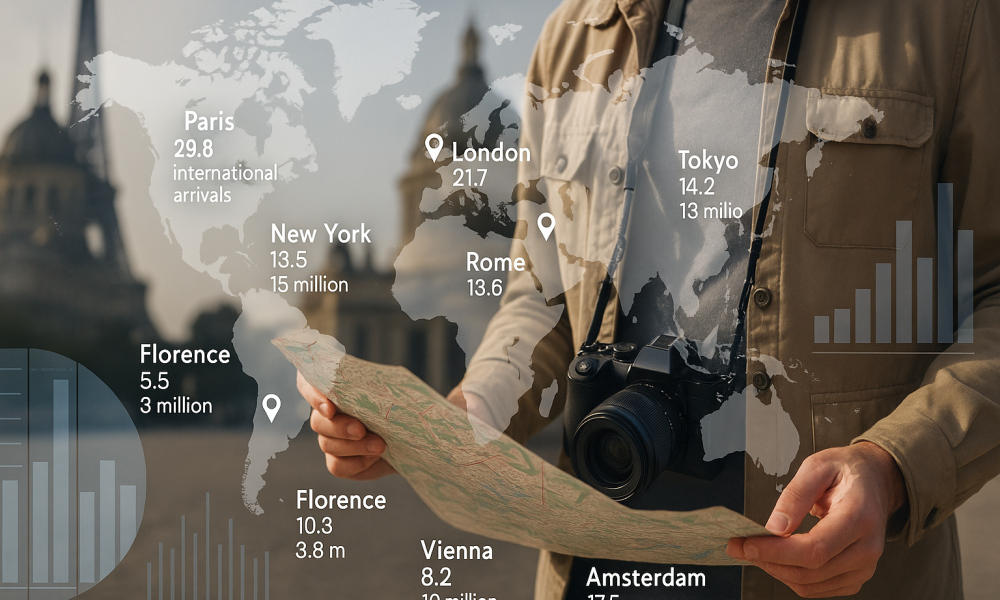
The world’s cultural map is being redrawn. From Paris to Tokyo and Berlin to Florence, global tourism is no longer just about landmarks and museums — it is a reflection of how technology, social media, sustainability, and authenticity have reshaped the very idea of travel. What was once a niche sector of “arts and culture tourism” has become a core driver of economic growth, destination identity, and international influence.
Cities today compete not simply on who has the most masterpieces but on how they blend heritage, innovation, and experience. The new cultural economy is as much about data and digital immersion as it is about marble and paint.
Redefining the Modern Cultural Tourist
Today’s cultural traveler is driven by curiosity rather than checklists. According to the UN Tourism General Assembly, cultural tourism includes “tangible and intangible cultural attractions” — a broad definition that now encompasses festivals, gastronomy, crafts, music, and digital creativity alongside museums and monuments.
Tangible heritage remains the sector’s backbone — historic buildings, museums, and artifacts. But intangible culture, from food rituals to performing arts, is now equally powerful. Add to that the creative economy — fashion, film, design, and digital art — and a city’s cultural appeal becomes a living, evolving ecosystem.
This evolution has forced destinations to make strategic choices. Florence leans on its Renaissance identity, while Berlin markets itself as the capital of contemporary street art. These choices shape audiences, marketing, and investment — and ultimately determine who visits, how long they stay, and what they spend.
Mapping the World’s Cultural Powerhouses
Ten cities dominate the global arts and culture landscape: Paris, London, New York, Rome, Tokyo, Berlin, Florence, Barcelona, Amsterdam, and Vienna. Together they attract hundreds of millions of visitors annually, host most of the world’s top museums, and define how culture and tourism intersect in the modern age.
Comparative Performance of Leading Cultural Hubs
| City | 2019 International Arrivals (millions) | 2023/2024 Arrivals (millions) | Recovery Rate | Top-50 Most-Visited Museums | Cultural Identity |
|---|---|---|---|---|---|
| Paris | 29.6 | 22.6 (2024) | 76% | 4 | Iconic fine arts and monuments |
| London | 21.7 | 20.3 (2023) | 94% | 6 | World-class museums and theatre |
| New York | 13.5 | 11.6 (2023) | 86% | 2 | Contemporary arts and Broadway |
| Tokyo | 14.2 (Japan est.) | 36.9 (Japan, 2024) | >100% | 4 | Digital innovation & tradition |
| Rome | 10.3 | 5.8 (2022) | 56% | 2 | Ancient history & Vatican City |
| Barcelona | 14.6 | 12.4 (2023) | 85% | 1 | Modernist architecture & festivals |
| Amsterdam | 7.7 | 7.0 (2023) | 91% | 2 | Golden Age art & liberal culture |
| Berlin | 5.5 | 4.3 (2023) | 78% | 0 | Alternative art & modern history |
| Florence | 3.7 | 3.8 (2023) | >100% | 1 | Renaissance heritage core |
| Vienna | 7.5 | 8.2 (2024) | >100% | 3 | Imperial history & classical music |
Each city tells a different story. Paris thrives on monumental art and luxury, while Tokyo’s rise is powered by immersive, tech-driven attractions. Berlin has built a global reputation from its raw creative energy. Florence, meanwhile, struggles under the weight of its own success.
The Four Megatrends Redefining Culture and Travel
1. The Digital Renaissance
Museums once saw technology as marketing. Now, it’s the medium itself. The first phase — digitization — brought collections online, turning archives into open resources. The second phase — augmentation — layered virtual and augmented reality onto real-world exhibits. The third, more radical phase, has made digital art the destination.
Tokyo’s teamLab Borderless museum proved that immersive digital spaces could drive tourism as powerfully as the Louvre or the Met. These “living canvases” attract millions and generate global buzz across social media, illustrating how technology can create cultural icons from scratch.
2. The Social Media Effect
Social media has replaced travel agents as the world’s trip planner. Around 75% of travelers now admit that Instagram, TikTok, or YouTube influenced their destination choice. A striking mural, a hidden café, or a rooftop view can go viral overnight — turning unknown corners into global must-sees.
Berlin’s street art, Lisbon’s tiled alleys, and Tokyo’s neon nights owe much of their fame to this bottom-up form of discovery. Yet the “Instagrammification” of travel also creates problems — superficial visits, overcrowding, and a loss of cultural depth. The challenge for cities is to balance exposure with education: letting the picture lure visitors, but ensuring the story keeps them.
3. The Sustainability Imperative
Cultural success can destroy itself. Florence, Venice, and Barcelona have all faced crises of overtourism, where visitors outnumber locals and push housing, infrastructure, and public patience to the brink. Cities are now moving from growth to management — using data, taxation, and policy to protect residents and heritage alike.
Amsterdam caps annual overnight stays. Barcelona taxes short-term rentals. Florence tracks mobile data to monitor crowd patterns. These strategies aim to redistribute tourism and reward longer, more sustainable stays. Sustainability has become not just a moral duty but an economic necessity.
4. The Quest for Authenticity
In contrast to mass tourism, modern travelers crave meaning. Cooking classes, artisan workshops, and local festivals now rival traditional sightseeing. Food tourism in particular has emerged as a key bridge to culture, with travelers seeking not Michelin stars but regional recipes, markets, and shared tables.
The “slow travel” movement — staying longer and exploring fewer places — is gaining traction. Combined with remote work and “bleisure” travel, it has given rise to a new pattern of longer cultural immersion that benefits both visitor and host. Authenticity, once free, is now a premium product.
Case Studies: Four Cities at the Cultural Crossroads
Paris: Tradition Enhanced by Technology
Paris has mastered the art of blending classic and modern. The Louvre’s experiments with VR have reduced congestion and enhanced engagement, while museum-led initiatives now draw new digital audiences. With 48.7 million tourists in 2024, nearly matching pre-pandemic peaks, the city’s resilience underscores the power of world-class institutions backed by innovation.
The Louvre alone generates hundreds of millions in direct revenue and supports thousands of jobs, proving that heritage, when intelligently managed, can sustain both art and economy.
Tokyo: The Rise of the Immersive City
Tokyo’s mix of ancient spirituality and digital futurism positions it at the cutting edge of cultural tourism. From the ancient Sensō-ji temple to teamLab’s glowing worlds, the city captures both authenticity and novelty. Japan’s record 36.9 million visitors in 2024 confirm that the immersive digital revolution has global pulling power. Tokyo has shown that culture need not be old to be powerful — it must simply be transformative.
Florence: Battling Its Own Popularity
Florence remains a city-museum — breathtaking but burdened. Over 15 million tourist overnight stays a year strain a resident population of just 360,000. Airbnbs outnumber homes, and local life is fading from the city center. Authorities are now using technology to manage crowds, creating “green corridors” and smart visitor routes to spread tourism across the region. Florence’s next challenge is to transform quantity into quality — attracting travelers who stay longer and engage deeper.
Berlin: Creativity and Sustainability as Currency
Berlin’s brand thrives on rebellion and reinvention. Its galleries spill into warehouses, its nightlife feeds its myth, and its murals make it one of the most photographed cities in Europe. The city has turned its cooler climate and vast green spaces into advantages, marketing itself as a sustainable, affordable, and creative alternative to southern capitals. With 13.5 million visitors in 2024, Berlin proves that counterculture can be a powerful economic force.
Florence vs. Berlin — Two Models of Cultural Success
| Strategic Dimension | Florence: The Preservationist Model | Berlin: The Contemporary Model |
|---|---|---|
| Primary Offer | Concentrated Renaissance art and architecture | Decentralized street art, music, and modern culture |
| Core Challenge | Managing density and preserving authenticity | Competing with older capitals while sustaining growth quality |
| Marketing Channel | Institution-led narratives rooted in heritage | Social media-driven discovery and user content |
| Sustainability Strategy | Defensive: crowd control and dispersal | Proactive: marketing sustainability and climate comfort |
| Target Visitor | The heritage seeker | The experience seeker |
What the Data Reveals
Cities that invest in digital-first cultural innovation — like Tokyo — are seeing record growth. Those that rely on classic heritage — like Rome — recover more slowly. Berlin’s organic growth through social media shows that authenticity and creativity can outperform heavy marketing budgets. Meanwhile, cities facing overtourism, such as Florence, are learning that sustainability is not just ethics but survival.
A clear correlation emerges: destinations that balance spectacle with soul, and technology with tradition, attract higher-value travelers who stay longer and spend more.
The Road Ahead: Culture as Strategy
The Next Wave
The cultural tourism boom will not slow — but it will evolve. The next phase will see AI-driven personalization of itineraries, deeper storytelling around exhibits, and climate-conscious travel shaping seasonal flows. “Immersion fatigue” will push destinations to prioritize substance over spectacle.
What Cities Must Do
Tourism boards must act as curators, not promoters.
Museums must blend digital access with physical wonder.
Governments must protect housing, regulate growth, and measure success by value per visitor rather than raw arrivals.
Investors must fund smart infrastructure and local creativity instead of short-term mass tourism projects.
A Cultural Economy Built for the Future
The world’s art capitals are no longer competing to display history — they are competing to define it. Paris will continue to reign through refinement, Tokyo through reinvention, Florence through resilience, and Berlin through rebellion.
The winners of this new era will be those who see culture not as a commodity but as a living ecosystem — managed with technology, powered by authenticity, and sustained by the communities that give it life.



