
BPA Free Cans Market Overview :
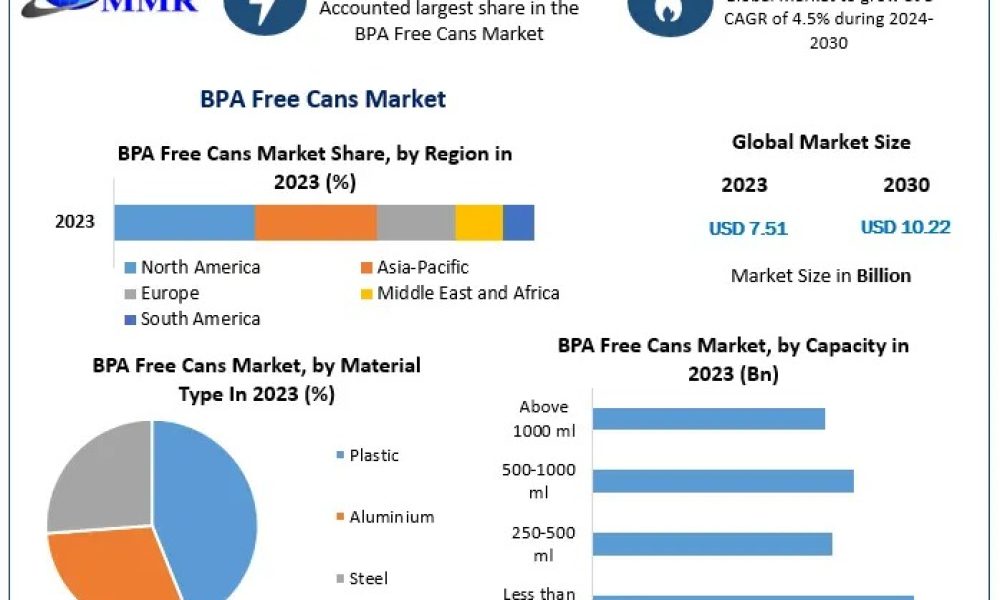
BPA Free Cans Market is expected to grow steadily at a CAGR of approximately 4.5% during the forecast period of 2024 to 2030, reaching a valuation of USD 10.22 billion by 2030. Rising consumer health concerns, regulatory measures against BPA use, and growing demand across end-use industries such as food & beverage, personal care, and pharmaceuticals are driving the market worldwide. North America currently holds the largest share, fueled by high consumer awareness and stringent government regulations on food safety.
Key Highlights & Insights
Market Size & Growth: Estimated to rise from USD 7.51 billion in 2023 to USD 10.22 billion by 2030, growing at a CAGR of 4.5%.
Dominating Region: North America leads the market driven by strong consumer preference for clean-label products, health-conscious packaging, and regulatory bans on BPA in food contact materials.
Leading Segment: Steel BPA free cans dominate the material type segment due to their superior durability and safety in food storage, while plastic cans are set to witness the highest growth rate due to ease of availability and cost-effectiveness.
Key Driver: Increasing regulations against BPA usage, escalating awareness about BPA’s potential health hazards, and the booming food & beverage sector fuel market expansion. Rising use in cosmetic, pharmaceutical, and personal care products further supplements growth.
Recent Developments
Leading companies such as Ball Corporation, Crown Holdings Inc., and Toyo Seikan Co. Ltd. focus on advancing BPA-free liner technologies, enhancing food safety and sustainability.
Governments worldwide are imposing stricter controls on BPA usage, accelerating the shift to BPA-free packaging across food, beverage, and personal care industries.
Innovation in epoxy-free coatings and alternative resin systems improve product performance while complying with regulatory requirements.
The ongoing trend toward sustainable packaging solutions and clean-label products positively impacts product adoption and market growth.
Market Dynamics
Growth Drivers:
Scientific and consumer awareness about adverse health effects stemming from BPA exposure spur demand for safer packaging.
Stringent government regulations and bans on BPA-containing food contact materials across multiple regions.
Expanding food & beverage industry requires safe and effective packaging, increasing BPA-free cans adoption.
Rising adoption in personal and homecare sectors driven by consumer preference for non-toxic packaging.
Challenges:
BPA’s functional benefits such as corrosion prevention complicate its replacement.
Higher cost and technology challenges of BPA-free coatings hinder some manufacturers.
Supply chain complexities and material cost fluctuations impact market growth pace.
For full access to the data, request a sample report now :https://www.maximizemarketresearch.com/request-sample/24291/
Regional Analysis
North America: Largest market share benefitting from health-conscious consumers and regulatory frameworks pushing BPA bans, especially in the U.S. and Canada.
Asia Pacific: Fastest-growing market due to rising demand in cosmetics, personal care, healthcare, and food sectors in China, India, Japan, and South Korea.
Europe: Growing market influenced by bans on BPA in baby products and strict food safety standards.
Latin America and Middle East & Africa: Emerging markets with expanding consumer awareness and increasing adoption of BPA-free packaging.
Product Segmentation
By Material: Steel (largest share), plastic (highest CAGR), aluminum.
By Capacity: Less than 250 ml, 250-500 ml, 500-1000 ml, Above 1000 ml.
By End-Use Industry: Food & beverage (largest), pharmaceuticals, personal & home care, others.
Key Trends
Shift from BPA-based to epoxy-free linings and polyester coatings to enhance safety.
Increasing consumer preference for clean-label, sustainable, and non-toxic packaging.
Growth in premium packaged foods and beverages fueling demand for high-quality BPA-free cans.
Government mandates and voluntary industry initiatives pushing innovation in BPA alternatives.
Quote
The North American BPA free cans market’s growth reflects mounting health and environmental awareness among consumers, combined with rigorous regulatory pressure to eliminate BPA from packaging. The global packaging landscape is rapidly evolving towards safer, sustainable alternatives, setting new standards for food safety and consumer trust.
With global health concerns and regulatory frameworks tightening, the BPA free cans market is on a strong ascent—delivering safer packaging solutions that drive consumer confidence, regulatory compliance, and innovation across industries worldwide.




