
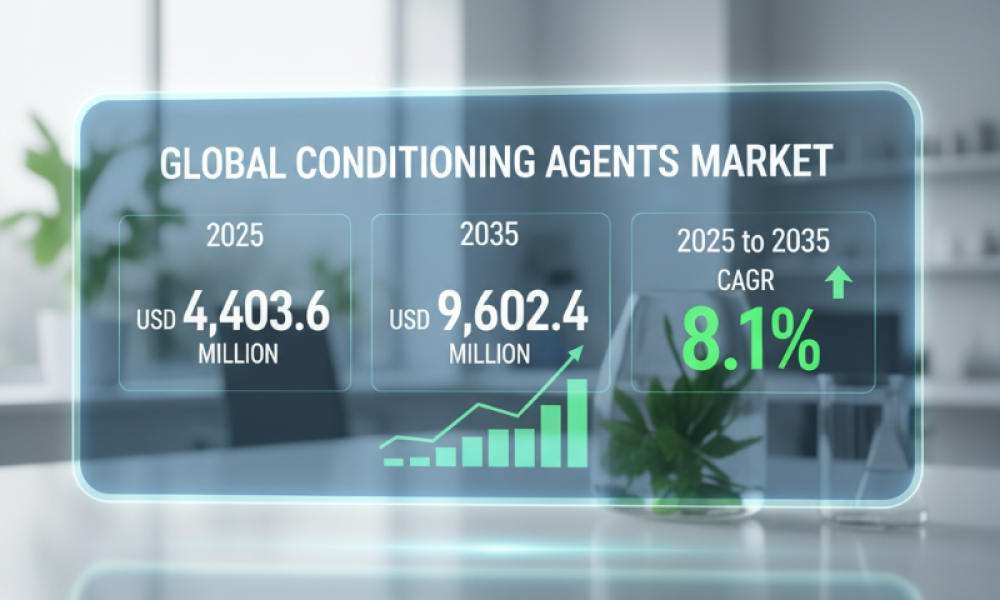
The global Conditioning Agents Market is poised for significant growth, with an expected valuation of USD 4,403.6 million in 2025 and a projected rise to USD 9,602.4 million by 2035, marking an impressive 118% increase over the decade. This growth translates to a robust compound annual growth rate (CAGR) of 8.1%, as the market undergoes transformative shifts driven by sustainability, premiumization, and innovation in personal care products.
Unlock detailed analytics – Request your personalized report now! https://www.futuremarketinsights.com/reports/sample/rep-gb-26334
Key Growth Drivers
The market’s expansion is fueled by rising consumer demand for haircare, skincare, and men’s grooming products that prioritize conditioning performance, multifunctionality, and eco-friendly attributes. Cationic quats, which currently lead the functional class with a 33.7% market share in 2025, continue to be integral to mainstream and premium formulations. These agents, essential for detangling, moisturizing, and enhancing texture, are witnessing increased demand as formulations evolve to meet sustainability trends.
Additionally, the market is transitioning toward bio-based and silicone-free conditioning agents as consumers and manufacturers increasingly emphasize clean-label, vegan, and biodegradable options. Companies such as Evonik, Croda, and BASF are capitalizing on this trend by innovating in green chemistry and renewable feedstock-based agents to maintain their competitive edge.
Regional Dynamics
Asia-Pacific is projected to lead the market, with China and India driving growth at CAGRs of 14.6% and 16.4%, respectively. The demand in these regions is largely influenced by growing disposable incomes, a burgeoning middle class, and the rising influence of beauty standards. E-commerce platforms play a significant role in accelerating the availability and adoption of multifunctional and silicone-free conditioning products.
The United States and Europe are also experiencing steady growth, with the USA expected to grow at a CAGR of 6.1% and Europe at 7.1%. The shift towards sustainable, premium products is particularly pronounced in the UK and Germany, where consumers are gravitating toward vegan, silicone-free, and bio-based alternatives. Professional salon adoption of advanced conditioning systems is further boosting market demand in these regions.
Innovations in Delivery Systems and Product Offerings
The market is also witnessing a shift in delivery systems, with free form systems projected to capture 51.7% of market share in 2025. Free form systems are favored for their versatility, cost-effectiveness, and ease of integration into various formulations, from rinse-off to leave-in conditioners and skincare lotions.
Meanwhile, liquid dispersions continue to dominate the physical form segment, holding a 48.3% share. Their ability to deliver superior conditioning benefits, such as detangling and softness, makes them the preferred choice for both mass-market and professional applications.
Competitive Landscape: Innovation and Strategic Shifts
The competitive landscape is becoming more dynamic as traditional chemical leaders face mounting pressure from emerging players specializing in natural, clean-label, and multifunctional products. Companies like Inolex and Solvay are distinguishing themselves with niche offerings in professional salon products and men’s grooming lines, while Evonik and BASF are leveraging their extensive portfolios of sustainable conditioning agents.
Competitive differentiation is shifting from commodity-based ingredients toward portfolios that emphasize sustainability, multifunctional performance, and regulatory compliance. Players that are investing in R&D and focusing on biodegradable, renewable, and high-performance agents are well-positioned for long-term success in this evolving market.
Key Market Insights
- Leading Functional Class: Cationic quats remain the dominant functional class, contributing 33.7% of the market value in 2025, with growing innovation in esterquat derivatives for improved biodegradability.
- Physical Form: Liquid dispersions will capture 48.3% of the market share due to their ease of use and compatibility with multiple conditioning actives.
- Delivery System: Free form systems, with a 51.7% market share in 2025, continue to lead due to their versatility and performance across a range of product categories.
- Growth Regions: China and India are set to drive double-digit growth, particularly in tier-2 and tier-3 cities, where the demand for affordable, multifunctional, and eco-friendly conditioning products is escalating.
Download Brochure for Full Insights: https://www.futuremarketinsights.com/reports/brochure/rep-gb-26334
Market Forecast and Outlook
The Conditioning Agents Market is set to experience remarkable growth through 2035, with bio-based and multifunctional solutions leading the charge. As consumer preferences continue to evolve, the shift towards sustainable, vegan, and clean-label products will shape the future of the industry. The ongoing innovation in formulation efficiency, coupled with the rapid expansion of the Asia-Pacific market, positions this sector as one of the most dynamic in the personal care industry.
About Future Market Insights (FMI)
Future Market Insights, Inc. (ESOMAR certified, recipient of the Stevie Award, and a member of the Greater New York Chamber of Commerce) offers profound insights into the driving factors that are boosting demand in the market. FMI stands as the leading global provider of market intelligence, advisory services, consulting, and events for the Packaging, Food and Beverage, Consumer Technology, Healthcare, Industrial, and Chemicals markets. With a vast team of over 400 analysts worldwide, FMI provides global, regional, and local expertise on diverse domains and industry trends across more than 110 countries.



