
The thermal energy harvesting market, valued at USD 185.3 million in 2025, is poised to reach USD 403.8 million by 2035, demonstrating a robust compound annual growth rate of 8.1%. This remarkable trajectory underscores the increasing global focus on energy efficiency solutions and the need to capture otherwise wasted thermal energy across industrial, automotive, and electronics applications. The growing adoption of heat-to-electricity devices and systems signals a broader trend: industries are seeking sustainable, cost-effective energy solutions that reduce reliance on conventional power sources while maximizing operational efficiency.
Over the next decade, the market’s growth pattern indicates accelerating acceptance of thermoelectric materials, waste heat recovery systems, and industrial-scale heat management solutions. By 2030, the market is expected to surpass USD 300 million, reflecting the expanding value potential for manufacturers, system integrators, and energy service providers. These stakeholders are increasingly witnessing strong returns on investments as they deploy energy harvesting technologies across diverse sectors. The rising industrial energy demands, coupled with efficiency-driven replacement of traditional systems, are propelling this market toward sustained expansion.
Full Market Report available for delivery. For purchase or customization, please request here: https://www.futuremarketinsights.com/reports/sample/rep-gb-25744
Market Drivers and Strategic Opportunities
The growth of thermal energy harvesting is being propelled by a combination of technological innovation and global emphasis on energy autonomy. Industries, from manufacturing to smart cities, are embracing self-powered systems that reduce operational costs and enhance energy resilience. Energy harvesting transducers, which account for the largest component share of 51.9% in 2025, play a central role by converting ambient heat into electrical power for low-power electronics. Continuous improvements in thermoelectric materials are boosting power output and conversion efficiency, making these systems increasingly viable for industrial monitoring, transportation, and building automation.
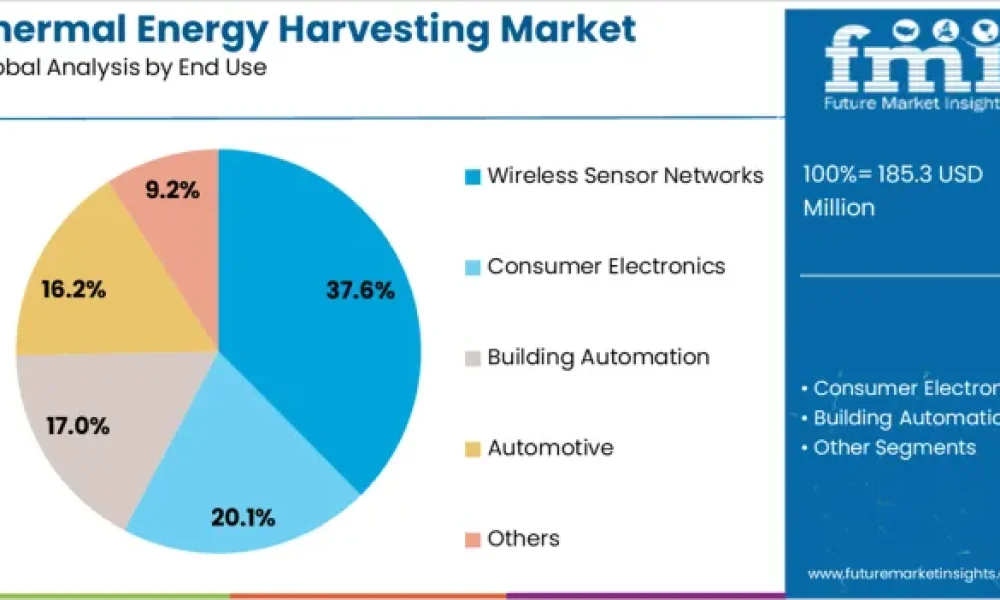
End-use demand is led by wireless sensor networks, capturing 37.6% of market revenue in 2025. The proliferation of distributed sensing systems in industrial automation, environmental monitoring, smart cities, and infrastructure diagnostics has created a strong need for reliable, maintenance-free power sources. Thermal energy harvesting enables sensors to operate autonomously in remote or inaccessible locations, eliminating frequent battery replacements and facilitating long-term, uninterrupted functionality. Advancements in ultra-low-power electronics and energy storage integration further enhance the performance and reliability of these systems.
The market’s adoption is further reinforced by the growing trend toward battery-free operations, particularly in maintenance-heavy or off-grid environments. Industries are increasingly turning to thermal energy harvesters as sustainable alternatives for powering sensors, wearable electronics, and micro-devices, enabling greater flexibility and scalability across applications. The expanding use of hybrid energy harvesting systems—combining thermal, vibration, and solar energy—demonstrates a market evolving around versatility and adaptability.
Segmental Analysis
The thermal energy harvesting market is segmented by component, end use, and geography. Components include energy harvesting transducers, power management integrated circuits (PMICs), and other supporting devices. End-use applications span wireless sensor networks, consumer electronics, building automation, automotive, and industrial applications. Regionally, the market covers North America, Europe, Asia-Pacific, Latin America, and the Middle East & Africa, with specific insights into leading economies driving adoption.
The energy harvesting transducer segment, commanding the largest revenue share, continues to lead due to its ability to reliably capture ambient heat and power low-energy devices. Improvements in design, form factor, and durability are expanding their adoption across harsh or remote industrial environments, while industrial pressure to reduce carbon footprints and eliminate battery dependencies strengthens their market relevance.
Wireless sensor networks, on the other hand, are increasingly leveraging thermal harvesting for sustainable and autonomous operation. Industrial IoT deployments, smart infrastructure projects, and environmental monitoring programs are driving adoption, as thermal energy harvesting provides a practical solution to power widely distributed sensors without maintenance overhead.
Regional Market Outlook
China is projected to grow at a CAGR of 10.9% from 2025 to 2035, making it the fastest-growing market globally. Rising industrial activity, government-led initiatives promoting energy efficiency, and widespread IoT adoption are driving demand. Chinese manufacturers are investing heavily in advanced thermoelectric materials and innovative device designs to improve efficiency and lower costs. Large-scale production capabilities further support both domestic supply and global exports, positioning China as a central hub for thermal energy harvesting growth.
India follows closely with a CAGR of 10.1%, supported by industrial automation, smart city initiatives, and government programs promoting energy-efficient technologies. Partnerships with global suppliers and the rise of wearable electronics and IoT monitoring systems are strengthening market penetration. Germany is expected to grow at 9.3%, fueled by automotive, industrial automation, and renewable energy applications. Focus on thermoelectric innovation and EU-supported clean energy initiatives further reinforces the market’s expansion in the region.
The United Kingdom, with a CAGR of 7.7%, sees adoption driven by IoT-enabled infrastructure, wearable devices, and energy-efficient industrial systems. Collaborative efforts with European technology providers are enhancing product offerings and supply chain resilience. In the United States, growth of 6.9% is being driven by aerospace, defense, industrial automation, and emerging healthcare applications, particularly self-powered monitoring devices. High-value applications and innovation remain central to market dynamics in mature markets.
Request Market Research Draft Report: https://www.futuremarketinsights.com/reports/thermal-energy-harvesting-market
Competitive Landscape
The thermal energy harvesting market features a blend of established multinational corporations and emerging innovators focused on expanding technological capabilities. Leading companies such as ABB, Texas Instruments, STMicroelectronics, and Honeywell are developing scalable solutions to convert waste heat into usable energy, leveraging expertise in semiconductors, sensors, and control systems. EnOcean and Fujitsu focus on building automation and IoT applications, delivering systems that minimize reliance on wired power or frequent battery replacements.
Renesas Electronics and Laird Thermal Systems, Inc. provide integrated thermoelectric modules and microcontrollers for compact, high-performance devices, while ZF Friedrichshafen specializes in automotive-grade energy harvesting applications. Powercast Corporation, Advanced Linear Devices, and Cedrat Technologies innovate in energy management circuits and advanced materials to optimize efficiency. Micropelt, Mide Technology, and Perpetua Power focus on industrial IoT, wearable devices, and remote monitoring applications with an emphasis on long-term reliability and low maintenance. Niche developers such as Kinergizer are enabling ultra-low-power solutions for connected electronics, often highlighted as part of sustainable energy ecosystems.
Distributors like Mouser Electronics play a key role in bridging supply availability, ensuring global access to components and modules. Across the competitive landscape, companies emphasize reliability, miniaturization, and independence from conventional power sources, which resonate with customers seeking energy cost reductions and extended device lifetimes. Strategic investments in R&D, technology integration, and market expansion continue to shape the dynamics of thermal energy harvesting, rewarding players with advanced materials, proven performance, and scalable deployment capabilities.
About Future Market Insights (FMI)
Future Market Insights, Inc. (ESOMAR certified, recipient of the Stevie Award, and a member of the Greater New York Chamber of Commerce) offers profound insights into the driving factors that are boosting demand in the market. FMI stands as the leading global provider of market intelligence, advisory services, consulting, and events for the Packaging, Food and Beverage, Consumer Technology, Healthcare, Industrial, and Chemicals markets. With a vast team of over 400 analysts worldwide, FMI provides global, regional, and local expertise on diverse domains and industry trends across more than 110 countries.
Contact Us:
Future Market Insights Inc.
Christiana Corporate, 200 Continental Drive,
Suite 401, Newark, Delaware – 19713, USA
T: +1-347-918-3531
For Sales Enquiries: [email protected]



