
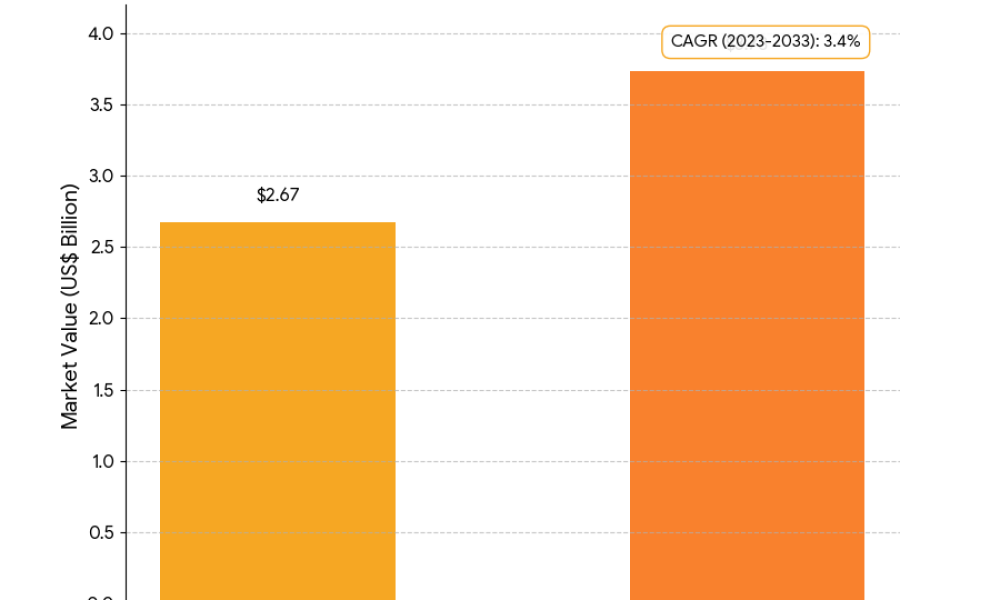
Worldwide sales of after sun care products are estimated at US$ 2.67 billion in 2023 and are predicted to reach US$ 3.73 billion by the end of 2033. After expanding at a sluggish 1.4% CAGR from 2018 to 2022, the global after sun care products market is set to exhibit faster expansion at 3.4% CAGR over the next ten years.This robust growth is driven by surging aesthetic awareness, increasing adoption of personal care products worldwide, and rising concerns over UV ray damage and skin cancer. The market is benefiting from a surge in sun exposure due to outdoor activities, expanding working women populations, and growing male interest in skincare. Emerging economies are fueling demand through higher disposable incomes and improved retail infrastructure. The United States, a key market, is expected to grow steadily, reaching $795.36 million by 2033, supported by high female spending on personal care and renovation trends. Globally, the market is shaped by economic development, health and fitness focus, and government initiatives promoting manufacturing in Asia-Pacific. However, challenges such as counterfeit products and lack of awareness could impact growth, necessitating innovation and anti-counterfeit strategies from manufacturers.
After Sun Care Products Market Technology Development:
Technological advancements are reshaping the after sun care products industry, emphasizing sustainability and efficacy. Innovations in formulations with natural and organic ingredients, such as aloe vera-infused lotions and antioxidant-rich gels, are gaining traction due to consumer demand for clean-label products. Water-based and hypoallergenic technologies reduce irritation while enhancing hydration and repair post-sun exposure. Developments like microencapsulation allow controlled release of soothing agents, improving product longevity and performance. Smart packaging with UV indicators and app-integrated usage tracking is emerging, aiding consumer compliance. Additionally, biotech advancements in plant-derived actives align with eco-friendly trends, complying with regulations on VOCs and chemicals. These innovations not only boost product functionality—offering anti-inflammatory and anti-aging benefits—but also support global sustainability goals, enabling manufacturers to differentiate in a competitive landscape and meet evolving preferences for genderless, ageless sun care.
After Sun Care Products Market Demand and Impact Analysis:
Demand for after sun care products is primarily driven by global increases in sun exposure from outdoor lifestyles, urbanization, and climate change, heightening risks of tanning, burns, and skin cancer. Over 50% of consumers now prioritize UV protection, boosting sales of moisturizers, lotions, and enhancers. In developing regions, rising disposable incomes and aesthetic awareness among women and men are propelling growth, with female users accounting for the majority. Environmental factors, like stricter UV awareness campaigns, drive demand for organic variants. However, counterfeit proliferation hampers trust and sales. Economic downturns could restrain discretionary spending, but opportunities arise from health trends and e-commerce expansion. The shift toward natural products aligns with green certifications, creating avenues for premium pricing and market share gains in eco-conscious regions like Europe.
After Sun Care Products Market Analysis by Top Investment Segments:
The after sun care products market is segmented by product type (creams & lotions, cleansers & foaming, essential oils, gels & scrubs, others), end user (male, female), nature (natural & organic, conventional), sales channel (modern trade, convenience stores, departmental stores, drug stores, online, others), and region. The creams & lotions segment is the most lucrative, projected to grow at 3.2% CAGR from 2023 to 2033, due to easy application and high efficacy, holding a prominent share. The female end-user segment leads, growing at 3.6% CAGR, driven by beauty trends and working women. Natural & organic nature is attractive for investments amid clean-label demand. Online sales channels are expanding rapidly with e-commerce booms. Asia-Pacific regions offer high returns due to low-cost manufacturing and consumer shifts, making these segments prime for innovation and targeted marketing.
Full Market Report available for delivery. For purchase or customization, please request here: https://www.factmr.com/connectus/sample?flag=S&rep_id=6863
After Sun Care Products Market Across Top Countries:
China leads with a 4.5% CAGR, projected to reach $653.46 million by 2033, driven by cheap labor, raw materials, and rising incomes. India follows at 4% CAGR, hitting $257.63 million by 2033, fueled by changing preferences and urbanization. The United States is significant, reaching $795.36 million by 2033, supported by outdoor activities and retail infrastructure. The United Kingdom grows at 3.8% CAGR to $500.37 million by 2033, emphasizing organic products amid skin cancer awareness. South Korea is projected at $306.19 million by 2033, benefiting from Asia-Pacific investments. These countries account for substantial global demand, with Asia-Pacific dominating due to manufacturing advantages and Europe leading in sustainable preferences.
Leading After Sun Care Products Companies and Their Industry Share:
The after sun care products market is dominated by multinational giants leveraging innovation and distribution. Key players include L’Oréal S.A., Johnson & Johnson Services Inc., Shiseido Co. Ltd., The Procter & Gamble Company, The Estee Lauder Companies Inc., Beiersdorf Aktiengesellschaft, Unilever PLC, Natura &Co, Kao Corporation, Avon Products Inc., and Christian Dior SE, holding significant shares through diverse portfolios. L’Oréal and Johnson & Johnson lead with strong R&D in soothing formulations. Shiseido excels in Asia-Pacific with premium offerings. These firms engage in product launches, acquisitions, and expansions to maintain dominance. Regional players add fragmentation, but multinationals control via quality compliance and marketing.
After Sun Care Products Market Historic and Future Pathway Analysis:
Historically, the after sun care products market grew at a sluggish 1.4% CAGR from 2018 to 2022, reaching $2.67 billion in 2023, amid post-pandemic recovery and awareness gaps. From 2023 onward, growth accelerates to 3.4% CAGR, driven by health trends and product diversification. Future pathways include organic innovations and digital sales, with Asia-Pacific leading expansion. Challenges like counterfeits require regulatory focus. By 2033, the market hits $3.73 billion, aligned with sustainability and personalization trends.
After Sun Care Products Industry News:
Recent developments highlight innovation in the after sun care market. In November 2024, Transparency Market Research reported the market on track for $3.3 billion by 2031 at 3.7% CAGR, emphasizing natural products. In April 2024, Research and Markets released a strategic report projecting $3.5 billion by 2030, focusing on partnerships for eco-friendly formulations. In May 2022, Eucerin launched its Sun line with dermatologist-developed after-sun options. In April 2022, Cay Skin raised $4.1 million for inclusive sun care. These initiatives reflect R&D investments, sustainability, and expansions in emerging markets.
Explore More Related Studies Published by Fact.MR Research:
Baby Disposable Diaper Market- https://www.factmr.com/report/79/baby-disposable-diaper-market
Surface Cleaning Products Market- https://www.factmr.com/report/85/surface-cleaning-products-market
About Fact.MR:
We are a trusted research partner of 80% of fortune 1000 companies across the globe. We are consistently growing in the field of market research with more than 1000 reports published every year. The dedicated team of 400-plus analysts and consultants is committed to achieving the utmost level of our client’s satisfaction.
Contact:
11140 Rockville Pike
Suite 400
Rockville, MD 20852
United States
Tel: +1 (628) 251-1583
Sales Team: [email protected]
Follow Us: LinkedIn | Twitter | Blog



