
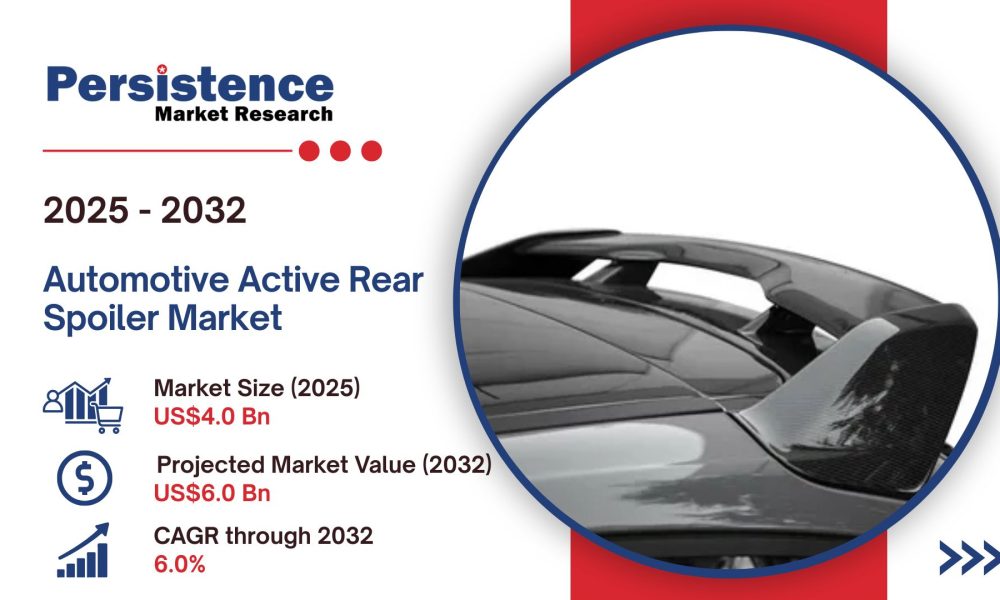
The global automotive active rear spoiler market is poised for sustained growth, with its valuation projected at US$4.0 billion in 2025, and further anticipated to reach US$6.0 billion by 2032, reflecting a compound annual growth rate (CAGR) of 6.0% during the forecast period from 2025 to 2032. This steady expansion underscores the pivotal role of advanced aerodynamics in the evolving automotive industry.
Several key drivers are shaping this growth trajectory. First, the rising consumer preference for high-performance and luxury vehicles has accelerated the adoption of active aerodynamic components, including adaptive rear spoilers. Second, the growing emphasis on fuel efficiency and vehicle stability is compelling automakers to integrate these solutions, as active spoilers enhance downforce, reduce drag, and improve cornering capability. Furthermore, the automotive industry’s transition toward lightweight materials, electrification, and connected mobility is creating new opportunities for innovative spoiler designs optimized for both performance and energy savings.
The convergence of technological advancements in electronics, sensors, and mechatronics with consumer demand for premium driving experiences continues to fuel the adoption of active aerodynamic solutions, making active rear spoilers a critical component in modern vehicle engineering.
Request Sample Copy of Report: https://www.persistencemarketresearch.com/samples/26041
Segmentation Analysis
By Type
The market for automotive active rear spoilers can be categorized into mechanically actuated spoilers and electronically actuated spoilers. Among these, electronically actuated spoilers dominate the global market, holding a significant revenue share in 2025 and expected to expand rapidly throughout the forecast period. Their popularity stems from their seamless integration with vehicle control systems, enabling real-time deployment and adjustment based on driving conditions, speed, and stability requirements.
Mechanical systems, though simpler and more cost-effective, are gradually being replaced by electronic counterparts, particularly in the premium and luxury vehicle segments. The shift reflects the industry’s broader transition toward automation, precision control, and smart vehicle systems, where electronic actuation provides superior responsiveness and customization.
By Vehicle Type
In terms of vehicle adoption, the passenger vehicle segment—particularly luxury sedans, sports cars, and high-end SUVs—dominates the market. Active rear spoilers are now considered a signature feature of premium brands, enhancing both aesthetics and functionality. The rising demand for SUVs and crossovers with sporty performance profiles is also boosting spoiler integration, as automakers seek to improve handling dynamics in larger vehicle bodies.
The electric vehicle (EV) segment is emerging as a significant growth area. As EVs emphasize aerodynamic efficiency to extend driving range, active spoilers are being increasingly adopted to manage airflow and reduce drag. This trend is particularly evident in premium EVs, where manufacturers are combining sleek design with adaptive aerodynamic technologies to maximize energy efficiency.
By Propulsion and Technology
The adoption of active rear spoilers varies across internal combustion engine (ICE) vehicles, hybrid vehicles, and electric vehicles. While ICE-powered performance cars were the first to implement this technology, hybrid and EV models are now driving the next wave of adoption. Active aerodynamics in EVs provide not only performance benefits but also range optimization, which is a key differentiator in the competitive electric mobility market.
Additionally, advances in smart actuation systems, AI-driven predictive controls, and IoT-enabled monitoring are transforming spoiler performance. Integration with 5G connectivity allows real-time data exchange between vehicle sensors and control systems, optimizing spoiler deployment based on external factors such as road conditions, weather, and traffic dynamics.
Request Customization of Report: https://www.persistencemarketresearch.com/request-customization/26041
Regional Insights
Geographically, the European market currently leads in terms of adoption and innovation. With a strong presence of luxury automotive manufacturers in Germany, Italy, and the UK, Europe accounts for a dominant share of global revenues. Automakers in the region are at the forefront of integrating advanced aerodynamic solutions into their performance and electric vehicles, supported by stringent EU regulations on fuel efficiency and carbon emissions.
North America represents another significant market, driven by strong consumer demand for sports cars and performance SUVs. The U.S. in particular has seen robust growth in aftermarket demand for performance enhancements, including active spoilers.
Meanwhile, Asia-Pacific is projected to be the fastest-growing region, expanding at a notable CAGR during 2025–2032. Countries such as China, Japan, and South Korea are contributing to this surge, owing to rapid automotive production, expanding luxury vehicle ownership, and government support for electric vehicle adoption. China’s booming EV market, coupled with domestic automakers investing in active aerodynamic technologies, positions the region as a critical growth hub.
Unique Features and Innovations in the Market
Modern automotive active rear spoilers stand out for their integration of intelligent electronics, adaptive control, and lightweight materials. Unlike traditional fixed spoilers, active systems adjust dynamically to driving conditions, deploying or retracting based on factors such as vehicle speed, steering angle, and braking intensity.
Innovations in the market increasingly focus on smart actuation technologies, where electronic actuators respond instantly to vehicle inputs, ensuring precision in downforce distribution. Furthermore, AI algorithms are being integrated to predict driving behaviors and proactively adjust spoiler positions, enhancing both safety and performance.
The adoption of IoT connectivity allows remote monitoring and real-time data analytics, enabling predictive maintenance and performance optimization. The advent of 5G technology further enhances these capabilities by ensuring low-latency communication between vehicle systems and cloud-based platforms.
Lightweight composites and carbon-fiber reinforced plastics (CFRP) are also reshaping spoiler design, balancing aerodynamic performance with improved energy efficiency and reduced vehicle weight. Together, these innovations are transforming active rear spoilers into multifunctional components that align with broader trends in smart mobility and sustainability.
Market Highlights
Automotive manufacturers and suppliers are increasingly adopting active rear spoilers for several key reasons. Firstly, they serve as critical enablers of fuel efficiency and stability, helping OEMs comply with stringent global emission standards. Secondly, active spoilers offer enhanced driver safety, reducing risks of oversteering or instability at high speeds. Thirdly, they provide an element of aesthetic differentiation, reinforcing brand identity and luxury appeal.
Regulations around vehicle efficiency and sustainability also play a central role in market growth. Governments worldwide are mandating reductions in carbon emissions, pushing manufacturers to adopt solutions that reduce drag and improve overall energy utilization. Active spoilers, by enhancing aerodynamics, contribute directly to compliance with these regulations while simultaneously appealing to performance-driven consumers.
Buy Now: https://www.persistencemarketresearch.com/checkout/26041
Key Players and Competitive Landscape
The competitive landscape of the automotive active rear spoiler market is characterized by technological innovation, strategic partnerships, and regional expansion. Leading companies include:
- Magna International Inc.: A pioneer in automotive systems, Magna focuses on advanced mechatronic solutions for aerodynamic control. Its strategic investments in lightweight composite materials continue to set industry benchmarks.
- Valeo SA: Leveraging its expertise in electronics and sensors, Valeo develops intelligent active spoiler systems integrated with predictive vehicle controls. The company emphasizes innovations aligned with connected and autonomous vehicle ecosystems.
- Polytec Group: Known for its expertise in lightweight plastics and composites, Polytec provides innovative aerodynamic solutions that balance performance with energy efficiency.
- HBPO Group: Specializing in modular systems, HBPO integrates active rear spoilers into front-end and rear-end modules, enabling streamlined production and design flexibility for OEMs.
- Porsche AG and BMW AG: These luxury automakers exemplify in-house innovation, developing proprietary spoiler systems that enhance brand exclusivity and driving dynamics. Their active aerodynamic features serve as differentiators in premium vehicle segments.
Emerging players in Asia-Pacific are also gaining traction by offering cost-effective solutions and forming partnerships with domestic automakers, particularly in the EV sector.
Future Opportunities and Growth Prospects
The future of the automotive active rear spoiler market is intrinsically tied to technological evolution and regulatory frameworks. The shift toward electrification is expected to amplify demand, as EV manufacturers prioritize aerodynamic efficiency to extend driving ranges. Active spoilers will serve as essential components in meeting these objectives.
Furthermore, the increasing role of autonomous driving technologies opens new possibilities for adaptive aerodynamics, where vehicle systems dynamically adjust spoilers for safety, stability, and energy management without driver input.
As sustainability remains a cornerstone of automotive development, the use of recyclable materials and eco-friendly composites in spoiler manufacturing will further expand the market’s appeal.
Overall, the convergence of AI, IoT, advanced materials, and electrification will transform active rear spoilers from niche performance features into mainstream automotive components, making them integral to the industry’s pursuit of efficiency, safety, and innovation.




