
Solid Electrolyte Market Overview
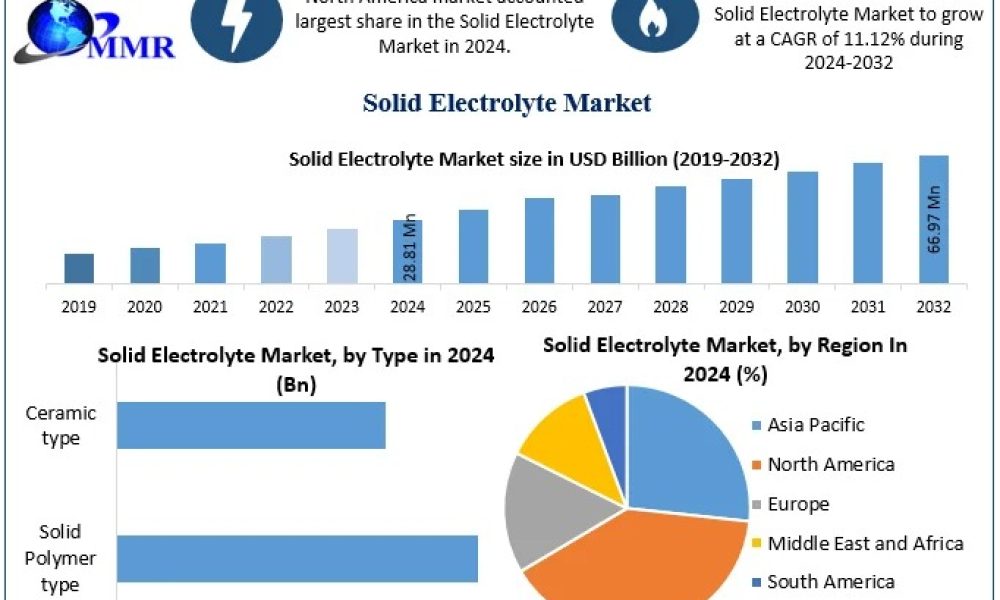
The Solid Electrolyte Market is gaining significant attention as industries worldwide seek safer, more efficient, and higher energy density storage solutions. Valued at USD 28.81 million in 2024, the market is expected to grow steadily at a CAGR of 11.12% between 2025 and 2032, reaching nearly USD 66.97 million by 2032. This rapid expansion is primarily fueled by the increasing adoption of solid-state batteries (SSBs) in electric vehicles (EVs), wearable electronics, and industrial applications.
Unlike conventional liquid and polymer electrolytes used in lithium-ion batteries, solid electrolytes offer enhanced thermal stability, reduced risk of leakage, and improved safety performance. With the growing push toward decarbonization and clean energy adoption, governments, automakers, and technology companies are heavily investing in research and development of solid electrolytes to support next-generation battery systems.
Key Market Insights
Market Growth Potential: Driven by rising EV production and consumer demand for safer energy storage, solid electrolytes are expected to play a transformative role in the future of energy.
Regional Dominance: North America leads the market with over 35.4% share in 2024, supported by proactive government incentives, EV adoption policies, and technological leadership.
Top Application: Electric vehicle batteries accounted for 58% of the market in 2024, underscoring the growing role of SSBs in mobility and sustainability.
Key Drivers: Increased focus on safety, higher energy density, and eco-friendly solutions across automotive, telecom, electronics, and industrial sectors.
Recent Industry Developments
Samsung Electronics has initiated a pilot line for solid-state batteries, marking an important step toward large-scale commercialization.
BMW and Ford have announced plans to integrate solid-state battery technologies into their EVs by 2029, signaling strong automaker commitment.
Hyundai and Samsung are making substantial investments in solid electrolyte research, demonstrating confidence in the long-term market outlook.
Breakthroughs in materials science are addressing critical issues such as lithium dendrite formation, interface stability, and conductivity—paving the way for mass adoption.
Market Dynamics
Growth Drivers
EV Market Expansion: The electric vehicle industry is projected to grow at a 15.8% CAGR, creating immense demand for safe, long-lasting, and high-capacity batteries.
Government Incentives: Subsidies and regulatory frameworks for clean energy and EV adoption worldwide are boosting the solid electrolyte ecosystem.
Safety Advantage: Solid electrolytes significantly reduce fire hazards compared to liquid electrolytes, making them an attractive choice for next-generation batteries.
Challenges
High Production Costs: The current cost of producing solid electrolytes and integrating them into battery systems remains a major barrier to large-scale commercialization.
Complex Manufacturing: Issues with interface compatibility and durability make scaling difficult.
Competition from Li-ion Improvements: Continued cost reduction and efficiency improvements in lithium-ion batteries challenge the immediate adoption of solid electrolytes.
Regional Insights
North America: Holds the largest share, driven by strong EV adoption, R&D investment, and policy support from governments.
Asia-Pacific: Fastest-growing region due to China and India’s booming EV markets, combined with industrial innovation in Japan and South Korea.
Europe: Prioritizing sustainability and clean energy goals, with companies investing in eco-friendly battery technologies.
Rest of the World: Gradual adoption is being observed, with interest growing in Latin America, Middle East, and Africa as electrification initiatives expand.
Market Segmentation
By Type:
Solid Polymer Electrolytes
Ceramic Electrolytes
By Application:
Thin Film Batteries
Electric Vehicle Batteries
By End User:
Telecom
Heavy Goods & Engineering
Electricals & Electronics
Future Outlook
The solid electrolyte market outlook is highly promising, with projections showing consistent double-digit growth through 2032. The increasing adoption of solid-state batteries in EVs will remain the strongest driver, particularly as major automakers transition toward safer and more sustainable technologies. Additionally, the integration of AI-based battery management systems, eco-friendly materials, and automation in production will accelerate cost reductions and scalability.
With North America leading today and Asia-Pacific emerging as a powerful growth engine, the market is expected to evolve into a highly competitive space, with significant opportunities for innovation. The shift toward sustainable electrification, reduced carbon footprints, and safer battery systems positions solid electrolytes as a cornerstone technology for the future of energy storage.




