
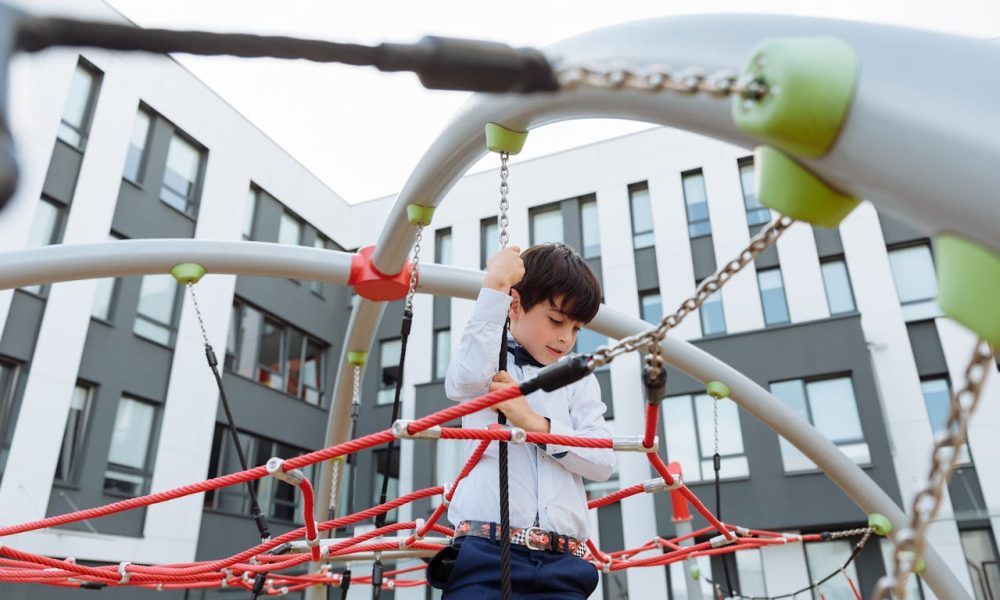
A great playground is the heart of a school’s outdoor space. It’s a place of joy, a laboratory for social skills, and a critical tool for a child’s physical and cognitive development. For the PTA leaders, school administrators, and parent volunteers tasked with choosing a new playground, it’s an exciting opportunity to make a lasting, positive impact on the lives of students for years to come.
But for the committee in charge, the task can be daunting. You need a structure that is not only fun and engaging but also incredibly safe and built to withstand a decade or more of constant, heavy use by hundreds of children. Choosing a commercial-grade school playground is a significant investment in your school’s future. To ensure you’re making a smart choice, you need to look beyond the bright colors and focus on the fundamental pillars of safety, durability, and play value.
Here are five key tips to guide you through the selection process.
1. Prioritize Safety and Compliance Above All Else
This is the absolute, non-negotiable first step. A public school playground is held to a much higher safety standard than a residential backyard playset. Before you even look at a catalog, you need to understand that any equipment you consider must be certified to meet these national safety standards.
The two key guidelines to be aware of are the U.S. Consumer Product Safety Commission (CPSC)’s Public Playground Safety Handbook and the ASTM International standards for playground equipment. A reputable manufacturer will be able to provide you with documentation certifying that their products meet or exceed these critical guidelines. This is your most important assurance of a safe design.
2. Focus on Durable, Commercial-Grade Materials
A school playground is used by hundreds of kids every single day, in all kinds of weather. It needs to be built to last. The materials used in its construction are the primary indicator of its long-term durability.
- Look for heavy-gauge, galvanized, and powder-coated steel for all the posts and structural supports. This multi-layer protection is essential for preventing rust and corrosion.
- Check the plastics. The slides, panels, and roofs should be made from a durable, UV-stabilized, rotationally molded plastic that is designed to resist fading and cracking in the sun.
- Examine the hardware. All nuts, bolts, and fasteners should be vandal-resistant and made from a material like stainless steel to prevent rust.
3. Choose Age-Appropriate and Developmentally-Rich Activities
A great playground is more than just a slide and a set of swings. It should offer a wide variety of play activities that challenge children and support different aspects of their development. As you look at designs, try to find a structure that includes a good mix of the following:
- Climbing activities (like a rock wall or a cargo net) to build upper body strength, coordination, and risk-assessment skills
- Sliding and spinning activities for a fun sensory experience
- Balancing activities (like a balance beam) to improve coordination
- Imaginative play elements, such as a storefront panel, a steering wheel, or a small playhouse, to encourage social interaction and creativity
4. Don’t Forget the Surfacing
The playground structure itself is only half of the safety equation. The protective surfacing that is installed underneath and around the equipment is just as critical. The number one cause of playground injuries is a fall onto an improper surface.
Your plan must include a high-quality, impact-absorbing safety surface, such as engineered wood fiber, poured-in-place rubber, or rubber tiles. The chosen material must have a “critical fall height” rating that is appropriate for the tallest piece of equipment on your playground.
5. Investigate the Warranty and the Company’s Reputation
A manufacturer’s warranty is a direct reflection of their confidence in their own product’s durability. Look for a company that offers a long and comprehensive warranty, especially on the most critical components like the steel posts and the hardware. A lifetime warranty on the posts and a 15-year warranty on the plastic components is a good benchmark.
Before you make a final decision, ask the company for a list of local references. There is no substitute for going to see a 10-year-old playground at another local school or park to see for yourself how the equipment has held up over time.
Choosing a new playground is a wonderful opportunity to enrich your students’ lives. By focusing on these key pillars of safety, durability, and play value, you can be confident that you are making a smart, long-term investment for your entire school community.




