
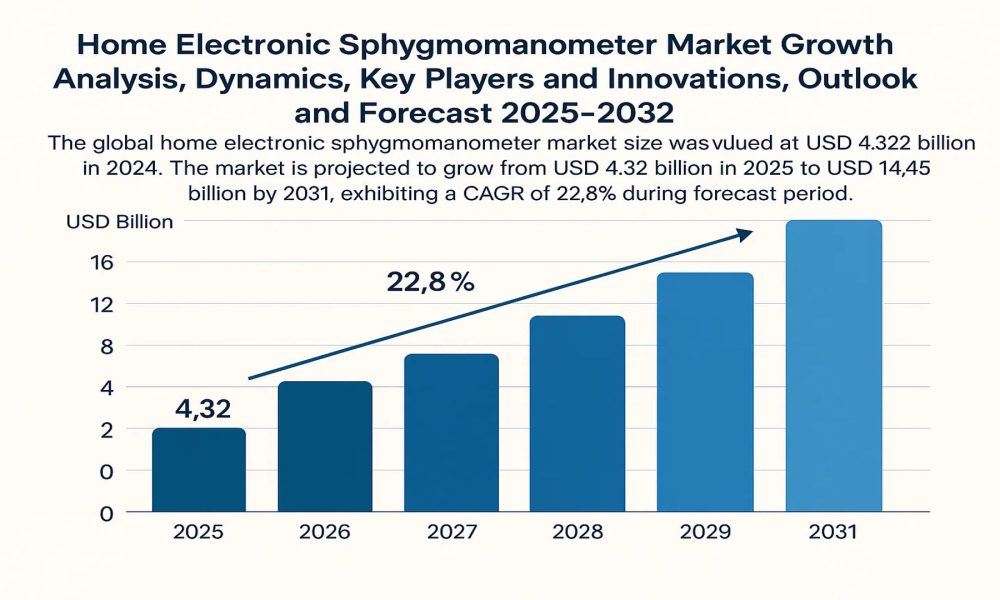
Home Electronic Sphygmomanometer Market size was valued at USD 3.53 billion in 2024. The market is projected to grow from USD 4.32 billion in 2025 to USD 14.45 billion by 2031, exhibiting a CAGR of 22.8% during the forecast period.
Home electronic sphygmomanometers are portable, user-friendly devices designed for monitoring blood pressure at home. These devices utilize oscillometric or auscultatory methods to measure systolic and diastolic pressure, offering real-time health tracking for individuals with hypertension or cardiovascular risks. The market includes wrist, upper arm, and finger-type monitors, with upper arm variants dominating due to higher clinical accuracy.
The market growth is driven by rising hypertension prevalence, which affects over 1.28 billion adults globally according to WHO data. Furthermore, aging populations – particularly in developed regions where 16% of people are over 65 – and increasing home healthcare adoption are accelerating demand. Technological advancements like Bluetooth connectivity and AI-based analysis in products from market leaders such as Omron and Microlife are creating new growth opportunities, while e-commerce expansion is improving product accessibility across emerging markets.
Claim Your Free Sample Report- https://www.intelmarketresearch.com/download-free-sample/9008/home-electronic-sphygmomanometer-market
MARKET DRIVERS
Rising Global Prevalence of Hypertension to Accelerate Market Growth
The increasing global burden of hypertension is a primary driver for home electronic sphygmomanometer adoption worldwide. With nearly 1.3 billion adults currently living with hypertension, the need for regular blood pressure monitoring has become critical for early detection and management. This chronic condition accounts for approximately 10 million deaths annually, making it one of the most significant global health challenges. Home monitoring devices provide patients with convenient, real-time tracking capabilities that enable better disease management and reduce hospital visits. The World Health Organization estimates that hypertension prevalence among adults aged 30-79 years has increased from 650 million in 1990 to 1.28 billion in 2021, creating an expanding market for home monitoring solutions.
Technological Advancements in Digital Health Devices to Boost Demand
Innovations in digital health technologies are significantly enhancing the functionality of home sphygmomanometers. Modern devices now incorporate Bluetooth connectivity, mobile app integration, cloud storage, and AI-powered analytics that provide deeper health insights beyond simple blood pressure readings. These smart features enable patients and healthcare providers to track trends, detect anomalies, and make data-driven treatment decisions. Recent product launches demonstrate this technological evolution, with leading manufacturers introducing devices that offer clinical-grade accuracy with user-friendly interfaces. The integration of these devices into broader telehealth ecosystems further increases their value proposition, making them indispensable tools for remote patient monitoring programs.
Aging Population and Increased Health Awareness to Drive Market Expansion
Global demographic shifts toward aging populations are creating sustained demand for home health monitoring devices. With the population aged 60+ expected to double by 2050, reaching 2.1 billion worldwide, age-related health monitoring becomes increasingly critical. Hypertension prevalence rises significantly with age, affecting approximately 60% of individuals over 60 years old. Concurrently, growing health consciousness among younger demographics, accelerated by the COVID-19 pandemic, has expanded the consumer base for preventive health monitoring devices. This combination of demographic trends and heightened health awareness creates a strong, long-term foundation for market growth across all age segments.
MARKET OPPORTUNITIES
Expansion in Emerging Markets to Offer Significant Growth Potential
Rapid urbanization and improving healthcare infrastructure in emerging economies present substantial opportunities for market expansion. Countries with large populations but relatively low current penetration rates of home monitoring devices, such as India, Brazil, and Indonesia, represent untapped markets with enormous growth potential. Rising disposable incomes, expanding middle-class populations, and increasing government focus on preventive healthcare measures create favorable conditions for adoption. Manufacturers developing affordable, locally relevant products tailored to these markets can establish strong footholds before competition intensifies.
Integration with Healthcare Ecosystems to Drive Value-added Services
The growing adoption of electronic health records and telehealth platforms creates opportunities for deeper integration of home sphygmomanometers into clinical workflows. Devices capable of seamlessly transmitting data to healthcare providers enable more proactive care management and early intervention. This integration potential extends to health insurance programs, where usage data can support personalized premiums and rewards for blood pressure management. Strategic partnerships between device manufacturers and healthcare providers can develop comprehensive monitoring solutions that combine hardware, software, and professional services, creating recurring revenue streams beyond device sales.
MARKET CHALLENGES
Intense Competition and Price Pressures to Impact Profitability
The home sphygmomanometer market faces increasing competitive intensity, with over 50 major manufacturers globally competing on features, brand reputation, and price. This crowded competitive landscape has triggered price wars, particularly in the entry-level segment, eroding profit margins for manufacturers. The market has seen average selling prices decline by approximately 15% over the past five years as companies strive to maintain market share. Smaller manufacturers struggle to compete with established brands that benefit from economies of scale, leading to consolidation in the industry. These competitive pressures challenge both profitability for manufacturers and quality assurance for consumers.
User Compliance and Data Interpretation Challenges to Affect Outcomes
Despite device availability, inconsistent user compliance remains a significant challenge affecting clinical outcomes. Studies indicate that nearly 40% of patients fail to use home monitoring devices as recommended, limiting the potential health benefits. Proper cuff placement, measurement timing, and data recording require patient education that often proves inadequate. Furthermore, many users lack the medical knowledge to correctly interpret readings and trends, potentially leading to inappropriate self-medication or anxiety. These challenges highlight the need for improved user education programs and more intuitive device interfaces that guide proper usage and interpretation.
Segment Analysis:
By Type
- Wrist Blood Pressure Monitor
- Upper Arm Blood Pressure Monitor
- Finger Blood Pressure Monitor
Upper Arm Blood Pressure Monitor dominates the market due to higher accuracy in measurements and widespread clinical validation compared to wrist or finger monitors.
By Application
- Online Sales
- Offline Sales
Online Sales are rapidly growing due to increasing e-commerce penetration and convenience, though offline channels still hold significant share in regions with strong pharmacy and retail networks.
By End User
- Individual Consumers
- Hospitals & Clinics
- Senior Care Facilities
Individual Consumers represent the largest segment, driven by rising health consciousness and the need for regular blood pressure monitoring among aging populations with hypertension risks.
By Technology
- Automatic
- Semi-Automatic
Automatic devices are preferred for home use due to their ease of operation with single-button measurement and digital displays, making them more user-friendly than manual or semi-automatic models.
List of Key Home Electronic Sphygmomanometer Manufacturers
- Omron Corporation (Japan)
- Withings (France)
- Xiaomi Corporation (China)
- Microlife AG (Switzerland)
- A&D Medical (Japan)
- Yuwell (Jiangsu Yuyue Medical Equipment Co., Ltd.)
- Sinocare (China)
- Rossmax International Ltd. (Taiwan)
- Panasonic Healthcare (Japan)
- Beurer GmbH (Germany)
- iHealth Labs (US)
- Citizen Systems Japan Co., Ltd.
The competitive intensity is further heightened by technology companies developing health platforms, with Apple and Samsung potentially entering the market through partnerships. While accuracy validation remains a barrier for new entrants, the growing $14.45 billion market opportunity continues attracting diverse players.
Increasing Adoption of Smart Health Devices to Drive Market Growth
The global home electronic sphygmomanometer market is experiencing rapid growth, driven by rising consumer awareness about preventive healthcare and the increasing prevalence of hypertension. With cardiovascular diseases (CVDs) accounting for an estimated 17.9 million deaths annually, blood pressure monitoring has become a critical aspect of personal health management. The demand for smart sphygmomanometers integrated with Bluetooth and mobile applications has surged as users seek real-time tracking and data sharing with healthcare providers. By 2024, over 45% of electronic sphygmomanometers sold globally are expected to feature wireless connectivity, reflecting a shift toward digital health solutions.
Other Trends
Expansion of Geriatric Population
The aging population, particularly in regions like North America, Europe, and Asia-Pacific, is fueling market expansion. Nearly 16% of the world’s population is projected to be aged 65 or older by 2050, intensifying the need for home-based medical devices. Hypertension prevalence among older adults exceeds 60% in high-income countries, making electronic sphygmomanometers indispensable for continuous monitoring. Manufacturers are responding by enhancing device ergonomics, such as voice-guided operation and oversized displays, catering to elderly users with limited dexterity or vision impairments.
Growth of E-Commerce in Medical Device Sales
The online sales segment is emerging as a dominant distribution channel for home sphygmomanometers, with platforms like Amazon and Alibaba capturing a 35% market share in 2024. Consumers increasingly favor e-commerce for its convenience, competitive pricing, and access to product reviews. Additionally, manufacturers are leveraging direct-to-consumer (D2C) models, offering subscription-based monitoring services with cloud storage for health data. This trend is expected to grow by 28% annually, supported by rising internet penetration and digital literacy in emerging economies.
Regulatory Approvals and Standardization
Stringent regulatory requirements are shaping product development, with agencies like the FDA and CE mandating stricter accuracy standards for validation. Recent guidelines emphasize ISO 81060-2:2018 compliance, ensuring clinical-grade precision in home-use devices. While this has elevated manufacturing costs, it has also enhanced consumer trust 82% of buyers now prioritize certified products over unbranded alternatives. Market leaders like Omron and Microlife are investing in AI-driven calibration technologies, reducing measurement errors to less than ±3 mmHg, well below the allowable threshold.
Claim Your Free Sample Report- https://www.intelmarketresearch.com/download-free-sample/9008/home-electronic-sphygmomanometer-market
Recent Developments in the Home Electronic Sphygmomanometer Market
- Integration with Smart Health Ecosystems
- Leading brands are increasingly integrating home electronic sphygmomanometers with smartphones, tablets, and cloud-based health management platforms.
- Devices now often feature Bluetooth or Wi-Fi connectivity, allowing users to sync their blood pressure data with apps for real-time monitoring and historical tracking.
- Example: Omron and Withings have introduced devices that not only measure blood pressure but also provide trend analysis and health recommendations through mobile apps.
- AI and Predictive Analytics
- Some recent models use AI algorithms to analyze blood pressure trends and alert users to potential hypertension risks before severe symptoms appear.
- This helps in early detection and better disease management, especially for elderly patients and people with chronic conditions.
- Enhanced Accuracy and User-Friendly Design
- Manufacturers are focusing on improving measurement accuracy by using advanced oscillometric technology and multi-cuff designs.
- Modern devices are designed with large, easy-to-read digital displays, one-touch operation, and memory storage for multiple users, making them more accessible for seniors.
- Growing Focus on Telemedicine Compatibility
- Post-pandemic, there is a rising trend of home sphygmomanometers being compatible with telemedicine platforms, allowing healthcare providers to remotely monitor patient blood pressure.
- This trend is driving demand in both developed and developing countries where home healthcare is expanding rapidly.
- Regulatory Approvals and Certifications
- Many companies are achieving FDA and CE certifications, which boosts consumer confidence and encourages adoption in home settings.
- Compliance with international standards ensures devices meet accuracy, safety, and reliability requirements.
- Expansion in Emerging Markets
- Manufacturers are targeting emerging markets in Asia-Pacific, Latin America, and the Middle East by offering affordable and compact devices.
- Localized marketing campaigns and partnerships with online retail platforms are increasing the reach of these devices in price-sensitive markets.
- Focus on Sustainability
- Some brands are adopting eco-friendly materials, energy-efficient batteries, and recyclable packaging to appeal to environmentally conscious consumers.
About Intel Market Research
Intel Market Research delivers actionable insights in technology and infrastructure markets. Our data-driven analysis leverages:
- Real-time infrastructure monitoring
- Techno-economic feasibility studies
Competitive intelligence across 100+ countries
Trusted by Fortune 500 firms, we empower strategic decisions with precision.
International: +1(332) 2424 294 | Asia: +91 9169164321
Website: https://www.intelmarketresearch.com
Follow us on LinkedIn: https://www.linkedin.com/company/intel-market-research




