
Thin Film Coatings Market Overview :
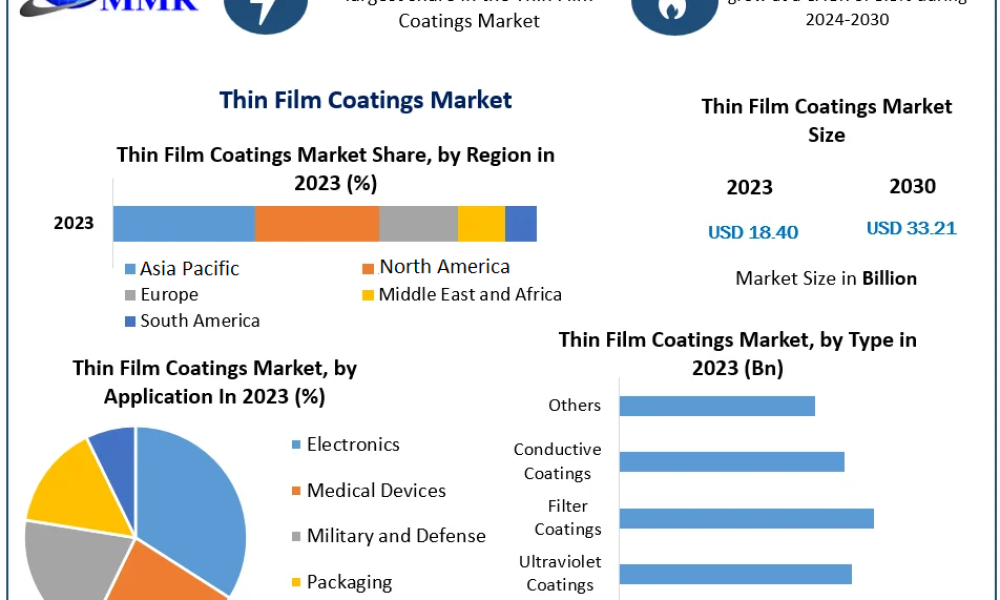
Thin Film Coatings Market is poised for substantial expansion, expected to grow from approximately USD 18.40 billion in 2023 to USD 33.21 billion by 2030. This sustained growth at a CAGR of 8.8% is driven by rising demand for advanced coatings in electronics, automotive, aerospace, and medical devices among other sectors. North America currently dominates the market thanks to technological innovation, large electronics manufacturing, and a thriving aerospace and automotive industry.
Key Highlights & Insights
Market Size & Growth: The global thin film coatings market was valued at USD 18.40 billion in 2023 and is anticipated to grow to USD 33.21 billion by 2030, posting a steady CAGR of 8.8%.
Dominating Region: North America maintains the highest market share due to its strong presence of manufacturers, high level of industrial development, and demand for thin film coatings in electronics and aerospace segments.
Leading Segment: Anti-reflection coatings hold about 27% of the market share in terms of revenue due to their widespread application in photovoltaics, optical lenses, display screens, and automotive components.
Key Driver: Expansion of LED display technology in consumer electronics and robust developments in automotive infotainment and infrastructure-related optical coatings.
Recent Developments
Governments and industries globally are investing heavily in military applications, boosting demand for anti-reflective and infrared coatings used in night vision cameras, missile seekers, and other defense systems.
Advances in smart glass technology with thin films providing enhanced durability and UV protection are widening applications in medical and architectural domains.
Research shows a marked increase in demand for optically coated glass in infrastructure, supporting renewable energy installations such as photovoltaic solar panels.
Leading companies, including Materion Corporation, IDEX, DuPont, and Shin-Etsu Chemical, continue to advance production technologies and expand facilities, especially in North America and Asia Pacific.
Market Dynamics
Growth Drivers:
Increasing consumer demand for compact, durable, and energy-efficient electronic devices such as smartphones, wearable tech, and smart TVs.
Growing urbanization and infrastructure development fuel the use of advanced coatings in automotive and architectural glass.
Government incentives promoting clean energy bolster thin film use in solar photovoltaic applications.
Expanding defense budgets across key global regions drive military-grade coating requirements.
Challenges:
Volatility in raw material costs including specialized chemicals and gases.
High capital expenditure for manufacturing equipment and continuous R&D investment requirements.
Environmental regulations mandating sustainable production processes and waste management.
Regional Analysis
North America: Holds the largest share, leading in adoption of thin film coatings in electronics, aerospace, and automotive manufacturing sectors.
Asia Pacific: Fastest-growing market given booming electronics manufacturing, expanding medical device industries, and growing packaging sector. Countries like China, Japan, and India lead growth.
Europe: Consistent growth supported by automotive and defense sectors along with stringent quality standards.
Others: Middle East & Africa and South America are nascent but showing emerging demand aligned with industrial expansion.
Product Segmentation
By Coating Type: Anti-Reflection, Infrared, Visible, Ultraviolet, Filter, Conductive, and Others.
By Application: Electronics (~30% share), Medical Devices, Military & Defense, Packaging, Aerospace, Automotive, and Others.
Key Trends
Proliferation of optically clear and anti-reflective coatings in consumer electronics.
Increasing use of thin films for improved energy efficiency and durability in solar panels.
Emerging applications in medical and pharmaceutical components driven by COVID-19-related demand.
Significant investments in precision coating technology to improve manufacturing yield and reduce defects.
Quote
North America’s dominance in the thin film coatings market is a result of its technological advancements and robust industrial base, particularly in high-precision electronics and aerospace. The ongoing innovations and global focus on energy efficiency are preparing the market for sustainable growth across diverse sectors.”
The thin film coatings market is set to transform industries ranging from consumer electronics to renewable energy by delivering superior product performance, energy savings, and durability—anchored by innovation-led growth in North America and accelerated adoption in emerging regions.




