
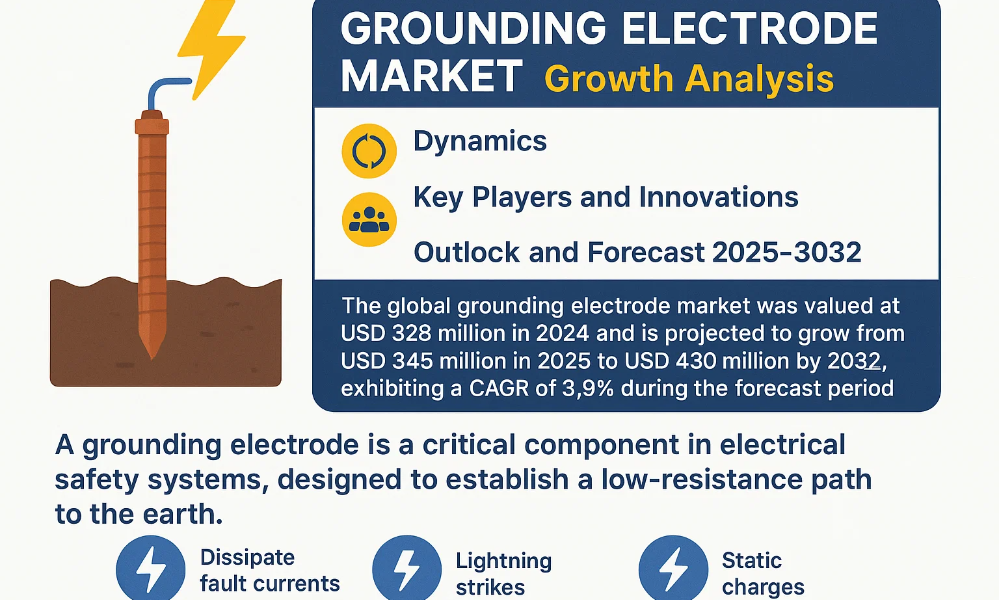
Grounding Electrode Market was valued at USD 328 million in 2024 and is projected to grow from USD 345 million in 2025 to USD 430 million by 2032, exhibiting a CAGR of 3.9% during the forecast period.
A grounding electrode is a critical component in electrical safety systems, designed to establish a low-resistance path to the earth. These conductive devices effectively dissipate fault currents, lightning strikes, and static charges, preventing electrical hazards such as equipment damage, fires, and electrocution. Common types include rod, plate, pipe, strip/wire, and chemical grounding electrodes, each suited for specific applications like residential buildings, power plants, and telecommunication towers.
The market is driven by increasing demand for reliable electrical infrastructure, stringent safety regulations, and rising investments in power distribution networks. North America, particularly the U.S., dominates the market due to aging grid infrastructure upgrades, while Asia-Pacific shows rapid growth due to urbanization and expanding renewable energy projects. Key players such as ABB, Schneider Electric, Siemens, and Pentair lead the market through innovation and strategic partnerships, further accelerating industry advancements.
Claim Your Free Sample Report- https://www.intelmarketresearch.com/download-free-sample/7250/grounding-electrode-market
MARKET DYNAMICS
MARKET DRIVERS
Rapid Expansion of Electrical Infrastructure Projects to Accelerate Market Growth
The global grounding electrode market is experiencing robust growth driven by large-scale electrical infrastructure development worldwide. With over $2.8 trillion projected to be invested in global power infrastructure by 2030, the demand for reliable grounding solutions has never been higher. Grounding electrodes play a critical role in ensuring safety across power generation facilities, transmission networks, and distribution systems by providing effective fault current dissipation. Emerging economies in Asia and Africa are particularly active in grid expansion projects, with several countries targeting 100% electrification rates, directly benefiting grounding electrode manufacturers.
Increasing Stringency of Electrical Safety Regulations to Boost Demand
Global safety standards for electrical installations continue to evolve with stricter requirements for grounding systems. Recent updates to the National Electrical Code (NEC) and IEC 62305 lightning protection standards have significantly raised the performance benchmarks for grounding electrodes. These regulatory changes are driving the replacement of older grounding systems and creating opportunities for advanced electrode solutions. Industrial facilities, data centers, and commercial buildings are particularly affected by these standards, leading to increased adoption of chemical and deep-driven grounding electrode systems that offer superior performance characteristics.
Growth of Renewable Energy Sector to Drive Specialized Grounding Needs
The renewable energy sector’s rapid expansion is creating specialized demand for grounding solutions. Solar farms, wind turbine installations, and battery storage facilities all require custom grounding electrode configurations to address unique electrical characteristics and challenging soil conditions. With global renewable capacity expected to grow by 60-75% over the next decade, grounding electrode manufacturers are developing specialized products for these applications. Floating solar installations and offshore wind farms in particular present new technical challenges that are driving innovation in corrosion-resistant and high-conductivity electrode designs.
MARKET OPPORTUNITIES
Development of Smart Grounding Monitoring Systems to Create New Revenue Streams
The integration of IoT technology into grounding systems presents significant growth opportunities. Smart grounding electrodes with embedded sensors can continuously monitor resistance values, corrosion levels, and environmental conditions. These systems provide real-time performance data that enables predictive maintenance, reducing downtime and improving safety. The global market for smart grid technologies, including advanced grounding solutions, is projected to grow at 12-15% annually through 2030, creating a substantial adjacent market for grounding electrode manufacturers.
Expansion of 5G Networks to Drive Demand for Specialized Grounding Solutions
The global rollout of 5G infrastructure requires specialized grounding solutions for tower sites and small cell installations. These systems must protect sensitive electronics from both lightning strikes and electromagnetic interference while meeting strict space constraints. With over 3 million new 5G base stations expected to be deployed by 2025, grounding electrode manufacturers have a significant opportunity to develop compact, high-performance solutions tailored to telecommunications applications. The unique grounding requirements of dense urban installations are particularly driving innovation in this segment.
Growing Focus on Sustainable Materials to Spur Product Innovation
Increasing environmental regulations and corporate sustainability initiatives are creating demand for eco-friendly grounding solutions. Manufacturers are developing electrodes using recycled materials and coatings that reduce soil contamination risks. These innovations are particularly valued in markets with strict environmental regulations and for projects pursuing green building certifications. Sustainable grounding solutions can command premium pricing while helping customers meet their environmental goals, representing a high-growth segment within the broader market
Segment Analysis:
By Type
- Rod Electrode
- Plate Electrode
- Pipe Electrode
- Strip or Wire Electrode
- Chemical Grounding Electrode
Rod Electrode is the most widely used due to its ease of installation and cost-effectiveness, making it ideal for residential and industrial applications.
By Application
- Residential
- Power Plants
- Telecommunication Towers
- Substations and Power Grids
Power Plants and Substations are the major application segments, driven by the critical need for efficient grounding systems to ensure operational safety.
By Material
- Copper
- Stainless Steel
- Copper-bonded Steel
- Zinc
Copper and Copper-bonded Steel are preferred for high conductivity and corrosion resistance, ensuring long-term performance in harsh environments.
List of Key Grounding Electrode Companies Profiled
- Pentair (U.S.)
- ABB (Switzerland)
- Schneider Electric (France)
- Siemens (Germany)
- Nehring Electrical Works (U.S.)
- nVent ERICO (U.S.)
- A.N. Wallis (UK)
- Galvan Industries (U.S.)
- Indelec (France)
- GE (U.S.)
- Eaton (U.S.)
- DEHN + SOHNE (Germany)
- Kingsmill Industries (UK)
GROUNDING ELECTRODE MARKET TRENDS
Rising Demand for Enhanced Electrical Safety Fuels Market Growth
The global grounding electrode market is experiencing steady growth, driven primarily by heightened awareness of electrical safety standards and regulations. As industries expand their electrical infrastructure, the need for reliable grounding solutions has become paramount. Grounding electrodes play a crucial role in dissipating fault currents and protecting equipment from lightning strikes, which account for substantial economic losses annually. In 2024 alone, lightning-related damages in the U.S. exceeded $1 billion, reinforcing the need for robust grounding systems. Technological advancements in electrode materials, such as copper-bonded and galvanized steel, have further improved conductivity and corrosion resistance, extending product lifespans in harsh environments. The market is also benefiting from stringent government mandates requiring proper grounding in commercial and industrial facilities.
Other Trends
Modernization of Power Infrastructure
The ongoing modernization of aging power grids, particularly in North America and Europe, is creating significant opportunities for grounding electrode suppliers. Utilities are investing heavily in smart grid technologies that require enhanced grounding solutions to ensure stability and fault tolerance. Renewable energy projects, such as solar farms and wind turbines, are adopting advanced grounding electrode systems to mitigate the risks associated with variable power generation. The rapid expansion of data centers globally projected to grow by 6% annually through 2030 is another key driver, as these facilities demand ultra-reliable grounding to protect sensitive electronic equipment.
Emerging Economies Present New Growth Frontiers
Developing nations are witnessing accelerated investments in electrical infrastructure, creating lucrative opportunities for grounding electrode manufacturers. Countries like China and India are driving regional market growth through large-scale urbanization projects and power grid expansions. The Middle East’s construction boom, particularly in smart city initiatives, is fueling demand for specialized grounding solutions that can withstand high-temperature desert conditions. Meanwhile, Latin American markets are adopting more rigorous electrical safety standards, boosting electrode adoption in industrial and commercial applications. This geographical diversification is helping manufacturers offset slower growth in mature markets while establishing long-term revenue streams in high-potential regions.
Claim Your Free Sample Report- https://www.intelmarketresearch.com/download-free-sample/7250/grounding-electrode-market
Recent Developments in the Grounding Electrode Market
- Adoption of Advanced Materials
Manufacturers are increasingly using copper-bonded and galvanized steel electrodes to enhance conductivity, corrosion resistance, and durability, responding to rising industrial safety standards. - Integration with Smart Grid Infrastructure
Grounding electrodes are being incorporated into smart grids to improve electrical safety, fault detection, and energy efficiency in urban and industrial power systems. - Expansion in Renewable Energy Projects
With the growth of solar farms, wind power, and other renewable energy installations, there is an increased demand for grounding electrodes to ensure system stability and protection against lightning and electrical faults. - Government Regulations and Safety Standards
Countries are enforcing stricter electrical safety codes, prompting infrastructure and construction sectors to adopt certified grounding solutions, driving market demand. - Technological Innovations
New designs, such as modular and pre-fabricated grounding systems, are being developed for faster installation, reduced maintenance, and better performance in challenging terrains. - Strategic Partnerships and Collaborations
Key players are entering partnerships to enhance R&D capabilities, expand distribution networks, and improve product portfolios to meet growing industrial and residential demands.
About Intel Market Research
Intel Market Research delivers actionable insights in technology and infrastructure markets. Our data-driven analysis leverages:
- Real-time infrastructure monitoring
- Techno-economic feasibility studies
Competitive intelligence across 100+ countries
Trusted by Fortune 500 firms, we empower strategic decisions with precision.
International: +1(332) 2424 294 | Asia: +91 9169164321
Website:https://www.intelmarketresearch.com
Follow us on LinkedIn: https://www.linkedin.com/company/intel-market-research




