
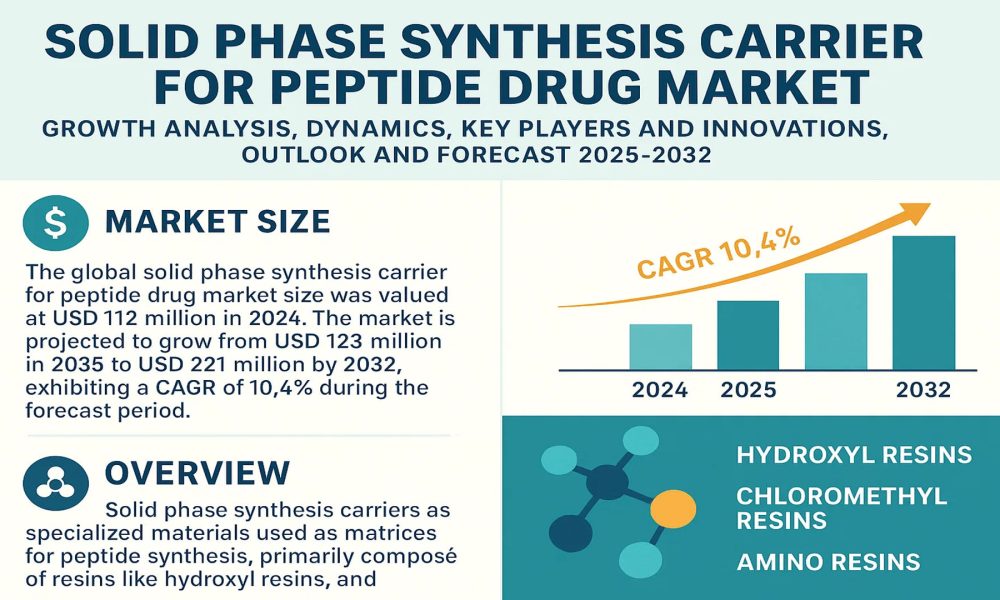
Solid Phase Synthesis Carrier for Peptide Drug Market size was valued at USD 112 million in 2024. The market is projected to grow from USD 123 million in 2025 to USD 221 million by 2032, exhibiting a CAGR of 10.4% during the forecast period.
Solid phase synthesis carriers are specialized materials used as matrices for peptide synthesis, primarily composed of resins like hydroxyl resins, chloromethyl resins, and amino resins. These carriers immobilize amino acids during synthesis, enabling stepwise peptide chain elongation while eliminating complex purification steps. This technology has revolutionized peptide drug manufacturing because of its efficiency in automated production, improved yield, and higher purity compared to traditional liquid-phase methods.
The market growth is driven by increasing demand for peptide therapeutics across oncology, metabolic disorders, and cardiovascular applications. Furthermore, advancements in automated peptide synthesizers and rising R&D investments in biopharmaceuticals are accelerating adoption. Key players like Sunresin, Merck, and CEM Corporation are expanding their resin portfolios, while regional markets in North America and Asia-Pacific show strong growth potential due to expanding pharmaceutical manufacturing capabilities.
Unlock Your Free Sample Report Here- https://www.intelmarketresearch.com/download-free-sample/6972/solid-phase-synthesis-carrier-for-peptide-drug-market
MARKET DYNAMICS
MARKET DRIVERS
Growing Demand for Peptide-Based Therapeutics Boosts Market Growth
The global peptide therapeutics market has demonstrated robust growth, driven by their high specificity, low toxicity, and improved bioavailability compared to traditional small molecule drugs. Solid-phase synthesis carriers play a pivotal role in this expansion by enabling efficient production of these complex molecules. Recent data indicates that over 80 peptide drugs have received FDA approval, with another 150+ in clinical development. The solid-phase approach significantly reduces synthesis time while improving yield and purity – key factors driving adoption in pharmaceutical manufacturing. Furthermore, innovations in resin chemistry are enhancing loading capacity and swelling properties, enabling synthesis of longer and more complex peptides up to 50 amino acids in length.
Automation and Process Optimization Accelerate Commercial Viability
Advances in automated peptide synthesizers utilizing solid-phase carriers are revolutionizing production capabilities. Modern systems can perform multiple synthesis cycles with minimal human intervention, achieving coupling efficiencies exceeding 99.5% per step. This automation directly addresses one of the industry’s major pain points – the labor-intensive nature of peptide synthesis. Recent developments in microwave-assisted solid-phase synthesis have further reduced reaction times from hours to minutes while maintaining high yields. These technological advancements are particularly impactful as the industry shifts toward GMP-compliant manufacturing to meet regulatory requirements for therapeutic peptides.
Increasing R&D Investment in Biopharmaceuticals Creates Demand
Biopharmaceutical companies are allocating substantial resources to peptide drug development, with global R&D spending in this sector growing at approximately 8% annually. The solid-phase synthesis market benefits directly from this trend as it remains the preferred method for research-scale and early-stage clinical production. A recent industry analysis revealed that over 70% of peptide synthesis projects utilize solid-phase carriers during discovery and preclinical phases. This strong research pipeline, particularly in oncology and metabolic disorders, ensures sustained demand for high-quality synthesis supports and resins.
MARKET OPPORTUNITIES
Emerging Markets Present Untapped Potential
Developing pharmaceutical markets in Asia Pacific and Latin America offer significant growth opportunities as local manufacturers expand peptide drug production capabilities. Countries like China and India have demonstrated particularly strong momentum, with domestic peptide API manufacturing capacity growing at 15-20% annually. This regional expansion creates demand for cost-competitive synthesis solutions, prompting global resin manufacturers to establish local production facilities and partnerships. Market projections suggest Asia Pacific could account for over 35% of global solid-phase synthesis carrier demand by 2030.
Innovations in Resin Technology Open New Applications
Recent breakthroughs in functionalized resins are expanding the addressable market for solid-phase synthesis. Novel photolabile and enzymatically-cleavable linkers now enable synthesis of previously inaccessible peptide structures, including cyclic and stapled peptides. These advanced materials align perfectly with growing interest in constrained peptides, which demonstrate enhanced stability and bioavailability. Industry analysts project that specialty resins could represent a $75 million market segment by 2028, growing at nearly 12% CAGR from current levels.
Increasing Focus on Personalized Cancer Vaccines
The rapid advancement of personalized neoantigen vaccines presents a transformative opportunity for solid-phase synthesis technologies. These patient-specific therapies require rapid synthesis of multiple custom peptides, a process ideally suited to automated solid-phase approaches. With over 50 neoantigen vaccine candidates currently in clinical trials and the first commercial launches anticipated within 3-5 years, specialized synthesis systems capable of producing small batches with quick turnaround times will become increasingly valuable. This emerging application could drive significant demand for flexible, high-throughput synthesis platforms.
Segment Analysis:
By Type
- Hydroxyl Resins
- Chloromethyl Resins
- Amino Resins
- Others
Hydroxyl Resins lead the segment due to their high compatibility with peptide synthesis, enabling efficient functionalization and high purity yields.
By Application
- Tumors
- Metabolic Diseases
- Cardiovascular
- Orthopedics
- Others
Tumors segment holds prominence, driven by increasing research in peptide-based oncology drugs offering targeted therapy with minimal side effects.
By End User
- Pharmaceutical Companies
- Contract Research Organizations (CROs)
- Academic & Research Institutes
Pharmaceutical Companies dominate due to large-scale investments in peptide drug R&D and commercialization.
By Synthesis Methodology
- Fmoc-based Synthesis
- Boc-based Synthesis
Fmoc-based Synthesis is widely adopted for its mild deprotection conditions, enhancing peptide stability during synthesis.
List of Key Solid Phase Synthesis Carrier Manufacturers Profiled
- Sunresin (China)
- Merck KGaA (Germany)
- Tianjin Nankai Hecheng Science & Technology (China)
- Zhejiang Zhengguang (China)
- Jiangsu Haipu Functional Materials (China)
- RawPEG (Sweden)
- CEM Corporation (U.S.)
SOLID PHASE SYNTHESIS CARRIER FOR PEPTIDE DRUG MARKET TRENDS
Increasing Demand for Peptide Therapeutics Driving Market Growth
The global solid phase synthesis carrier for peptide drug market is experiencing robust growth, driven by the rising demand for peptide-based therapeutics across multiple therapeutic areas such as oncology, metabolic disorders, and cardiovascular diseases. With the market valued at $112 million in 2024 and projected to reach $221 million by 2032, a compound annual growth rate (CAGR) of 10.4% underscores the expanding application of peptide drugs in modern medicine. The efficiency and automation compatibility of solid-phase synthesis make it the preferred method for peptide drug production, ensuring high purity and yield while reducing manual intervention, a crucial factor in scaling up pharmaceutical manufacturing.
Other Trends
Technological Advancements in Solid Phase Synthesis
Innovations in resin chemistries, particularly hydroxyl resins and amino resins, are reshaping the solid phase synthesis landscape. The hydroxyl resins segment is expected to witness significant CAGR growth, as they offer superior swelling properties and compatibility with diverse peptide sequences. Additionally, improvements in linker molecules and coupling reagents have enhanced synthesis efficiency, with some systems achieving peptide chain elongation rates exceeding 99% per coupling cycle. These advancements are allowing pharmaceutical companies to synthesize complex peptides, including cyclic and stapled peptides, with greater ease.
Regional Expansion and Strategic Collaborations
The North American market, particularly the U.S., leads the industry with established biopharma players investing heavily in peptide drug development. Meanwhile, China is emerging as a key growth region due to increasing domestic pharmaceutical R&D investments and collaborations with international manufacturers. Market leaders like Sunresin, Merck, and CEM Corporation are engaging in strategic alliances to enhance resin development and production capabilities, further driving market consolidation. Such partnerships not only boost innovation but also ensure supply chain stability, a critical factor in sustaining peptide drug production.
Unlock Your Free Sample Report Here- https://www.intelmarketresearch.com/download-free-sample/6972/solid-phase-synthesis-carrier-for-peptide-drug-market
Recent Developments in the Solid Phase Synthesis Carrier for Peptide Drug Market
- Expansion of Production Facilities
- Leading companies in the market, such as Merck KGaA and ChemMatrix, have announced expansion of their manufacturing capacities to meet the increasing demand for solid-phase synthesis carriers in peptide drug production.
- These expansions focus on introducing high-purity resins and improved carriers that enhance peptide yield and purity.
- Introduction of Novel Resin Technologies
- Companies are launching innovative resins, including polymer-supported carriers and cleavable linkers, which allow for faster peptide synthesis and reduce production costs.
- For example, recent developments in PEG-based and polystyrene-based resins are gaining traction due to their stability and compatibility with automated synthesizers.
- Strategic Collaborations and Partnerships
- Several market players have entered collaborations with biotech firms to co-develop peptide synthesis carriers tailored for therapeutic peptides, especially in oncology and metabolic disorders.
- These partnerships aim to accelerate peptide drug discovery and enhance the efficiency of solid-phase synthesis workflows.
- Focus on Green Chemistry and Sustainable Carriers
- With growing environmental concerns, companies are investing in eco-friendly carriers that minimize solvent usage and reduce chemical waste during peptide synthesis.
- This trend aligns with global sustainability initiatives in the pharmaceutical manufacturing sector.
- R&D Investments for Customization and Automation
- Firms are increasing investments in R&D to produce carriers compatible with automated peptide synthesizers, enabling high-throughput production for clinical and commercial applications.
- Customizable carriers for difficult-to-synthesize peptides are emerging as a key focus area.
About Intel Market Research
Intel Market Research delivers actionable insights in technology and infrastructure markets. Our data-driven analysis leverages:
- Real-time infrastructure monitoring
- Techno-economic feasibility studies
Competitive intelligence across 100+ countries
Trusted by Fortune 500 firms, we empower strategic decisions with precision.
International: +1(332) 2424 294 | Asia: +91 9169164321
Website: https://www.intelmarketresearch.com
Follow us on LinkedIn: https://www.linkedin.com/company/intel-market-research




